Short answer: the Neumann KH80 DSP. It ranks #7 of 64 powered bookshelf speakers by sound quality at $598.98; the Sigberg Audio SBS.1 ranks #37 and costs $2500, so there is not much of a tradeoff to weigh.
What the Neumann KH80 DSP offers: Compact 2-way nearfield monitor - a 1” tweeter in an elliptical waveguide over a 4” mid-woofer, crossed over around 1.8kHz with steep 48dB/octave slopes. Exceptionally linear on-axis response, within about ±1.5dB, with essentially nothing worth equalizing beyond a minor, likely port-related wrinkle around 800Hz. Vertical dispersion is unusually wide and consistent for a monitor this size, holding together to roughly ±40° versus the ±20° or so typical of similarly compact designs - a benefit of the steep crossover slopes and waveguide minimizing comb filtering, so listening height and seating posture matter less than on most small monitors. Back-panel switches (freestanding, small/medium/large desk) tailor the low-mid response to compensate for desk-boundary reflections. Distortion in the midrange doesn’t change when high-passed to a subwoofer at 80Hz, showing the drivers already have a clean distortion profile on their own. Maintains good composure and linearity up to about 96dB SPL down to roughly 80Hz before an active protection circuit engages; tested with dense multitone program material rather than a sine sweep, output around 96dB costs only about 1dB in the midrange, putting realistic maximum SPL near 95dB. Watch for: High price for its size, at roughly $1,000/pair. The horizontal pattern stays wide and essentially constant out to about ±30° before beaming and narrowing further out (then flattening again near 2kHz) - a wide, controlled pattern in absolute terms, but one that reflects more high-frequency energy off nearby sidewalls than a narrower design would. At greater listening distances or in more reflective rooms (tested around 6 feet away at 75-80dB), that shows up as a top end that reads a bit hot despite the speaker measuring essentially flat on-axis - a byproduct of its directivity rather than its tonal balance, and mostly moot for genuine nearfield desktop use inside about a meter. The estimated in-room response shows a shallow dip around 1-2kHz and a treble trend running 2-3dB above the midrange in that same far-field estimate. Multitone distortion for a single speaker climbs into the 3-5% range at 96dB SPL, though that’s only really relevant well above typical nearfield listening levels. Bass rolls off below its F3 of 57Hz (F10 48Hz), so the 4” mid-woofer still needs a subwoofer for real low-end content. The companion app for EQ/setup is iPad-only, with no Android or Bluetooth option despite being control-only, and the in-room calibration microphone is a separate purchase in most cases. In a separate comparison test, the smoother-measuring KH80 actually sounded smaller and less present than the cheaper JBL 305P MKII, which had more perceived bass and clarity despite measuring worse on paper.
What the Sigberg Audio SBS.1 offers: Its 6.26 Spinorama preference score with a perfect subwoofer is the appropriate bass-normalized result because the SBS.1 is designed as a system with companion subwoofers, not for standalone use. That score exceeds the Manta’s 5.91, supported by better on-axis linearity and in-room smoothness above the subwoofer range. Distinctive 4-way coaxial design with dual 5.5” midbass drivers flanking a coincident 1” tweeter for time-aligned output. Active 3-channel Hypex nCore Class D amplification (350W per speaker) with a 9-band parametric EQ and factory presets. Watch for: Its 6.26 preference score with a perfect subwoofer trails the SBS Gen 2’s 6.74, and it has the widest listening-window deviation of the three Sigberg systems. Discontinued and sold out, replaced by the SBS Gen 2.
Buy the Neumann KH80 DSP. It ranks higher for sound quality than the Sigberg Audio SBS.1 and costs less, so there is no real case for the other one.
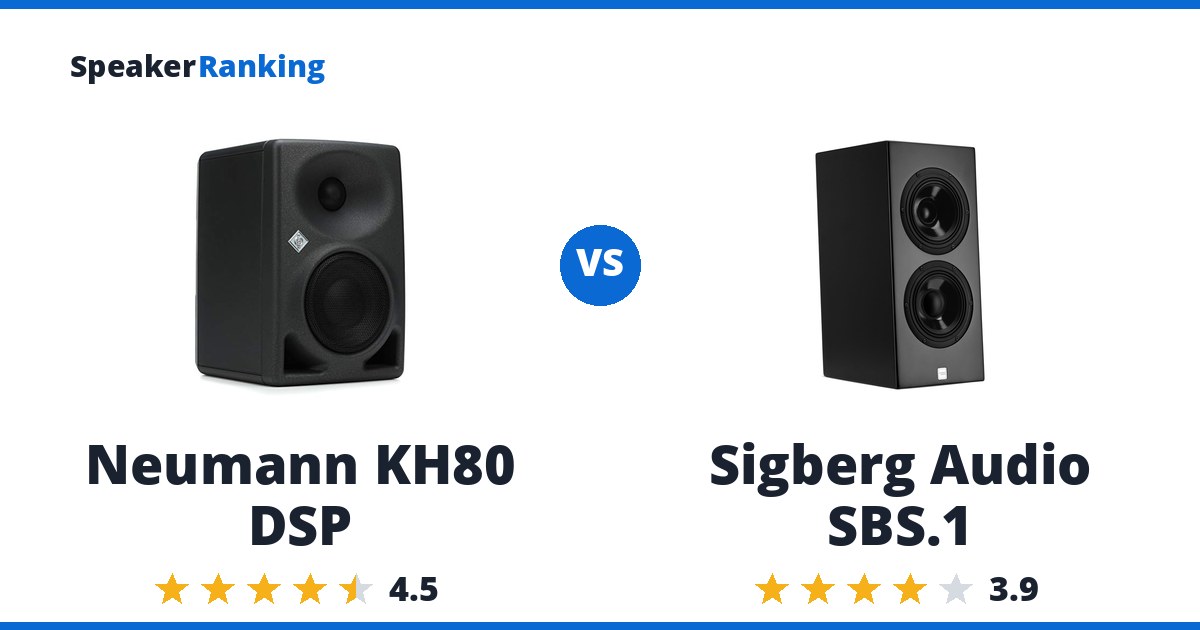
Specifications Side By Side
| Neumann KH80 DSP | Sigberg Audio SBS.1 | |
|---|---|---|
| Price | $598.98 | $2,500.00 2023 listing, per speaker; requires a separate subwoofer, Discontinued |
| Ranked | #7 of 64 in Medium Size Powered Bookshelf Speakers | #37 of 64 in Medium Size Powered Bookshelf Speakers |
| Dimensions | 13.6"H x 10.8"W x 9.6"D (345.4 x 274.3 x 243.8 mm) | 16.1"H x 7.5"W x 9.1"D (410 x 190 x 230 mm) |
| Frequency Response | 57 Hz - 25 kHz (+-3 dB) (Manufacturer specified) | - |
| Inputs | XLR | XLR, RCA, Optical, Coaxial/SPDIF, AES |
| Weight | 9 lbs / 4.1 kg each | 20.9 lbs / 9.5 kg each |
| Drivers | 4.1" woofer, 1" fabric dome tweeter | 2x 5.5" midbass, 1" coaxial silk dome tweeter |
| App | Yes (MA 1 alignment) | No |
| Bass Extension (-10dB) | 51Hz (measured, Erin’s Audio Corner) | - |
| Bass Extension (-3dB) | 57Hz (measured, Erin’s Audio Corner) | 18Hz (manufacturer, with companion subwoofers) |
| Bluetooth | No | No |
| DSP | Yes | Yes |
| EQ | Yes (via DSP) | Yes (9-band parametric, factory presets) |
| Max SPL | 110.7dB @ 1m | 116dB |
| Sensitivity | 91.9dB (measured at 0.3V/1m, Erin’s Audio Corner) | - |
| Output Power | 140W (90W woofer + 50W tweeter) | 350W per speaker |
| Enclosure | - | sealed |
| Country | - | Norway |
| Measurement Source | - | Manufacturer |
| Discontinued | - | Yes |
Related Speaker Comparisons
More useful head-to-heads from the same speaker class:
- JBL 705P vs Genelec 8020D
- Genelec 8020D vs Neumann KH120 MKII
- Edifier R1280T vs KEF LS50 Wireless II
- Edifier S2000MKIII vs Sigberg Audio SBS.1
- KEF LSX II LT vs Sigberg Audio SBS.1
Prices on this page were last checked August 25, 2026 at 6:19 AM UTC. Product prices and availability are accurate as of that date/time and are subject to change; the price and availability shown on Amazon at the time of purchase will apply to the purchase of this product.
As an eBay Partner, we may be compensated if you make a purchase.
The Two Speakers In Full
 Neumann KH80 DSP: $598.98 Amazon Bhphotovideo eBay
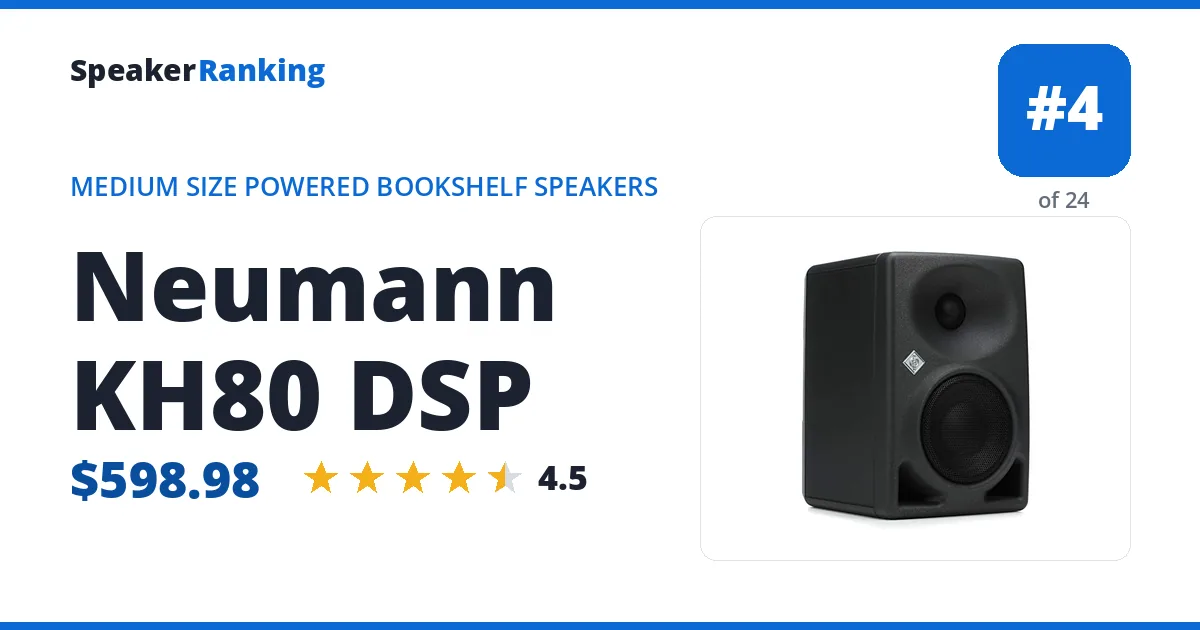
Pros: Compact 2-way nearfield monitor - a 1” tweeter in an elliptical waveguide over a 4” mid-woofer, crossed over around 1.8kHz with steep 48dB/octave slopes. Exceptionally linear on-axis response, within about ±1.5dB, with essentially nothing worth equalizing beyond a minor, likely port-related wrinkle around 800Hz. Vertical dispersion is unusually wide and consistent for a monitor this size, holding together to roughly ±40° versus the ±20° or so typical of similarly compact designs - a benefit of the steep crossover slopes and waveguide minimizing comb filtering, so listening height and seating posture matter less than on most small monitors. Back-panel switches (freestanding, small/medium/large desk) tailor the low-mid response to compensate for desk-boundary reflections. Distortion in the midrange doesn’t change when high-passed to a subwoofer at 80Hz, showing the drivers already have a clean distortion profile on their own. Maintains good composure and linearity up to about 96dB SPL down to roughly 80Hz before an active protection circuit engages; tested with dense multitone program material rather than a sine sweep, output around 96dB costs only about 1dB in the midrange, putting realistic maximum SPL near 95dB.
Cons: High price for its size, at roughly $1,000/pair. The horizontal pattern stays wide and essentially constant out to about ±30° before beaming and narrowing further out (then flattening again near 2kHz) - a wide, controlled pattern in absolute terms, but one that reflects more high-frequency energy off nearby sidewalls than a narrower design would. At greater listening distances or in more reflective rooms (tested around 6 feet away at 75-80dB), that shows up as a top end that reads a bit hot despite the speaker measuring essentially flat on-axis - a byproduct of its directivity rather than its tonal balance, and mostly moot for genuine nearfield desktop use inside about a meter. The estimated in-room response shows a shallow dip around 1-2kHz and a treble trend running 2-3dB above the midrange in that same far-field estimate. Multitone distortion for a single speaker climbs into the 3-5% range at 96dB SPL, though that’s only really relevant well above typical nearfield listening levels. Bass rolls off below its F3 of 57Hz (F10 48Hz), so the 4” mid-woofer still needs a subwoofer for real low-end content. The companion app for EQ/setup is iPad-only, with no Android or Bluetooth option despite being control-only, and the in-room calibration microphone is a separate purchase in most cases. In a separate comparison test, the smoother-measuring KH80 actually sounded smaller and less present than the cheaper JBL 305P MKII, which had more perceived bass and clarity despite measuring worse on paper.
Full Neumann KH80 DSP review and specifications →
| App | Yes (MA 1 alignment) |
|---|---|
| Bass Extension (-10dB) | 51Hz (measured, Erin's Audio Corner) |
| Bass Extension (-3dB) | 57Hz (measured, Erin's Audio Corner) |
| Bluetooth | No |
| DSP | Yes |
| Dimensions | 13.6"H x 10.8"W x 9.6"D (345.4 x 274.3 x 243.8 mm) |
| Drivers | 4.1" woofer, 1" fabric dome tweeter |
| EQ | Yes (via DSP) |
| Frequency Response | 57 Hz - 25 kHz (+-3 dB) (Manufacturer specified) |
| Inputs | XLR |
| Max SPL | 110.7dB @ 1m |
| Output Power | 140W (90W woofer + 50W tweeter) |
| Sensitivity | 91.9dB (measured at 0.3V/1m, Erin's Audio Corner) |
| Weight | 9 lbs / 4.1 kg each |
- Links
- Reviews, Comparisons and Sound Samples
- Erin’s Audio Corner: Neumann KH 80 Studio Monitor Review. Excellent Performance. Small Size. More from Erin’s Audio Corner →
- Erin’s Audio Corner Review Measurements
- Audio Science Review Measurements More from Audio Science Review →
- DSAUDIO.review: Neumann KH80 DSP vs Genelec 8020D Sound & Frequency Response Comparison More from DSAUDIOreview →
- DSAUDIO.review: Neumann KH80 DSP vs Yamaha HS8 Sound & Frequency Response Comparison
- DSAUDIO.review: Neumann KH80 DSP vs Focal Shape 40 Sound & Frequency Response Comparison
- DSAUDIO.review: Neumann KH80 DSP vs IK Multimedia iLoud MTM Sound & Frequency Response Comparison
- DSAUDIO.review: Neumann KH80 DSP vs JBL 305P MKII Sound & Frquency Response Comparison
- DSAUDIO.review: KEF LSX vs Neumann KH80 DSP Sound & Frequency Response Comparison
- DSAUDIO.review: Adam Audio A3X vs Neumann KH80 DSP Sound & Frequency Response Comparison
- DSAUDIO.review: Neumann KH80 DSP vs KRK Rokit 5 G4 RP5G4 Sound & Frequency Response Comparison
- Joy & Oluv’Sone: 🎃🔥 UBoom X - Halloween Rock Special 🎸🤘 More from Oluv’Sone →
- Audio Science Review Measurements (spinorama.org)
- Reddit Search for Neumann KH80 DSP Review
- Head-to-Head Comparisons
- Neumann KH80 DSP vs Genelec 8020D
- Neumann KH80 DSP vs Kali LP-UNF
- Neumann KH80 DSP vs Genelec 8330A
- Neumann KH80 DSP vs Genelec 8320A
- Neumann KH80 DSP vs Kali Audio SM-5
- Neumann KH80 DSP vs Devialet Phantom II 98 dB
- Neumann KH80 DSP vs JBL 305P MKII
- Neumann KH80 DSP vs Genelec 8030C
- See all 63 comparisons
 Sigberg Audio SBS.1: $2,500.00 2023 listing, per speaker; requires a separate subwoofer, Discontinued eBay
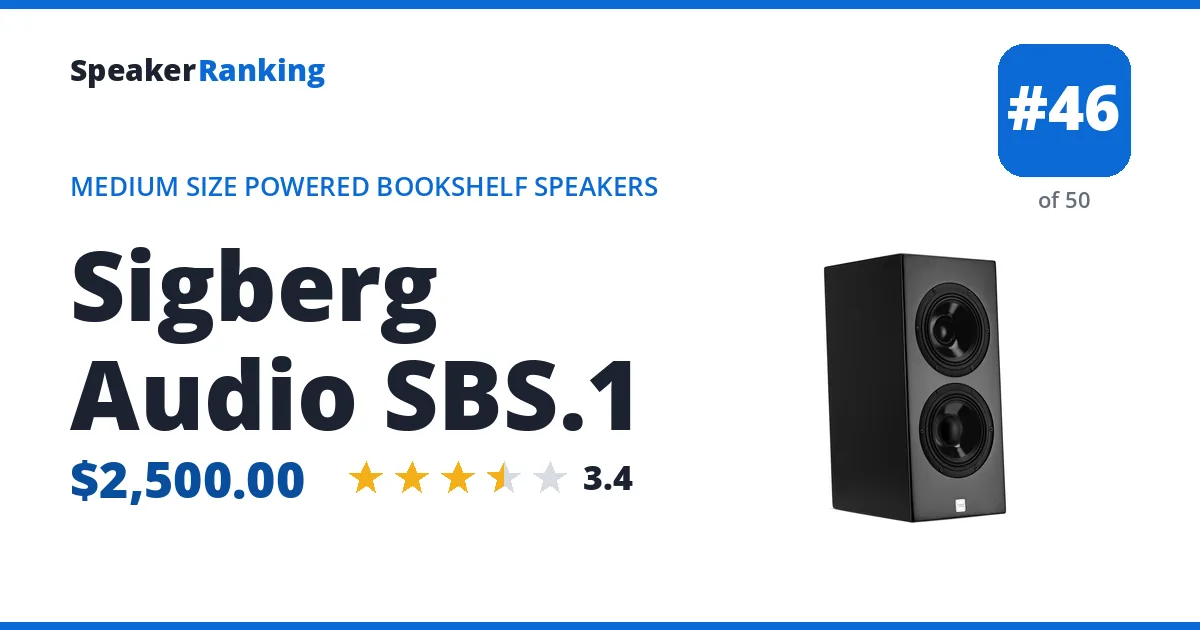
Pros: Its 6.26 Spinorama preference score with a perfect subwoofer is the appropriate bass-normalized result because the SBS.1 is designed as a system with companion subwoofers, not for standalone use. That score exceeds the Manta’s 5.91, supported by better on-axis linearity and in-room smoothness above the subwoofer range. Distinctive 4-way coaxial design with dual 5.5” midbass drivers flanking a coincident 1” tweeter for time-aligned output. Active 3-channel Hypex nCore Class D amplification (350W per speaker) with a 9-band parametric EQ and factory presets.
Cons: Its 6.26 preference score with a perfect subwoofer trails the SBS Gen 2’s 6.74, and it has the widest listening-window deviation of the three Sigberg systems. Discontinued and sold out, replaced by the SBS Gen 2. Discontinued.
Full Sigberg Audio SBS.1 review and specifications →
| App | No |
|---|---|
| Bass Extension (-3dB) | 18Hz (manufacturer, with companion subwoofers) |
| Bluetooth | No |
| Country | Norway |
| DSP | Yes |
| Dimensions | 16.1"H x 7.5"W x 9.1"D (410 x 190 x 230 mm) |
| Discontinued | Yes |
| Drivers | 2x 5.5" midbass, 1" coaxial silk dome tweeter |
| EQ | Yes (9-band parametric, factory presets) |
| Enclosure | sealed |
| Inputs | XLR, RCA, Optical, Coaxial/SPDIF, AES |
| Max SPL | 116dB |
| Measurement Source | Manufacturer |
| Output Power | 350W per speaker |
| Weight | 20.9 lbs / 9.5 kg each |
- Links
- Reviews, Comparisons and Sound Samples
- Head-to-Head Comparisons
- Sigberg Audio SBS.1 vs Edifier R1280DB
- Sigberg Audio SBS.1 vs KRK Classic 5
- Sigberg Audio SBS.1 vs Edifier S2000MKIII
- Sigberg Audio SBS.1 vs KEF LSX II LT
- Sigberg Audio SBS.1 vs IK Multimedia iLoud MTM MKII
- Sigberg Audio SBS.1 vs Kali Audio IN-5
- Sigberg Audio SBS.1 vs Yamaha HS5
- Sigberg Audio SBS.1 vs Adam Audio T5V
- See all 10 comparisons