Short answer: the Klipsch RP-600M II for better sound quality, the ELAC Debut 2.0 B6.2 for the lower price. The Klipsch RP-600M II ranks #53 of 100 bookshelf speakers at $489.99. The ELAC Debut 2.0 B6.2 ranks #62 at $329, $160.99 cheaper.
What the Klipsch RP-600M II gets right: Redesigned waveguide extends flush to the baffle edge, reducing diffraction compared to the original RP-600M. The catch: On-axis, the treble runs notably hot - even hotter than the original RP-600M in some respects - and needs about 20° of toe-out or the grille installed to sound balanced.
The case for the ELAC Debut 2.0 B6.2: Reasonably flat on-axis and listening-window response with reasonably even horizontal directivity, holding about ±60° up to roughly 8kHz for consistent stereo width whether aimed directly at the listener or toed out. The tradeoff: A good size resonant peak around 700Hz stands out from an otherwise smooth response and lingers in cumulative spectral decay (waterfall) measurements - in one reviewer’s sighted A/B test.
Buy the Klipsch RP-600M II if sound quality matters more than the price. Buy the ELAC Debut 2.0 B6.2 if the price matters more than sound quality.
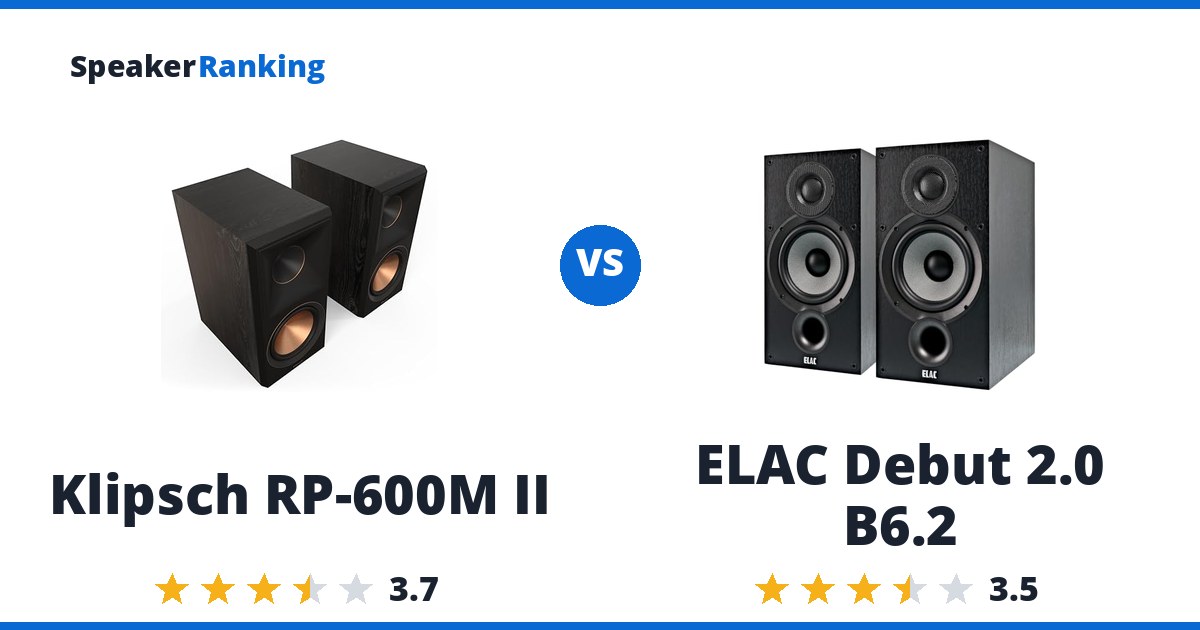
Specifications Side By Side
| Klipsch RP-600M II | ELAC Debut 2.0 B6.2 | |
|---|---|---|
| Price | $489.99 | $329.00 |
| Ranked | #53 of 100 in Large Size Bookshelf Speakers | #62 of 100 in Large Size Bookshelf Speakers |
| Bass Extension (-10dB) | 41Hz (measured, Erin’s Audio Corner) | 40Hz (measured, Erin’s Audio Corner) |
| Bass Extension (-3dB) | 70Hz (measured, Erin’s Audio Corner) | 64Hz (measured, Erin’s Audio Corner) |
| Dimensions | 15.7"H x 8"W x 12.5"D (398.8 x 203.2 x 317.5 mm) | 14.8"H x 7.7"W x 10.6"D (375.0 x 195.0 x 268.0 mm) |
| Impedance | 8 ohms nominal (3.5 ohms minimum above 80Hz, measured by Erin’s Audio Corner) | 6 ohms nominal, 5.2 ohms minimum (measured, Erin’s Audio Corner) |
| Sensitivity | 86dB (measured, Erin’s Audio Corner) | 86.5dB (measured, Audio Science Review) |
| Drivers | 6.5" Cerametallic cone woofer, 1" titanium LTS vented tweeter with Tractrix horn | 25mm tweeter + 165mm woofer |
| Weight | 13 lbs / 5.9 kg each | 29.1 lbs / 13.2 kg |
| Woofer Cabinet | ported | ported, front |
Related Speaker Comparisons
More useful head-to-heads from the same speaker class:
- Infinity IL10 vs SVS Prime Bookshelf
- Behringer B2030P vs SVS Prime Bookshelf
- SVS Prime Bookshelf vs Polk Monitor XT20
- ELAC DB63 vs ELAC Debut 2.0 B6.2
- Klipsch RP-600M II vs Polk Monitor XT20
The Two Speakers In Full
 Klipsch RP-600M II: $489.99 Amazon
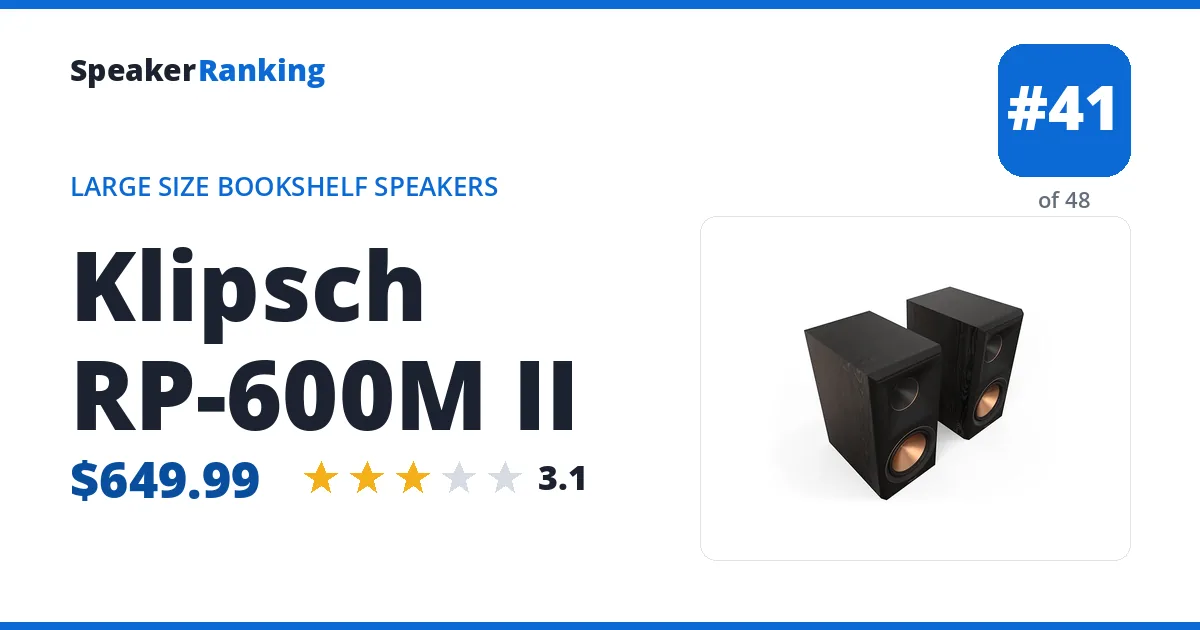
Pros: Redesigned waveguide extends flush to the baffle edge, reducing diffraction compared to the original RP-600M. Roughly 10-20° wider horizontal radiation than the original, giving more soundstage envelopment while retaining precise imaging. A major step up in overall tonal neutrality compared to the original RP-600M, largely eliminating that model’s midrange resonance issues. Unusually, sounds better with the grille on - the grille smooths out the elevated treble rather than degrading the sound, a rare trait among speakers the reviewer has tested. More refined back-panel hardware, including anodized binding posts and jumper cables for optional bi-amping. Responds well to EQ correction (verified using measurement software and a miniDSP), letting the on-axis response be made genuinely linear.
Cons: On-axis, the treble runs notably hot - even hotter than the original RP-600M in some respects - and needs about 20° of toe-out or the grille installed to sound balanced. Horizontal dispersion is very slightly less linear across angles than the original RP-600M, a minor trade-off for the wider overall radiation pattern. Klipsch’s marketed sensitivity (about 94.5dB) is, like the original, a half-space rating roughly 9dB above the anechoic reality (closer to 85-86dB). In-room bass rolls off around 60Hz in practice, and a 120Hz boost paired with a midrange scoop gives kick drums their “tambour” without real low-end weight - a subwoofer is still recommended. Vertical listening tolerance is limited to about ±10° from the tweeter axis. Toeing the speaker out for better on-axis tonality (rather than using the grille) introduces slightly more diffuse imaging from added sidewall reflections.
Full Klipsch RP-600M II review and specifications →
| Bass Extension (-10dB) | 41Hz (measured, Erin's Audio Corner) |
|---|---|
| Bass Extension (-3dB) | 70Hz (measured, Erin's Audio Corner) |
| Dimensions | 15.7"H x 8"W x 12.5"D (398.8 x 203.2 x 317.5 mm) |
| Drivers | 6.5" Cerametallic cone woofer, 1" titanium LTS vented tweeter with Tractrix horn |
| Impedance | 8 ohms nominal (3.5 ohms minimum above 80Hz, measured by Erin's Audio Corner) |
| Sensitivity | 86dB (measured, Erin's Audio Corner) |
| Weight | 13 lbs / 5.9 kg each |
| Woofer Cabinet | ported |
As an eBay Partner, we may be compensated if you make a purchase.
- Links
- Reviews, Comparisons and Sound Samples
- Erin’s Audio Corner: The Truth about Klipsch’s “NEW” Sound. RP-600M Update.
- Erin’s Audio Corner Website Klipsch RP-600M II
- GR-Research: We Bought The “NEW” RP-600M II Is KLIPSCH Listening?!
- Erin’s Audio Corner: 5 AWESOME SPEAKERS Under $1000 You Won’t Regret
- Reddit Search for Klipsch RP-600M II Review
- Head-to-Head Comparisons
- Klipsch RP-600M II vs Dynaudio Emit 20
- Klipsch RP-600M II vs Infinity Reference R162
- Klipsch RP-600M II vs JBL Studio 630
- Klipsch RP-600M II vs Behringer B2030P
- Klipsch RP-600M II vs SVS Ultra Bookshelf
- Klipsch RP-600M II vs Infinity IL10
- Klipsch RP-600M II vs Dynaudio Special Forty
- Klipsch RP-600M II vs Dynaudio Contour 20i
- See all 16 comparisons
 ELAC Debut 2.0 B6.2: $329.00 Amazon Crutchfield
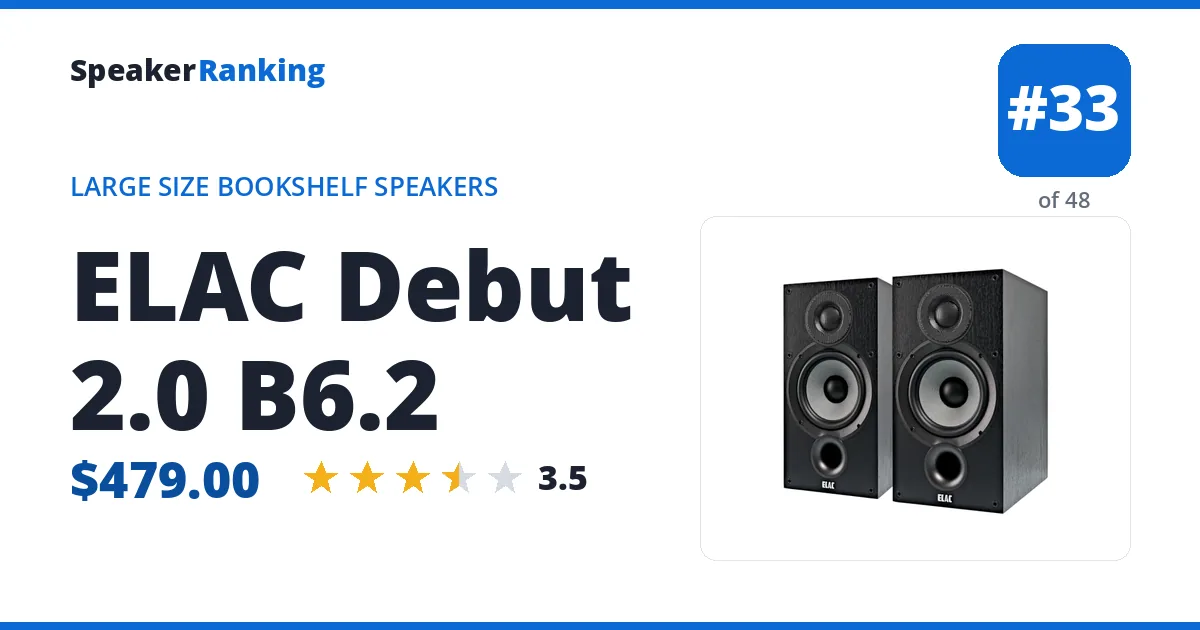
Pros: Reasonably flat on-axis and listening-window response with reasonably even horizontal directivity, holding about ±60° up to roughly 8kHz for consistent stereo width whether aimed directly at the listener or toed out. Its larger-than-typical woofer lets it play very loud with minimal distortion, staying under about 1% THD down to 50Hz at 86dB, and minimum impedance stays a comfortable 5-6 ohms. In-room bass extension reaches about 50Hz without much trouble, enough for a solid kick-drum sound. Takes equalization very well - correcting the on-axis response doesn’t cost sensitivity through the midrange, and the underlying directivity behavior (diffraction, vertical mismatch) is mild enough that EQ alone gets most of the way to a well-balanced sound. Vertical tolerance is asymmetric and fairly forgiving: about 10° above the tweeter axis and 20° below it before tonal balance meaningfully shifts. One reviewer called it “a good speaker” with “a good price” rather than just good-for-the-price, and found it fairly neutral overall in-room.
Cons: A good size resonant peak around 700Hz stands out from an otherwise smooth response and lingers in cumulative spectral decay (waterfall) measurements - in one reviewer’s sighted A/B test, reducing it by about 5dB via EQ made a noticeable but not dramatic difference. Directivity error shows up around 3.3kHz, and the upper-midrange around 4-6kHz stood out as edgy and sharp, almost sibilant at times, in casual listening - the predicted in-room response shows a lack of energy between 1-2kHz and a bit too much above that, which one reviewer thought would sound bright. Distortion at 96dB SPL/1m shows two harmonic peaks the reviewer says “should not be there,” one from woofer breakup around 400Hz and another around 7-8kHz from the tweeter, and multitone distortion approaches 10% in the 500-800Hz range at that output level. Real compression shows up even at moderate volume and worsens at 96dB and above, with the woofer clearly giving up around 60-70Hz - a subwoofer is recommended for anyone wanting to listen loud, since running it full-range at high output costs real dynamic range in the midbass and bass. Don’t place it close to a wall - boundary reinforcement adds a midbass bump that undoes the otherwise smooth, linear response. Getting the best out of it takes EQ (taming the 700Hz peak, filling in the 1-2kHz dip, and trimming the highs).
Full ELAC Debut 2.0 B6.2 review and specifications →
| Bass Extension (-10dB) | 40Hz (measured, Erin's Audio Corner) |
|---|---|
| Bass Extension (-3dB) | 64Hz (measured, Erin's Audio Corner) |
| Dimensions | 14.8"H x 7.7"W x 10.6"D (375.0 x 195.0 x 268.0 mm) |
| Drivers | 25mm tweeter + 165mm woofer |
| Impedance | 6 ohms nominal, 5.2 ohms minimum (measured, Erin's Audio Corner) |
| Sensitivity | 86.5dB (measured, Audio Science Review) |
| Weight | 29.1 lbs / 13.2 kg |
| Woofer Cabinet | ported, front |
As an eBay Partner, we may be compensated if you make a purchase.
- Links
- Reviews, Comparisons and Sound Samples
- Head-to-Head Comparisons
- ELAC Debut 2.0 B6.2 vs SVS Prime Bookshelf
- ELAC Debut 2.0 B6.2 vs Dynaudio Special Forty
- ELAC Debut 2.0 B6.2 vs KEF Q3 Meta
- ELAC Debut 2.0 B6.2 vs Polk Monitor XT20
- ELAC Debut 2.0 B6.2 vs Infinity IL10
- ELAC Debut 2.0 B6.2 vs GR-Research X-LS Encore
- ELAC Debut 2.0 B6.2 vs Sonus Faber Lumina II
- ELAC Debut 2.0 B6.2 vs Behringer B2030P
- See all 20 comparisons