Short answer: the JBL HDI-1600 for its very flat spinorama, with the ELAC UBR62 the harder load. The JBL ranks #45 of 134 with a very flat spinorama and smooth early-window directivity, though it dips above 10kHz on axis. The UBR62 costs $1,199, $781 less as a concentric three-way, but Erin measured very low 83dB/2.83V/1m sensitivity, needing the more powerful HINT 6 where a 110W Parasound was insufficient.
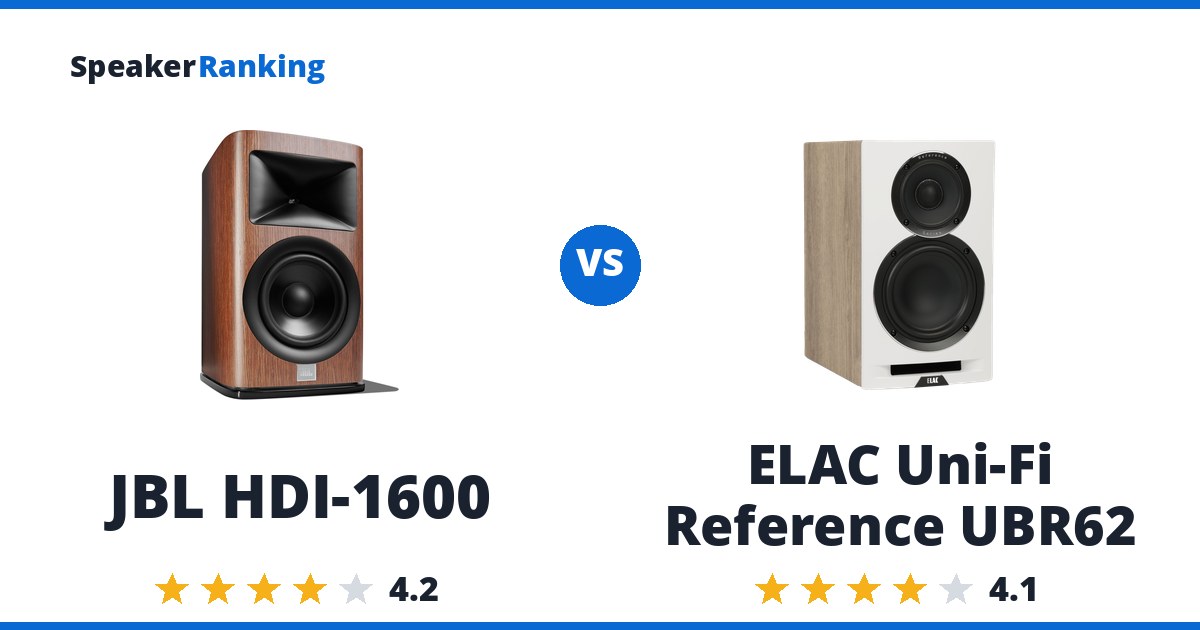
Buy the ELAC Uni-Fi Reference UBR62 if you want one new; the JBL HDI-1600 is discontinued, so only look for it used.
Want more options? Browse the full Passive Home rankings.
Specifications Side By Side
| JBL HDI-1600 | ELAC Uni-Fi Reference UBR62 | |
|---|---|---|
| Price | $1980 per pair Discontinued | $1,199 per pair |
| Ranked | #45 of 134 in Large Size Bookshelf Speakers | #54 of 134 in Large Size Bookshelf Speakers |
| Bass Extension (-3dB) | 55.7Hz (measured, Audio Science Review) | 58.6Hz (measured, Erin’s Audio Corner) |
| Bass Extension (-10dB) | 40Hz (derived, log-interpolated between spinorama.org -9dB/-12dB points) | 41.9Hz (measured, Erin’s Audio Corner) |
| Impedance | 4 ohms nominal (measured, Audio Science Review) | 4 ohms minimum near 50Hz (measured, Erin’s Audio Corner) |
| Sensitivity | 85dB (2.83V/1m, measured, Audio Science Review) | 83dB/2.83V/1m (measured, Erin’s Audio Corner) |
| Drivers | 1” tweeter + 6.5” woofer | 1” tweeter coaxial with 4” midrange; 6.5” woofer |
| Weight | 53.4 lbs (24.2 kg) | 23.5 lbs (10.68 kg) each |
| Dimensions | 14.6”H x 9.1”W x 11.4”D (370.0 x 230.0 x 288.9 mm) | 14.1”H x 8.2”W x 13.1”D |
| Woofer Cabinet | ported, rear | ported, dual front slot vents |
| Spinorama Preference Score | 5.37 (spinorama.org) | 5.44 (measured, spinorama.org) |
| Spinorama Preference Score with Perfect Sub | 7.32 (spinorama.org) | 7.7 (measured, spinorama.org) |
| DIY Kit | No | No |
| Bass Extension | - | 41Hz manufacturer specified; Erin’s response-linearity graph shows limited high-output bass headroom |
Related Speaker Comparisons
More top alternatives to JBL HDI-1600:
- KEF R3 Meta vs JBL HDI-1600
- KEF Q Concerto Meta vs JBL HDI-1600
- MoFi SourcePoint 8 vs JBL HDI-1600
- Dynaudio Heritage Special vs JBL HDI-1600
- Wharfedale Linton 85 vs JBL HDI-1600
Prices on this page were last checked October 2, 2026 at 10:18 PM UTC. Product prices and availability are accurate as of that date/time and are subject to change; the price and availability shown on Amazon at the time of purchase will apply to the purchase of this product.
As an eBay Partner, we may be compensated if you make a purchase.
The Two Speakers In Full
 JBL HDI-1600: $1980 per pair Discontinued Crutchfield eBay
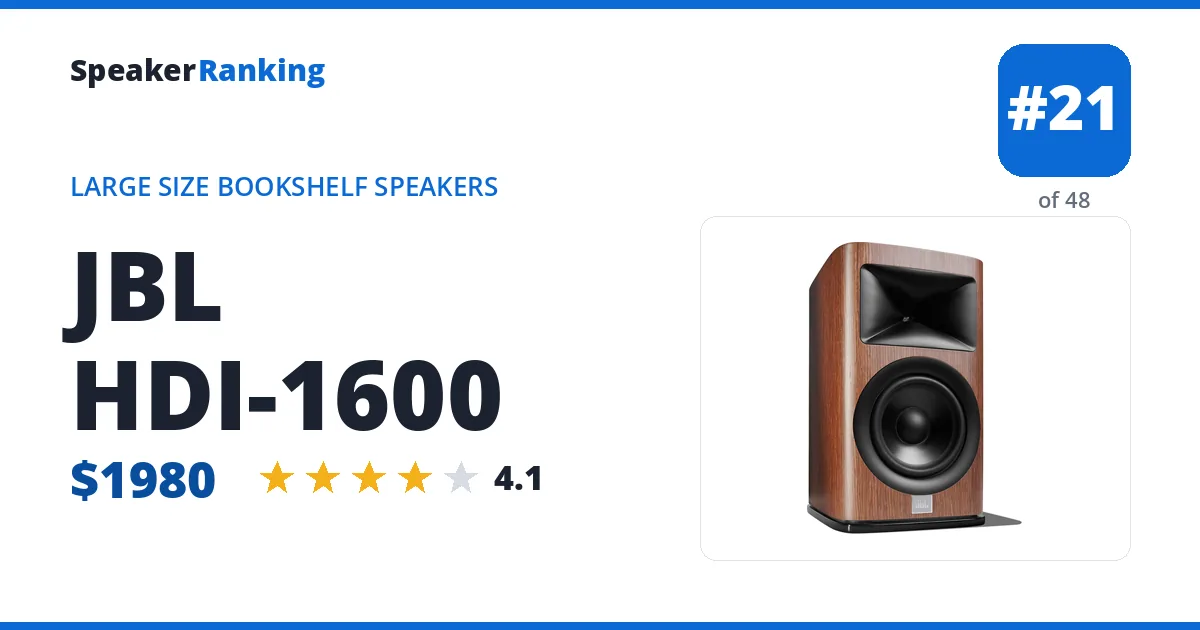
Pros: CEA2034 spinorama is very flat in the critical mid-to-upper frequencies, with a slight bass boost that should have a good subjective effect and very smooth early-window directivity. Predicted in-room response in a simulated average listening room closely tracks the reviewer’s own preferred target curve. Measured bass extension of 55.7Hz (-3dB), with a measured sensitivity of 85dB.
Cons: A dip appears above 10kHz on-axis. Cumulative spectral decay (waterfall) shows some messiness around the crossover along with a 700Hz resonance. Harmonic distortion rises to nearly 2% right at the 1.9kHz crossover point at 96dB SPL/1m. Discontinued.
Full JBL HDI-1600 review and specifications →
| Bass Extension (-10dB) | 40Hz (derived, log-interpolated between spinorama.org -9dB/-12dB points) |
|---|---|
| Bass Extension (-3dB) | 55.7Hz (measured, Audio Science Review) |
| DIY Kit | No |
| Dimensions | 14.6”H x 9.1”W x 11.4”D (370.0 x 230.0 x 288.9 mm) |
| Drivers | 1” tweeter + 6.5” woofer |
| Impedance | 4 ohms nominal (measured, Audio Science Review) |
| Sensitivity | 85dB (2.83V/1m, measured, Audio Science Review) |
| Spinorama Preference Score | 5.37 (spinorama.org) |
| Spinorama Preference Score with Perfect Sub | 7.32 (spinorama.org) |
| Weight | 53.4 lbs (24.2 kg) |
| Woofer Cabinet | ported, rear |
- Links
- Reviews, Comparisons and Sound Samples
- Head-to-Head Comparisons
- JBL HDI-1600 vs Aalto Speakers Aalto 3 Passive
- JBL HDI-1600 vs Arendal 1723 Bookshelf S THX
- JBL HDI-1600 vs ELAC Debut 3.0 DB63
- JBL HDI-1600 vs Emotiva Airmotiv XB2
- JBL HDI-1600 vs Revel Concerta2 M16
- JBL HDI-1600 vs ELAC VELA BS 403
- JBL HDI-1600 vs Revel M126Be
- JBL HDI-1600 vs Ascend Acoustics Sierra-LX
- See all 29 comparisons
 ELAC Uni-Fi Reference UBR62: $1,199 per pair Amazon eBay
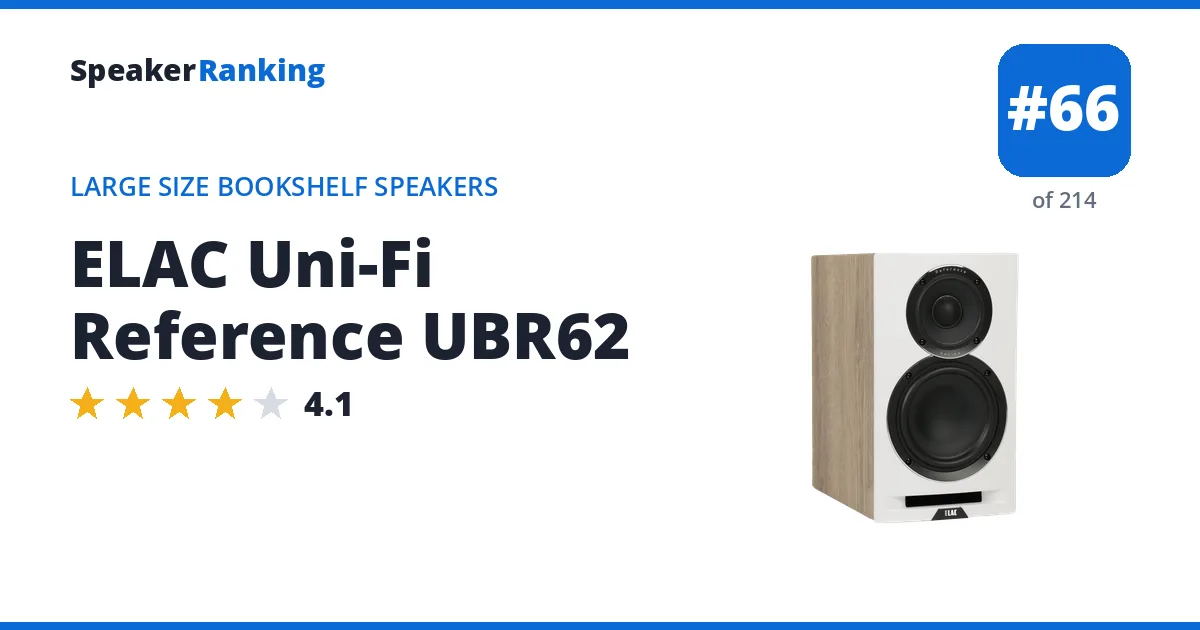
Pros: True three-way stand-mount using a 1-inch tweeter concentrically mounted in a 4-inch aluminum midrange plus a dedicated 6.5-inch aluminum woofer. Erin found the directivity and overall tonality well controlled, with dual front slot vents minimizing placement sensitivity and cabinet bracing suppressing obvious coloration. The mostly 5-ohm-or-higher load is manageable for a genuinely 4-ohm-capable amplifier, and the coherent concentric upper range supports stable imaging across seats. Measured bass extension of 58.6Hz (-3dB), with a measured sensitivity of 83dB.
Cons: Erin measured very low 83dB/2.83V/1m sensitivity; his 110W Parasound was insufficient for the high-level test and the more powerful HINT 6 was needed. Impedance reaches 4 ohms near 50Hz (Erin), while woofer excursion and bass output were less capable than expected for the cabinet size. A broad 500-700Hz rise and associated lower/female-vocal coloration were audible, and the slightly subdued listening-window treble is necessary to avoid an overly bright in-room balance rather than evidence of ruler-flat axial tuning.
Full ELAC Uni-Fi Reference UBR62 review and specifications →
| Bass Extension | 41Hz manufacturer specified; Erin’s response-linearity graph shows limited high-output bass headroom |
|---|---|
| Bass Extension (-10dB) | 41.9Hz (measured, Erin’s Audio Corner) |
| Bass Extension (-3dB) | 58.6Hz (measured, Erin’s Audio Corner) |
| DIY Kit | No |
| Dimensions | 14.1”H x 8.2”W x 13.1”D |
| Drivers | 1” tweeter coaxial with 4” midrange; 6.5” woofer |
| Impedance | 4 ohms minimum near 50Hz (measured, Erin’s Audio Corner) |
| Sensitivity | 83dB/2.83V/1m (measured, Erin’s Audio Corner) |
| Spinorama Preference Score | 5.44 (measured, spinorama.org) |
| Spinorama Preference Score with Perfect Sub | 7.7 (measured, spinorama.org) |
| Weight | 23.5 lbs (10.68 kg) each |
| Woofer Cabinet | ported, dual front slot vents |
- Links
- Reviews, Comparisons and Sound Samples
- Head-to-Head Comparisons
- ELAC Uni-Fi Reference UBR62 vs Power Sound Audio MT-110-M
- ELAC Uni-Fi Reference UBR62 vs ELAC DBR62
- ELAC Uni-Fi Reference UBR62 vs Revel Concerta2 M16
- ELAC Uni-Fi Reference UBR62 vs Yamaha NS-800A
- ELAC Uni-Fi Reference UBR62 vs Definitive Technology Demand D11
- ELAC Uni-Fi Reference UBR62 vs Technics SB-C700
- ELAC Uni-Fi Reference UBR62 vs Dynaudio Contour 20i
- ELAC Uni-Fi Reference UBR62 vs SVS Ultra Bookshelf
- See all 25 comparisons