Short answer: the Audio First Fidelia for value, the Radiant Acoustics Clarity 4.2 for a finished Purifi design. The Fidelia is a kit speaker offering exceptional value and tonal accuracy, but it requires kit assembly. The Clarity 4.2 arrives complete, pairing a 4” Purifi mid-woofer with matching passive radiators and an AMT tweeter, though its low sensitivity (rated 78dB, measured 78.5dB) is the trade-off for its bass extension.
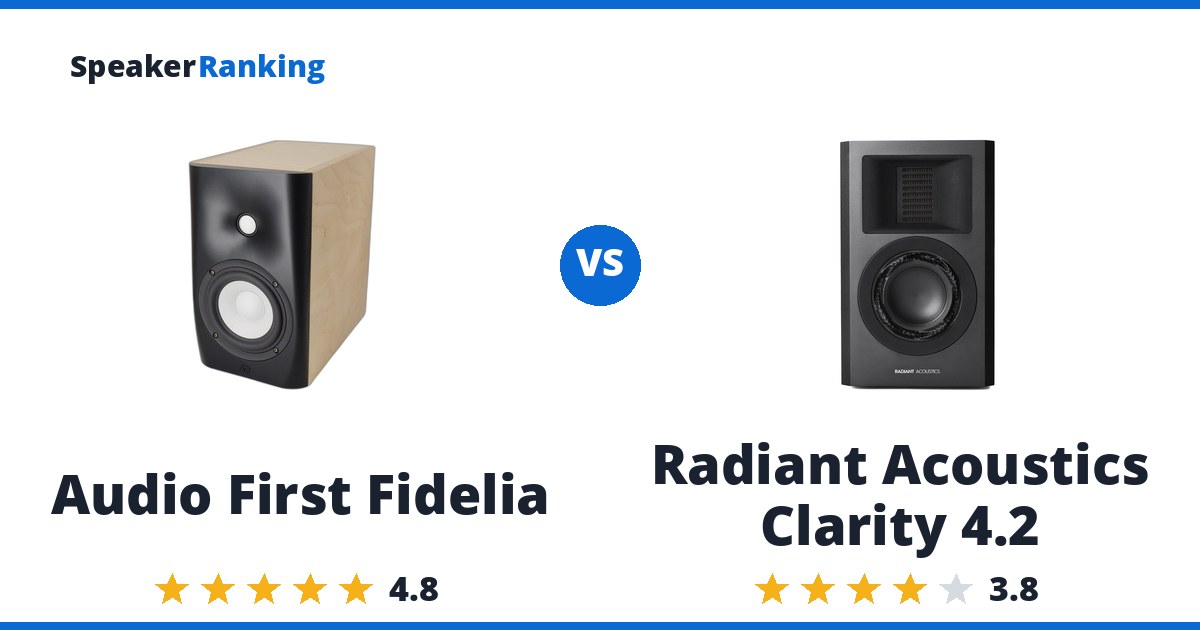
Buy the Audio First Fidelia. It is rated higher for sound quality than the Radiant Acoustics Clarity 4.2.
Looking for alternatives? See the complete Passive Home rankings.
Specifications Side By Side
| Audio First Fidelia | Radiant Acoustics Clarity 4.2 | |
|---|---|---|
| Price | £950 per pair for the flatpack kit (assembly required) | $2,998 per pair |
| Ranked | #1 of 160 in Medium Size Bookshelf Speakers | #40 of 160 in Medium Size Bookshelf Speakers |
| Bass Extension (-10dB) | 38Hz (measured, Erin’s Audio Corner) | 35 Hz (measured, Erin’s Audio Corner) |
| Bass Extension (-3dB) | 53Hz (measured, Erin’s Audio Corner) | 44 Hz (measured, Erin’s Audio Corner) |
| Crossover Frequency | 1560Hz | - |
| Dimensions | 11.8”H x 7.1”W x 11.7”D (300 x 180 x 297.6 mm) | 9.5”H x 6.3”W x 9.4”D (241 x 160 x 239 mm) |
| Impedance | 4 ohms | 4 ohms |
| Sensitivity | 84dB | 78 dB |
| Drivers | 5” ceramic-aluminum cone woofer, 1” ceramic-aluminum tweeter | (2) 4” (102mm) woofer + AMT tweeter |
| Weight | 15 lbs (6.8 kg) each | 28.7 lbs (13 kg) (per pair: 57.3 lbs (26 kg)) |
| Woofer Cabinet | ported, rear | passive radiator |
| Spinorama Preference Score | 6.45 | - |
| Spinorama Preference Score with Perfect Sub | 8.46 | - |
| DIY Kit | Yes | No |
| Frequency Response | - | 40 Hz - 25 kHz |
| Recommended Power | - | 50-200W |
| Amplifier Power | - | External amplifier required |
Related Speaker Comparisons
How Audio First Fidelia compares with other leading options:
- Philharmonic Ceramic Mini vs Audio First Fidelia
- Ascend Sierra 1 v2 vs Audio First Fidelia
- KEF LS50 Meta vs Audio First Fidelia
- XMechanik Mechano23 DIY vs Audio First Fidelia
- Ascend Acoustics HTM-200SE2 vs Audio First Fidelia
Prices on this page were last checked October 7, 2026 at 9:25 PM UTC. Product prices and availability are accurate as of that date/time and are subject to change; the price and availability shown on Amazon at the time of purchase will apply to the purchase of this product.
As an eBay Partner, we may be compensated if you make a purchase.
The Two Speakers In Full
 Audio First Fidelia: £950 per pair for the flatpack kit (assembly required) Audio First Designs eBay
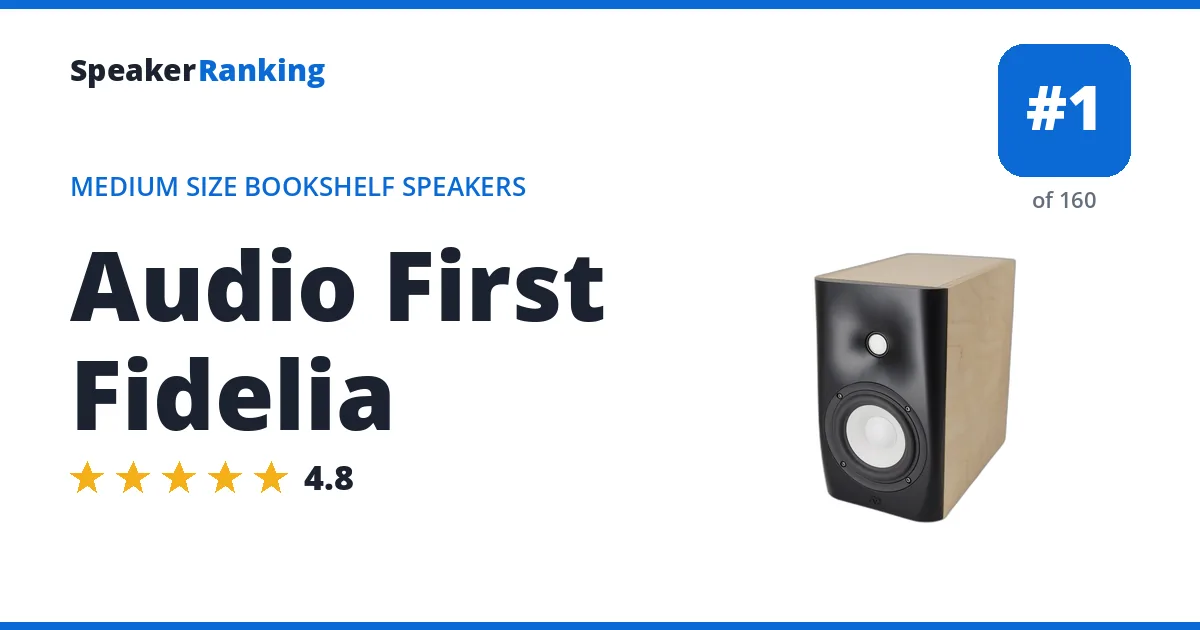
Pros: Kit speaker offering exceptional value and tonal accuracy; chosen by reviewer as reference standard for future speaker tonality comparisons despite 1,250 USD price point. Achieves bass extension to 53 Hz (F3) and 38 Hz (F10) from compact cabinet. Direct-from-manufacturer availability eliminates retailer markup. Measured bass extension of 53Hz (-3dB).
Cons: Kit assembly required; lower sensitivity (~83-85 dB vs. typical 85 dB average) demands adequate amplifier power. Only available direct from UK manufacturer with associated shipping costs and lead times. Trade-off between compact driver configuration and maximum dynamic output.
Full Audio First Fidelia review and specifications →
| Bass Extension (-10dB) | 38Hz (measured, Erin’s Audio Corner) |
|---|---|
| Bass Extension (-3dB) | 53Hz (measured, Erin’s Audio Corner) |
| Crossover Frequency | 1560Hz |
| DIY Kit | Yes |
| Dimensions | 11.8”H x 7.1”W x 11.7”D (300 x 180 x 297.6 mm) |
| Drivers | 5” ceramic-aluminum cone woofer, 1” ceramic-aluminum tweeter |
| Impedance | 4 ohms |
| Sensitivity | 84dB |
| Spinorama Preference Score | 6.45 |
| Spinorama Preference Score with Perfect Sub | 8.46 |
| Weight | 15 lbs (6.8 kg) each |
| Woofer Cabinet | ported, rear |
- Links
- Reviews, Comparisons and Sound Samples
- Erin’s Audio Corner: The #1 Reason audiophiles Are Raving About Fidelia’s Sound Quality More from Erin’s Audio Corner →
- Erin’s Audio Corner: I Tested 250 Speakers So You Don’t Have To!
- Erin’s Audio Corner: My Absolute Favorite Products of 2024 Revealed
- Erin’s Audio Corner Measurements (spinorama.org)
- Erin’s Audio Corner Website: Audio First Fidelia
- Head-to-Head Comparisons
- Audio First Fidelia vs Philharmonic Ceramic Mini
- Audio First Fidelia vs Ascend Sierra 1 v2
- Audio First Fidelia vs KEF LS50 Meta
- Audio First Fidelia vs XMechanik Mechano23 DIY
- Audio First Fidelia vs Ascend Acoustics HTM-200SE2
- Audio First Fidelia vs Arendal 1961 Monitor
- Audio First Fidelia vs Ascend Acoustics Luna V2 Mini-Monitor Titan
- Audio First Fidelia vs Aalto Speakers Aalto 1 EVO
- See all 26 comparisons
 Radiant Acoustics Clarity 4.2: $2,998 per pair Radiant Acoustics eBay
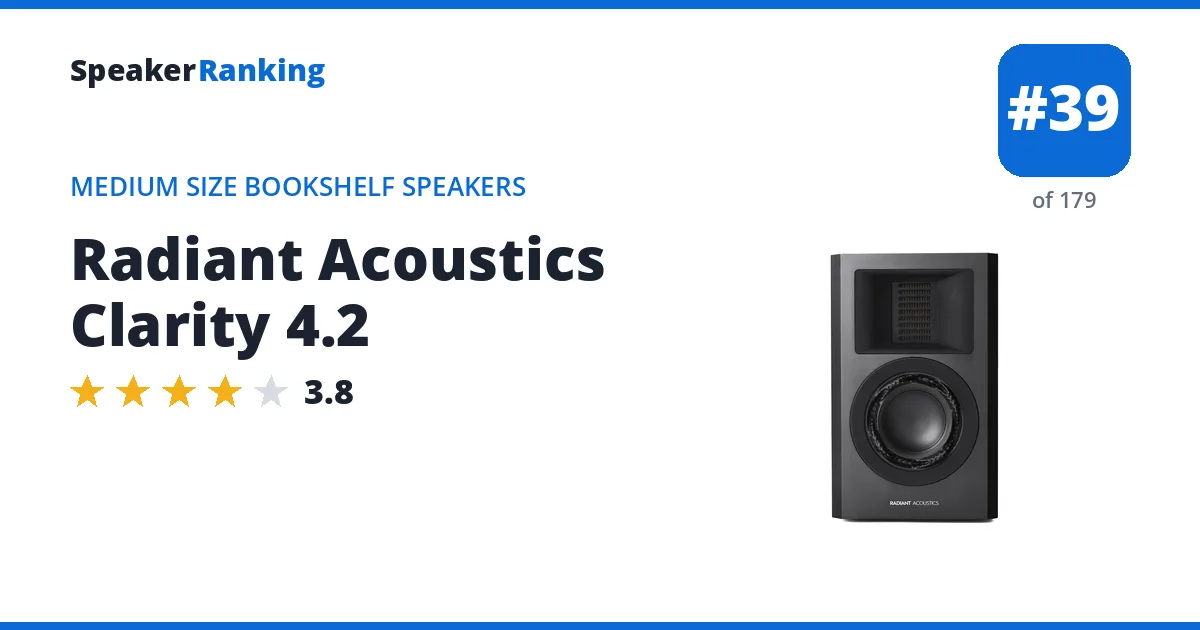
Same family: the Radiant Acoustics Clarity 6.2 (larger bookshelf, rated 4.4/5) and the Radiant Acoustics Clarity 66 (floorstanding, rated 4.6/5).
Pros: Compact bookshelf design using a 4” Purifi mid-woofer with matching Purifi passive radiators and an AMT tweeter on a purpose-designed waveguide, built with genuine heft: aluminum baffle, extensive internal bracing and damping. Surprisingly wide horizontal dispersion (about ±70° through the midrange and into the treble), more enveloping than its larger 6.2 sibling despite the smaller cabinet. More linear on-axis than the bigger Clarity 6.2, which needs 15-20° of toe-out to tame a rising treble; the 4.2 can be listened to closer to on-axis without that same correction. Wider-than-typical vertical dispersion (roughly +30°/-20°) for a two-way design, since its smaller woofer keeps the tweeter-to-woofer distance short. Genuinely deep bass extension for its size (F3 44Hz, reaching about 40Hz in-room), though it comes at a real cost to sensitivity. No resonance issues visible in impedance measurements. Measured bass extension of 44 Hz (-3dB).
Cons: Low sensitivity (rated 78dB, measured 78.5dB) is the trade-off for its bass extension: needs a fair amount of amplifier power, around 100W recommended for small-to-medium rooms versus the manufacturer’s own 60W baseline. Designed specifically for smaller rooms; the reviewer had to move testing out of his open-plan living room and into a smaller bedroom to avoid running into compression. A dip in the upper midrange gives a mild lack of attack and clarity, and a peak around 5kHz occasionally added a touch of extra sibilance. Multitone distortion crosses the reviewer’s 3% threshold at 96dB, making about 88dB a better average listening level; a slight upper-midrange bump persists even with an 80Hz high-pass filter applied. Dynamic range is limited: fine at 86dB, but the woofer starts giving up headroom by 96dB and drops off significantly by 102dB. Compared to its pricier sibling Clarity 6.2, has notably less dynamic range and higher multitone distortion, reflecting the smaller driver complement. A niche product size-wise: the reviewer couldn’t identify a clear direct competitor in the same size/price/SPL class.
Full Radiant Acoustics Clarity 4.2 review and specifications →
| Amplifier Power | External amplifier required |
|---|---|
| Bass Extension (-10dB) | 35 Hz (measured, Erin’s Audio Corner) |
| Bass Extension (-3dB) | 44 Hz (measured, Erin’s Audio Corner) |
| DIY Kit | No |
| Dimensions | 9.5”H x 6.3”W x 9.4”D (241 x 160 x 239 mm) |
| Drivers | (2) 4” (102mm) woofer + AMT tweeter |
| Frequency Response | 40 Hz - 25 kHz |
| Impedance | 4 ohms |
| Recommended Power | 50-200W |
| Sensitivity | 78 dB |
| Weight | 28.7 lbs (13 kg) (per pair: 57.3 lbs (26 kg)) |
| Woofer Cabinet | passive radiator |
- Links
- Reviews, Comparisons and Sound Samples
- Head-to-Head Comparisons
- Radiant Acoustics Clarity 4.2 vs Wharfedale Diamond 12.1
- Radiant Acoustics Clarity 4.2 vs KEF Q150
- Radiant Acoustics Clarity 4.2 vs Wharfedale Super Denton
- Radiant Acoustics Clarity 4.2 vs Polk Audio XT15
- Radiant Acoustics Clarity 4.2 vs Klipsch RP-500M II
- Radiant Acoustics Clarity 4.2 vs Moondrop M4P MTM
- Radiant Acoustics Clarity 4.2 vs Arendal 1961 Monitor
- Radiant Acoustics Clarity 4.2 vs KEF LS50 Meta
- See all 23 comparisons