Short answer: the Revel M16, for the flatter response. The Yamaha NS-800A is exceptionally well built, with no internal resonance in burst decay or impedance measurements, but a wide scoop from roughly 2kHz-10kHz gives a laidback, soft, low-attack character notably worse than the reviewer’s Audio First Fidelia reference in an A/B comparison. The M16 is flat on-axis from 200Hz to 10kHz, with distortion peaks around 80Hz and 350Hz.
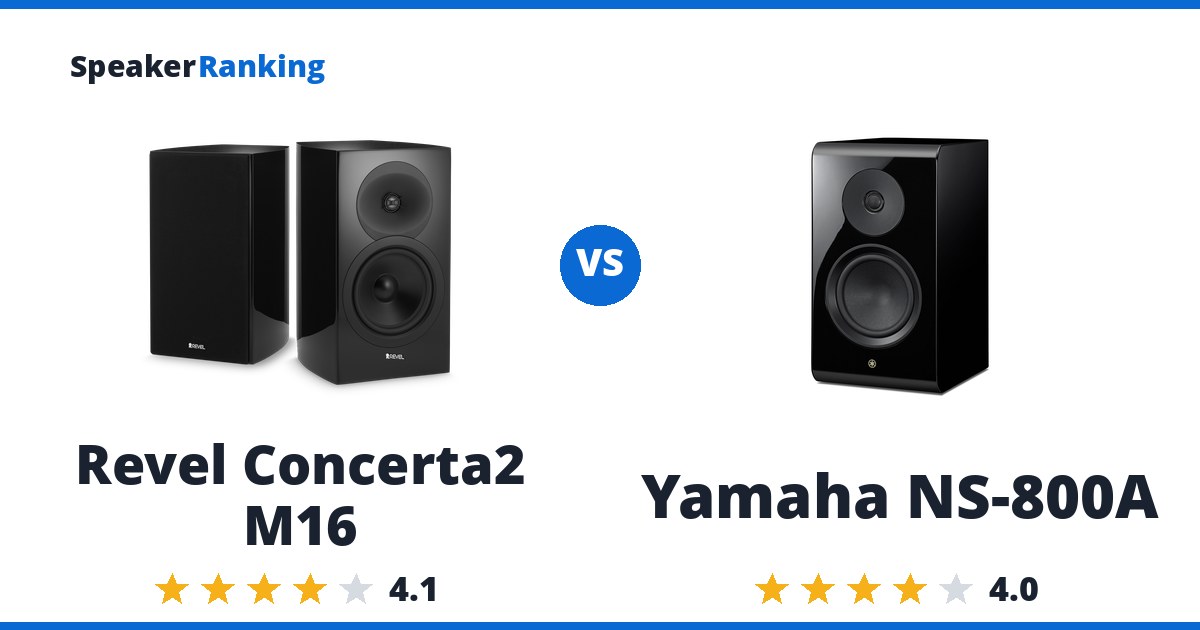
Buy the Yamaha NS-800A new; the Revel Concerta2 M16 is no longer sold new, so it only makes sense as a used find.
Looking for alternatives? See the complete Passive Home rankings.
Specifications Side By Side
| Revel Concerta2 M16 | Yamaha NS-800A | |
|---|---|---|
| Price | $600 per pair used (about), Discontinued | $4,999.90 per pair |
| Ranked | #51 of 134 in Large Size Bookshelf Speakers | #58 of 134 in Large Size Bookshelf Speakers |
| Drivers | 25mm tweeter + 165mm woofer | 1.25” dome tweeter, 6.5” mid-woofer |
| Weight | 32 lbs (14.5 kg) | 28.7 lbs (13.0 kg) each |
| Sensitivity | 86dB | 84.9dB (measured average 300Hz-3kHz @ 2.83V/1m, Erin’s Audio Corner; 86.5dB manufacturer specified) |
| Impedance | 6 ohms | 6 ohms nominal, 4.3 ohms minimum (measured above 80Hz, Erin’s Audio Corner) |
| Dimensions | 14.8”H x 8.6”W x 10.8”D (374.7 x 218.4 x 273.3 mm) | 16.5”H x 9.1”W x 14.1”D (419.1 x 231.8 x 358.8 mm) |
| Woofer Cabinet | ported, rear | Bass reflex |
| Bass Extension (-3dB) | 60.1Hz (measured, Audio Science Review) | 68Hz (measured, Erin’s Audio Corner) |
| Bass Extension (-10dB) | 41.6Hz (measured, Audio Science Review) | 35Hz (measured, Erin’s Audio Corner) |
| Spinorama Preference Score | 5.06 | 4.66 |
| Spinorama Preference Score with Perfect Sub | 7.28 | 6.43 |
| DIY Kit | No | No |
| Crossover Frequency | - | 2600Hz |
| Power Handling | - | 40W nominal, 120W max |
Related Speaker Comparisons
How Revel Concerta2 M16 compares with other leading options:
- AsciLab C6B vs Revel Concerta2 M16
- Revel M106 vs Revel Concerta2 M16
- KEF R3 Meta vs Revel Concerta2 M16
- KEF Q Concerto Meta vs Revel Concerta2 M16
- Ascend Acoustics CMT-340 SE2 vs Revel Concerta2 M16
Prices on this page were last checked October 2, 2026 at 10:18 PM UTC. Product prices and availability are accurate as of that date/time and are subject to change; the price and availability shown on Amazon at the time of purchase will apply to the purchase of this product.
As an eBay Partner, we may be compensated if you make a purchase.
The Two Speakers In Full
 Revel Concerta2 M16: $600 per pair used (about) Discontinued eBay
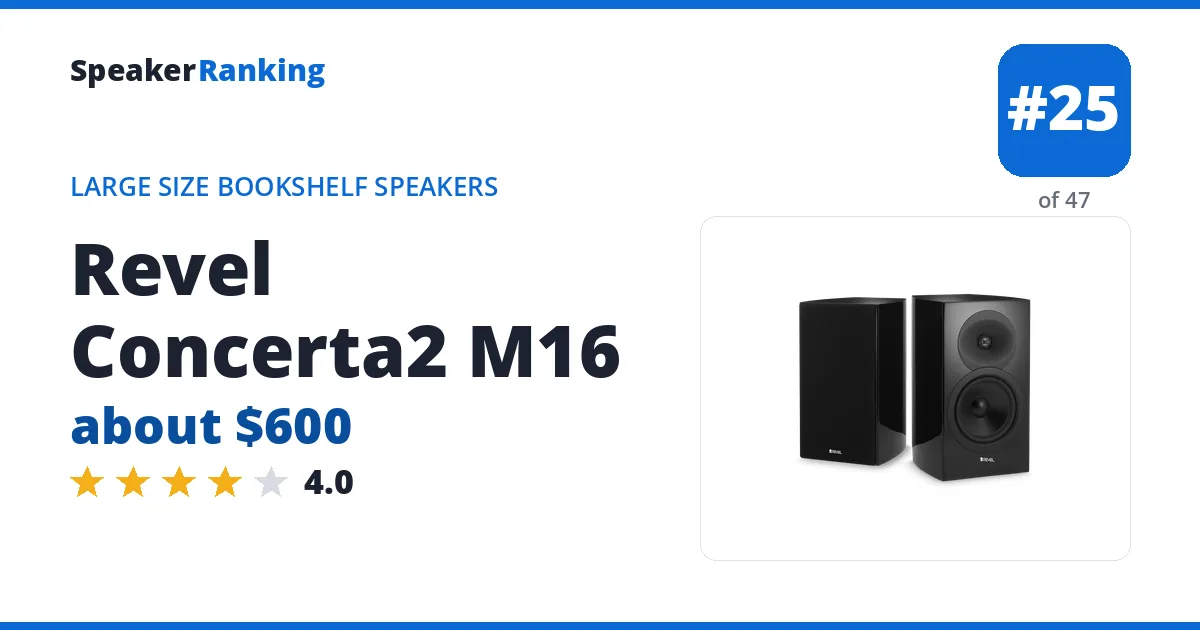
Pros: CEA2034 spinorama shows an on-axis response that’s essentially flat from 200Hz to 10kHz, with some bass boost around 100Hz. Predicted in-room response is very nice, with just extra bass and a bit of roll-off above 20kHz: the reviewer calls it “nice!” Distortion is well controlled through most of the range at both test levels. Measured bass extension of 60.1Hz (-3dB).
Cons: Harmonic distortion shows a notable peak around 80Hz and a sharp spike around 350Hz, plus the woofer appears to get a bit unhappy right before handing off to the tweeter. Cumulative spectral decay (waterfall) shows some lingering resonances in the 300Hz-1kHz region. The reviewer cautions not to over-cover the cabinet/grille area with thin fabric, as it can audibly affect the top-end response. Discontinued.
Full Revel Concerta2 M16 review and specifications →
| Bass Extension (-10dB) | 41.6Hz (measured, Audio Science Review) |
|---|---|
| Bass Extension (-3dB) | 60.1Hz (measured, Audio Science Review) |
| DIY Kit | No |
| Dimensions | 14.8”H x 8.6”W x 10.8”D (374.7 x 218.4 x 273.3 mm) |
| Drivers | 25mm tweeter + 165mm woofer |
| Impedance | 6 ohms |
| Sensitivity | 86dB |
| Spinorama Preference Score | 5.06 |
| Spinorama Preference Score with Perfect Sub | 7.28 |
| Weight | 32 lbs (14.5 kg) |
| Woofer Cabinet | ported, rear |
- Links
- Reviews, Comparisons and Sound Samples
- Head-to-Head Comparisons
- Revel Concerta2 M16 vs ELAC Uni-Fi Reference UBR62
- Revel Concerta2 M16 vs JBL HDI-1600
- Revel Concerta2 M16 vs ELAC DBR62
- Revel Concerta2 M16 vs Definitive Technology Demand D11
- Revel Concerta2 M16 vs ELAC Debut 3.0 DB63
- Revel Concerta2 M16 vs Technics SB-C700
- Revel Concerta2 M16 vs Emotiva Airmotiv XB2
- Revel Concerta2 M16 vs Dynaudio Contour 20i
- See all 26 comparisons
 Yamaha NS-800A: $4,999.90 per pair The Music Room eBay
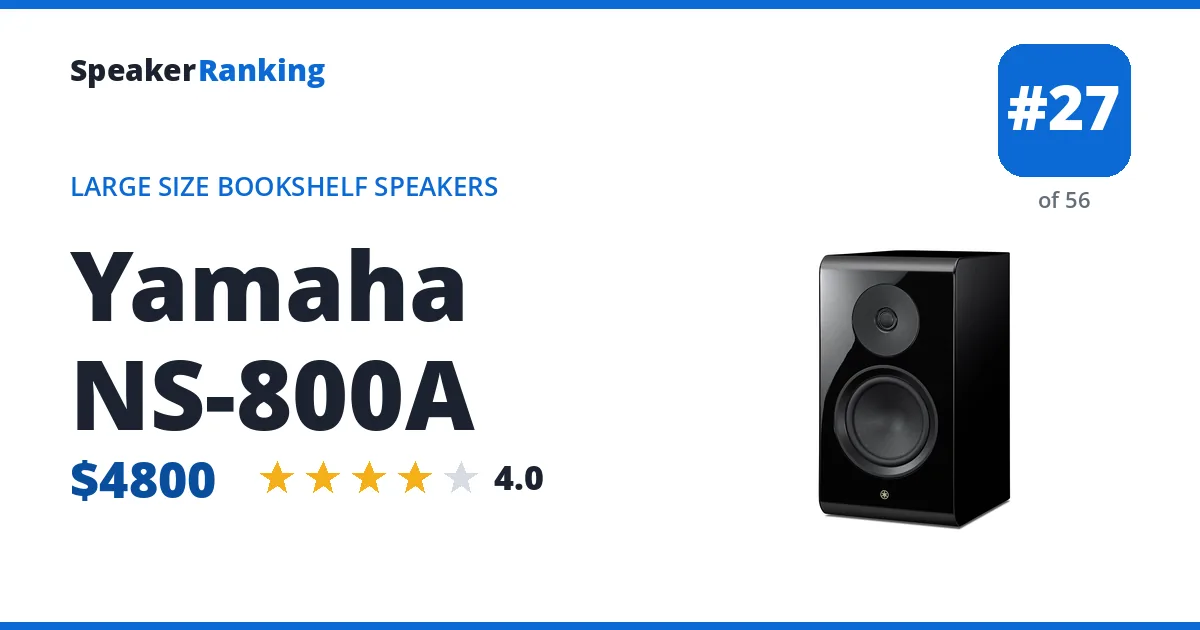
Pros: Exceptionally well-built cabinet with no internal resonance issues at all: confirmed clean in both burst decay and impedance measurements. Good, wide directivity (~75 degrees horizontal) that stays consistent enough to EQ successfully. Distortion is low, staying under 3% at 96dB, and dynamic range holds up well until right near its 102dB limit. A shallower, higher-frequency bass rolloff profile (F3 68Hz, F10 35Hz) means it can be placed closer to the wall (about a foot) without turning boomy, actually gaining bass presence rather than losing it. Measured bass extension of 68Hz (-3dB), with a measured sensitivity of 84.9dB.
Cons: A wide, roughly 2kHz-10kHz scoop in the upper-midrange/lower-treble gives it a laidback, soft, low-attack character: notably worse than the reviewer’s Audio First Fidelia reference in an A/B comparison. On top of that, treble breaks up badly above 10kHz, swinging up as much as 8dB: a significant, named flaw. Sounds inconsistently voiced as a result (bright on some material like cymbals and shakers, dull/laidback on vocals and instrument attack) until corrected with real parametric EQ (the reviewer needed a +2dB boost around 4.5kHz at Q0.5 plus taming the treble spike to bring it to life) combined with near-wall placement and 30-degree toe-out. Without that combination, it’s a tough sale for a $5000 bookshelf speaker.
Full Yamaha NS-800A review and specifications →
| Bass Extension (-10dB) | 35Hz (measured, Erin’s Audio Corner) |
|---|---|
| Bass Extension (-3dB) | 68Hz (measured, Erin’s Audio Corner) |
| Crossover Frequency | 2600Hz |
| DIY Kit | No |
| Dimensions | 16.5”H x 9.1”W x 14.1”D (419.1 x 231.8 x 358.8 mm) |
| Drivers | 1.25” dome tweeter, 6.5” mid-woofer |
| Impedance | 6 ohms nominal, 4.3 ohms minimum (measured above 80Hz, Erin’s Audio Corner) |
| Power Handling | 40W nominal, 120W max |
| Sensitivity | 84.9dB (measured average 300Hz-3kHz @ 2.83V/1m, Erin’s Audio Corner; 86.5dB manufacturer specified) |
| Spinorama Preference Score | 4.66 |
| Spinorama Preference Score with Perfect Sub | 6.43 |
| Weight | 28.7 lbs (13.0 kg) each |
| Woofer Cabinet | Bass reflex |
- Links
- Reviews, Comparisons and Sound Samples
- Head-to-Head Comparisons
- Yamaha NS-800A vs Definitive Technology Demand D11
- Yamaha NS-800A vs ELAC DBR62
- Yamaha NS-800A vs Technics SB-C700
- Yamaha NS-800A vs Dynaudio Contour 20i
- Yamaha NS-800A vs ELAC Uni-Fi Reference UBR62
- Yamaha NS-800A vs SVS Ultra Bookshelf
- Yamaha NS-800A vs Infinity Reference R162
- Yamaha NS-800A vs JBL HDI-1600
- See all 22 comparisons