Short answer: the JBL Studio 530 for better sound quality, the JBL Stage 2 250B for the lower price. The JBL Studio 530 ranks #23 of 56 bookshelf speakers at $399. The JBL Stage 2 250B ranks #30 at $349.95, $49.05 cheaper.
What the JBL Studio 530 offers: CEA2034 spinorama shows a fairly flat on-axis response. Watch for: A peak around 1.4kHz is attributed to a tweeter resonance, and shows up as a distinct spike in harmonic distortion at that frequency along with a second resonance-driven bump around 2kHz.
On the JBL Stage 2 250B side: Consistent, EQ-able dips in the frequency response mean the tonal issues are at least correctable if you’re willing to use equalization. Set against that: The reviewer was “even less enthusiastic” about this one than its disappointing floorstanding sibling.
Buy the JBL Studio 530 if sound quality matters more than the price. Buy the JBL Stage 2 250B if the price matters more than sound quality.
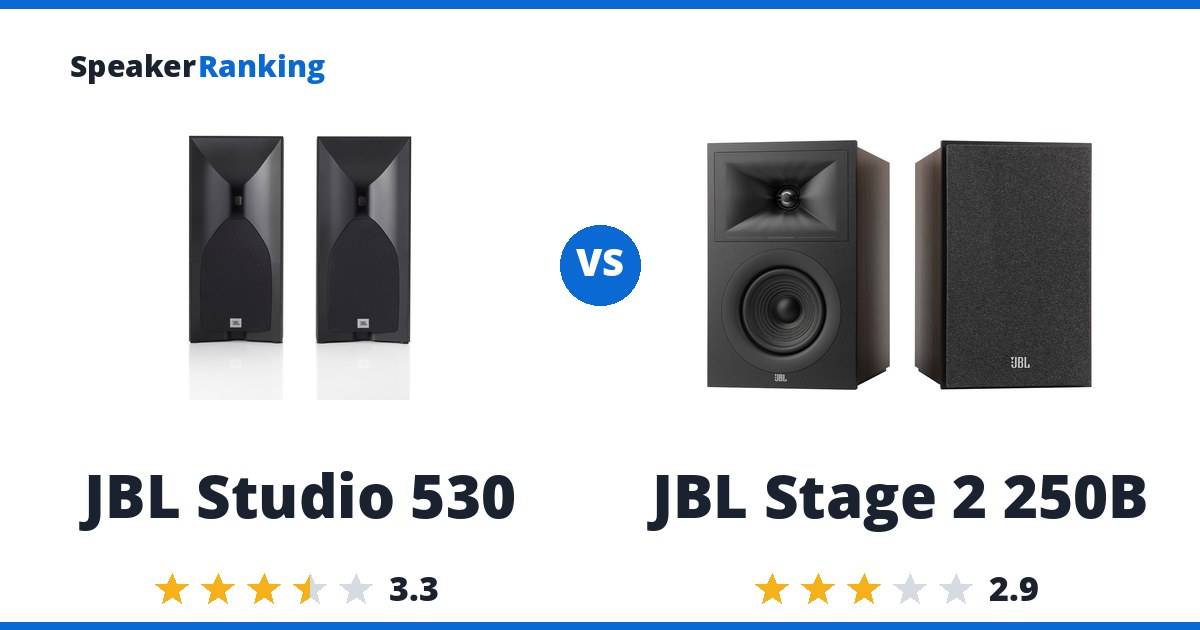
Specifications Side By Side
| JBL Studio 530 | JBL Stage 2 250B | |
|---|---|---|
| Price | $399 Discontinued | $349.95 |
| Ranked | #23 of 56 in Medium Size Bookshelf Speakers | #30 of 56 in Medium Size Bookshelf Speakers |
| Bass Extension (-3dB) | 88Hz (measured, Audio Science Review) | 64Hz (measured, Erin’s Audio Corner) |
| Bass Extension (-10dB) | 65Hz (measured, Audio Science Review) | 50Hz (measured, Erin’s Audio Corner) |
| Crossover Frequency | 1.5kHz | - |
| Dimensions | 18.4"H x 8.4"W x 8.7"D (467 x 214 x 222 mm) | 12.6"H x 7.9"W x 9.5"D (321.0 x 200.0 x 241.0 mm) |
| Impedance | 6 ohms nominal (4 ohms minimum, measured by Audio Science Review) | 6 ohms nominal, 3.3 ohms minimum (measured, Erin’s Audio Corner) |
| Sensitivity | ~85dB (measured by Audio Science Review) | 86dB (2.83V/1m, measured by Erin’s Audio Corner) |
| Drivers | 5.25" (130mm) PolyPlas™ cone woofer with SFG magnet, 1" (25mm) compression driver with Teonex® diaphragm on Bi-Radial® horn | 1" anodized aluminum dome tweeter with HDI waveguide, 5.25" polycellulose woofer |
| Discontinued | Yes | - |
| Weight | 17 lbs / 7.7 kg each | 12.3 lbs / 5.6 kg (12.4 lb) per pair |
| Woofer Cabinet | ported | ported, rear |
| Output Power | - | 75W RMS |
Related Speaker Comparisons
More useful head-to-heads from the same speaker class:
- Klipsch RP-500M II vs ELAC Debut 2.0 B5.2
- Klipsch RP-500M II vs Boston Acoustics A25
- KEF Q150 vs ELAC Debut 2.0 B5.2
- KEF Q150 vs JBL Studio 530
- Wharfedale Diamond 220 vs JBL Studio 530
The Two Speakers In Full
 JBL Studio 530: $399 Discontinued
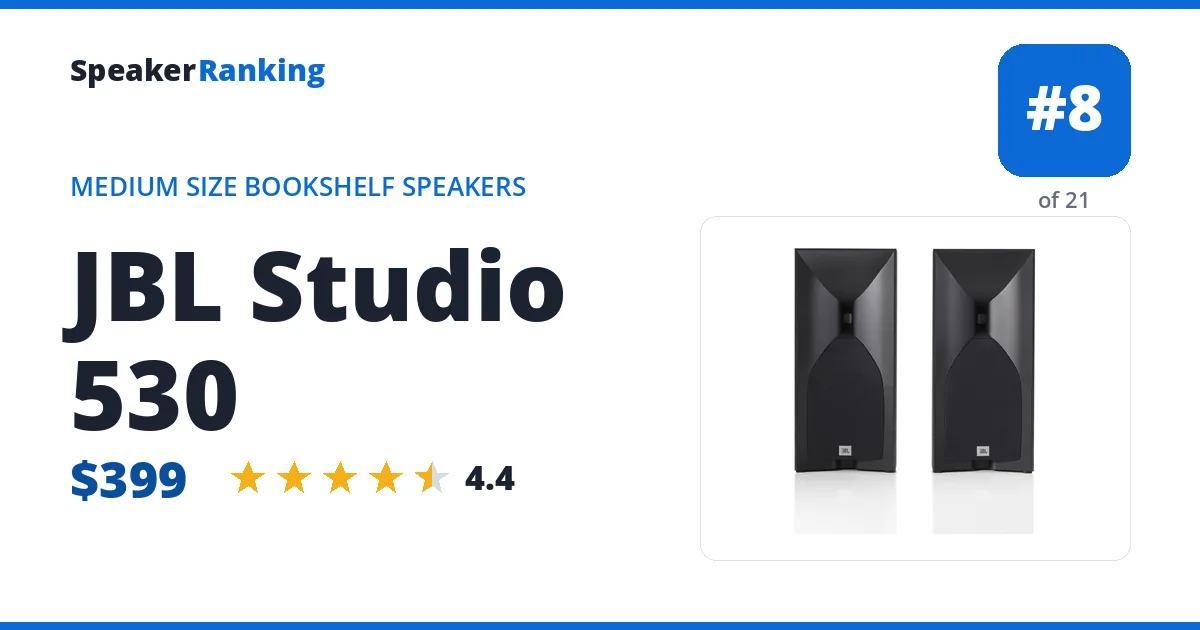
Pros: CEA2034 spinorama shows a fairly flat on-axis response. Predicted in-room response is very smooth aside from the high-frequency roll-off.
Cons: A peak around 1.4kHz is attributed to a tweeter resonance, and shows up as a distinct spike in harmonic distortion at that frequency along with a second resonance-driven bump around 2kHz. Response rolls off in the high frequencies and the tuning is a bit bass-shy overall. Cumulative spectral decay (waterfall) shows the same 1kHz-region resonances lingering in time. Discontinued.
Full JBL Studio 530 review and specifications →
| Bass Extension (-10dB) | 65Hz (measured, Audio Science Review) |
|---|---|
| Bass Extension (-3dB) | 88Hz (measured, Audio Science Review) |
| Crossover Frequency | 1.5kHz |
| Dimensions | 18.4"H x 8.4"W x 8.7"D (467 x 214 x 222 mm) |
| Discontinued | Yes |
| Drivers | 5.25" (130mm) PolyPlas™ cone woofer with SFG magnet, 1" (25mm) compression driver with Teonex® diaphragm on Bi-Radial® horn |
| Impedance | 6 ohms nominal (4 ohms minimum, measured by Audio Science Review) |
| Sensitivity | ~85dB (measured by Audio Science Review) |
| Weight | 17 lbs / 7.7 kg each |
| Woofer Cabinet | ported |
As an eBay Partner, we may be compensated if you make a purchase.
- Links
- Reviews, Comparisons and Sound Samples
- Head-to-Head Comparisons
- JBL Studio 530 vs ELAC Debut 2.0 B5.2
- JBL Studio 530 vs Boston Acoustics A25
- JBL Studio 530 vs Sony SS-CS5 M2
- JBL Studio 530 vs Paradigm Monitor SE Atom
- JBL Studio 530 vs Wharfedale Diamond 220
- JBL Studio 530 vs Dynaudio Emit M10
- JBL Studio 530 vs KEF Q150
- JBL Studio 530 vs ELAC BS U5
- See all 19 comparisons
 JBL Stage 2 250B: $349.95 Amazon
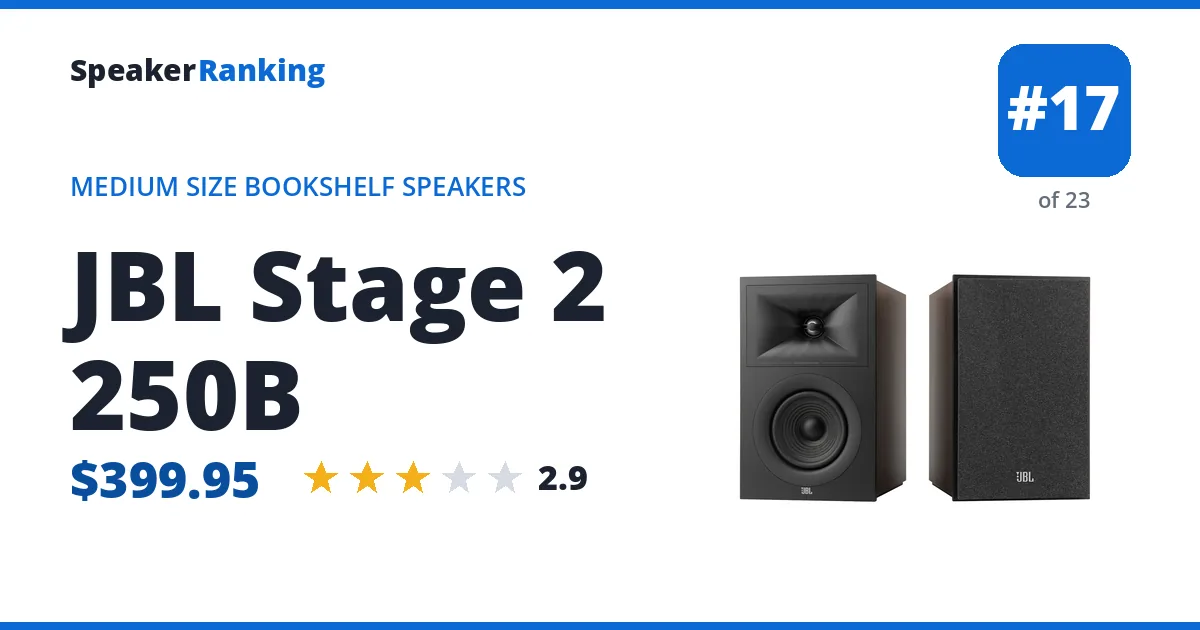
Pros: Consistent, EQ-able dips in the frequency response mean the tonal issues are at least correctable if you’re willing to use equalization. Horizontal dispersion is reasonably wide and controlled (~50-60 degrees). The tweeter itself holds up fine under compression testing - it’s the midwoofer that gives out first.
Cons: The reviewer was “even less enthusiastic” about this one than its disappointing floorstanding sibling. A confusing, hard-to-place tonal signature - a lower-midrange dip creates a recessed, lacking-attack character that’s then partly offset by a rebound around 2-4kHz, so it reads as recessed and forward at different times depending on the material. Treble falls off sharply above 6-7kHz, same issue as the larger 280F. Multitone distortion at 96dB is genuinely poor - well over 3%, reportedly around 10% at some frequencies. Limited bass extension (F3 64Hz, F10 50Hz) means a subwoofer is basically required if used as main speakers. Compression sets in early on the bass/midwoofer at higher output. The reviewer explicitly recommends the similarly-priced Polk Reserve R200/R100 instead for anyone who wants a more linear, EQ-free sound.
Full JBL Stage 2 250B review and specifications →
| Bass Extension (-10dB) | 50Hz (measured, Erin's Audio Corner) |
|---|---|
| Bass Extension (-3dB) | 64Hz (measured, Erin's Audio Corner) |
| Dimensions | 12.6"H x 7.9"W x 9.5"D (321.0 x 200.0 x 241.0 mm) |
| Drivers | 1" anodized aluminum dome tweeter with HDI waveguide, 5.25" polycellulose woofer |
| Impedance | 6 ohms nominal, 3.3 ohms minimum (measured, Erin's Audio Corner) |
| Output Power | 75W RMS |
| Sensitivity | 86dB (2.83V/1m, measured by Erin's Audio Corner) |
| Weight | 12.3 lbs / 5.6 kg (12.4 lb) per pair |
| Woofer Cabinet | ported, rear |
As an eBay Partner, we may be compensated if you make a purchase.
- Links
- Reviews, Comparisons and Sound Samples
- Head-to-Head Comparisons
- JBL Stage 2 250B vs ELAC BS U5
- JBL Stage 2 250B vs Dynaudio Emit M10
- JBL Stage 2 250B vs Dynaudio X14
- JBL Stage 2 250B vs Pioneer SP-BS22-LR (Philharmonic AAM Mod)
- JBL Stage 2 250B vs Paradigm Monitor SE Atom
- JBL Stage 2 250B vs JBL L52 Classic
- JBL Stage 2 250B vs Sony SS-CS5 M2
- JBL Stage 2 250B vs ELAC Debut 2.0 B5.2
- See all 18 comparisons