Short answer: the Sony SS-CS5 M2. It ranks #25 of 56 bookshelf speakers by sound quality at $278; the JBL Stage 2 250B ranks #30 and costs $349.95, so there is not much of a tradeoff to weigh.
What the Sony SS-CS5 M2 offers: Added internal bracing (corners, sides, front baffle) plus an updated crossover meaningfully reduce the resonance issues that plagued the original SS-CS5, giving a smoother, more neutral character overall. Watch for: Mild sibilance in the 3-5kHz range stands out on S and T sounds in vocals.
On the JBL Stage 2 250B side: Consistent, EQ-able dips in the frequency response mean the tonal issues are at least correctable if you’re willing to use equalization. Set against that: The reviewer was “even less enthusiastic” about this one than its disappointing floorstanding sibling.
Buy the Sony SS-CS5 M2. It ranks higher for sound quality than the JBL Stage 2 250B and costs less, so there is no real case for the other one.
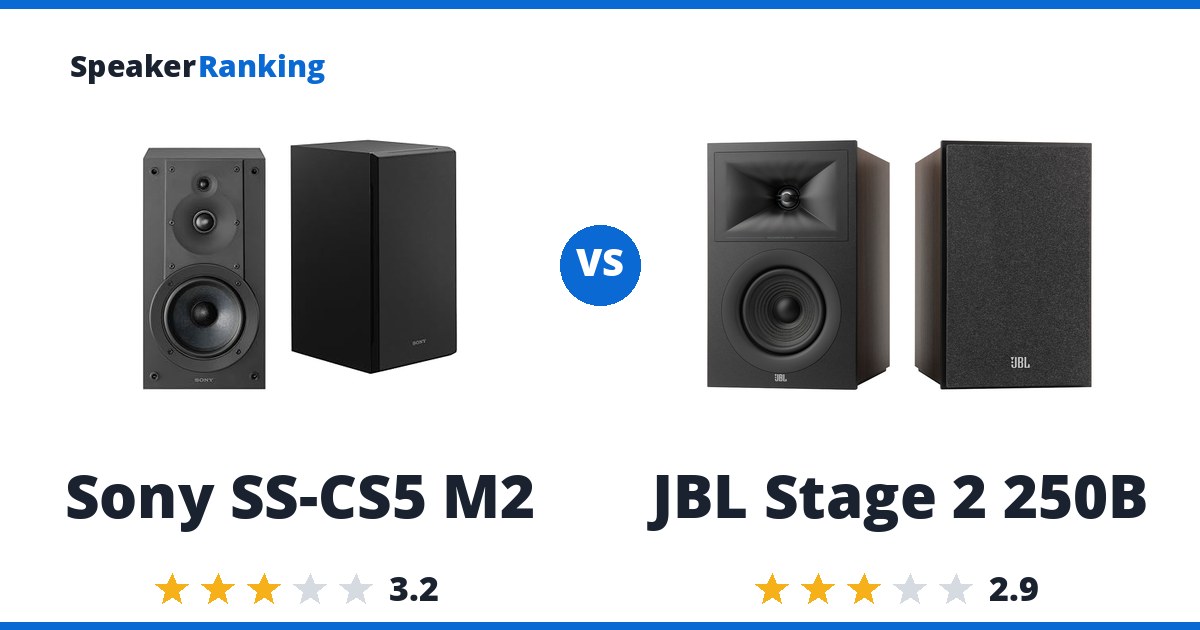
Specifications Side By Side
| Sony SS-CS5 M2 | JBL Stage 2 250B | |
|---|---|---|
| Price | $278.00 | $349.95 |
| Ranked | #25 of 56 in Medium Size Bookshelf Speakers | #30 of 56 in Medium Size Bookshelf Speakers |
| Bass Extension (-10dB) | 54Hz (measured, Erin’s Audio Corner) | 50Hz (measured, Erin’s Audio Corner) |
| Bass Extension (-3dB) | 80Hz (measured, Erin’s Audio Corner) | 64Hz (measured, Erin’s Audio Corner) |
| Dimensions | 13.2"H x 7"W x 8.7"D (335 x 178 x 220 mm) | 12.6"H x 7.9"W x 9.5"D (321.0 x 200.0 x 241.0 mm) |
| Impedance | 6 ohms | 6 ohms nominal, 3.3 ohms minimum (measured, Erin’s Audio Corner) |
| Sensitivity | 82.5dB | 86dB (2.83V/1m, measured by Erin’s Audio Corner) |
| Supertweeter | 0.75 in | - |
| Drivers | 5.12" woofer, 0.98 in tweeter | 1" anodized aluminum dome tweeter with HDI waveguide, 5.25" polycellulose woofer |
| Weight | 9.5 lbs / 4.3 kg each | 12.3 lbs / 5.6 kg (12.4 lb) per pair |
| Woofer Cabinet | ported, rear | ported, rear |
| Output Power | - | 75W RMS |
Related Speaker Comparisons
More useful head-to-heads from the same speaker class:
- ELAC Debut 2.0 B5.2 vs JBL Stage A120
- Boston Acoustics A25 vs ELAC Debut 2.0 B5.2
- Boston Acoustics A25 vs Paradigm Monitor SE Atom
- KEF Q150 vs Sony SS-CS5 M2
- Wharfedale Diamond 220 vs Sony SS-CS5 M2
The Two Speakers In Full
 Sony SS-CS5 M2: $278.00 Amazon
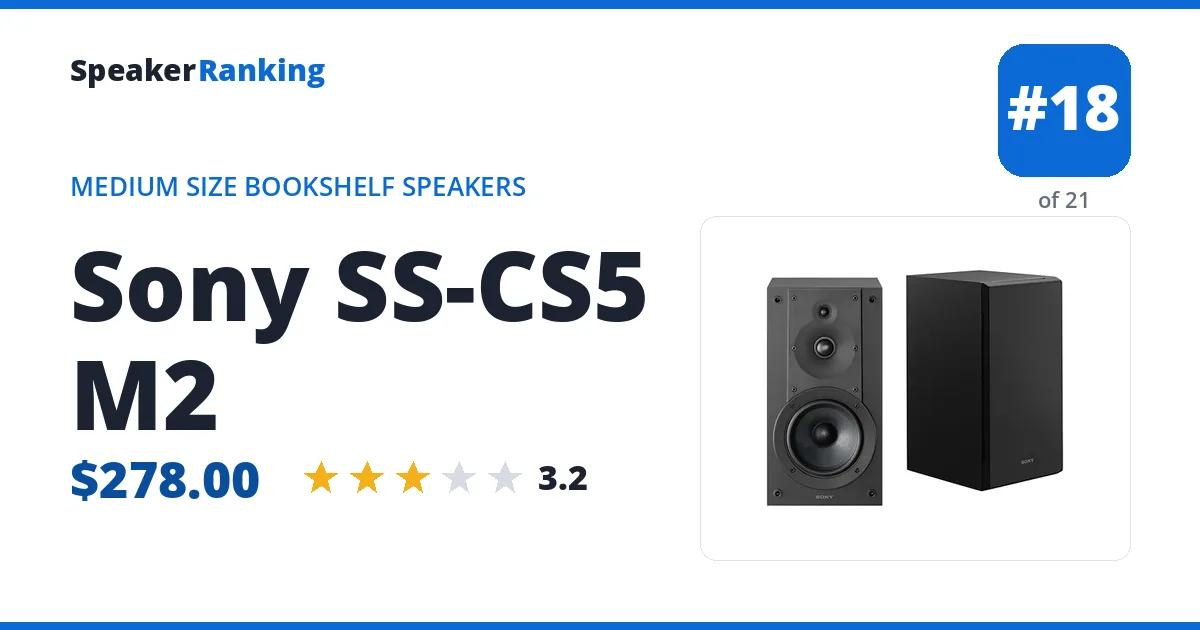
Pros: Added internal bracing (corners, sides, front baffle) plus an updated crossover meaningfully reduce the resonance issues that plagued the original SS-CS5, giving a smoother, more neutral character overall. A modest mid-range dip (about 1-2dB) is present but tolerable, and the reviewer would rather have this dip than a peak in that region. Slightly deeper bass than the previous version, measuring about 2dB more output around 60Hz. Distortion drops noticeably when crossed to a subwoofer around 80-120Hz, meaningfully improving midrange clarity and detail versus running full-range. Easy to drive on a standard AVR - no need for a dedicated high-power amplifier. More modern, understated waveguide look compared to the previous version’s glossy trim.
Cons: Mild sibilance in the 3-5kHz range stands out on S and T sounds in vocals. Some forwardness in the midrange noticeable on certain vocal recordings. Soundstage and sense of envelopment are comparatively flat and two-dimensional, especially next to reference-quality speakers with strong 3D imaging. Marketed as a “three-way” design mainly due to an added super-tweeter that the reviewer considers largely superfluous - it engages only at very high frequencies and adds complexity without a clearly audible benefit, when that cost might have been better spent on the main crossover. Output-limited: realistic ceiling is around the mid-90s dB SPL at a few meters, with comfortable listening closer to 75-85dB at 3-4 meters before distortion and compression become audible. Bass noticeably compresses/shelves below about 120Hz as volume increases, softening kick-drum impact at higher output. Smaller drivers and a lighter motor structure than rivals like the Polk XT20, which the reviewer generally prefers for its better directivity and higher SPL capability. Still needs a subwoofer for any real bass extension.
Full Sony SS-CS5 M2 review and specifications →
| Bass Extension (-10dB) | 54Hz (measured, Erin's Audio Corner) |
|---|---|
| Bass Extension (-3dB) | 80Hz (measured, Erin's Audio Corner) |
| Dimensions | 13.2"H x 7"W x 8.7"D (335 x 178 x 220 mm) |
| Drivers | 5.12" woofer, 0.98 in tweeter |
| Impedance | 6 ohms |
| Sensitivity | 82.5dB |
| Supertweeter | 0.75 in |
| Weight | 9.5 lbs / 4.3 kg each |
| Woofer Cabinet | ported, rear |
As an eBay Partner, we may be compensated if you make a purchase.
- Links
- Reviews, Comparisons and Sound Samples
- Head-to-Head Comparisons
- Sony SS-CS5 M2 vs ELAC Debut 2.0 B5.2
- Sony SS-CS5 M2 vs Paradigm Monitor SE Atom
- Sony SS-CS5 M2 vs Totem Kin One
- Sony SS-CS5 M2 vs JBL Studio 530
- Sony SS-CS5 M2 vs Boston Acoustics A25
- Sony SS-CS5 M2 vs Dynaudio Emit M10
- Sony SS-CS5 M2 vs ELAC BS U5
- Sony SS-CS5 M2 vs Neumi Silk 4
- See all 20 comparisons
 JBL Stage 2 250B: $349.95 Amazon
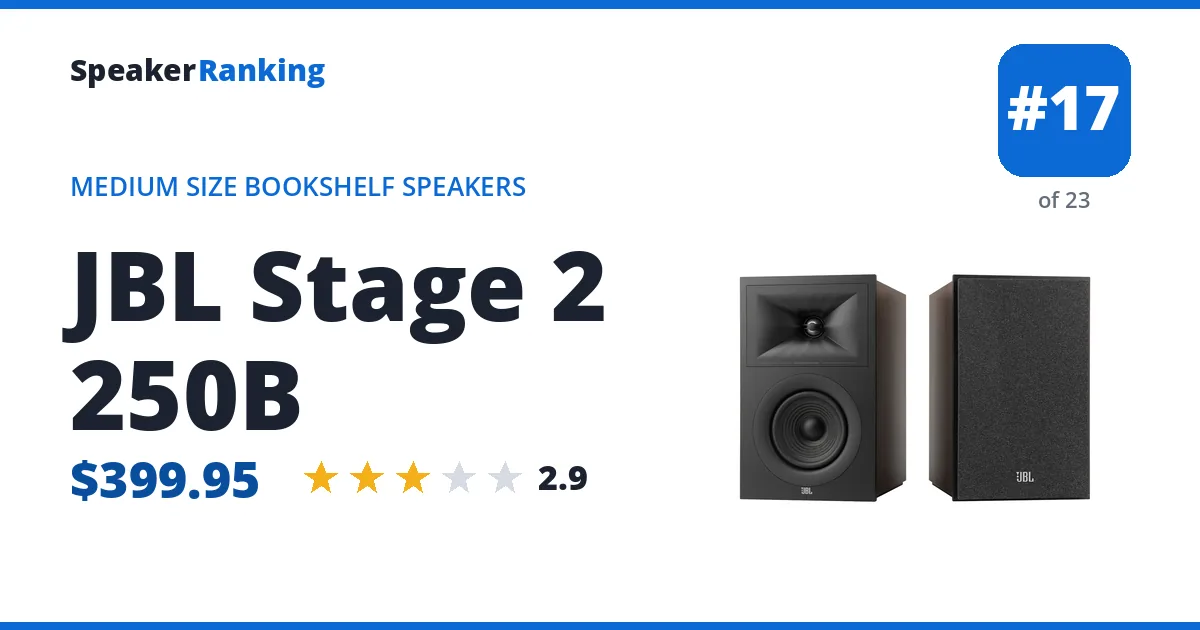
Pros: Consistent, EQ-able dips in the frequency response mean the tonal issues are at least correctable if you’re willing to use equalization. Horizontal dispersion is reasonably wide and controlled (~50-60 degrees). The tweeter itself holds up fine under compression testing - it’s the midwoofer that gives out first.
Cons: The reviewer was “even less enthusiastic” about this one than its disappointing floorstanding sibling. A confusing, hard-to-place tonal signature - a lower-midrange dip creates a recessed, lacking-attack character that’s then partly offset by a rebound around 2-4kHz, so it reads as recessed and forward at different times depending on the material. Treble falls off sharply above 6-7kHz, same issue as the larger 280F. Multitone distortion at 96dB is genuinely poor - well over 3%, reportedly around 10% at some frequencies. Limited bass extension (F3 64Hz, F10 50Hz) means a subwoofer is basically required if used as main speakers. Compression sets in early on the bass/midwoofer at higher output. The reviewer explicitly recommends the similarly-priced Polk Reserve R200/R100 instead for anyone who wants a more linear, EQ-free sound.
Full JBL Stage 2 250B review and specifications →
| Bass Extension (-10dB) | 50Hz (measured, Erin's Audio Corner) |
|---|---|
| Bass Extension (-3dB) | 64Hz (measured, Erin's Audio Corner) |
| Dimensions | 12.6"H x 7.9"W x 9.5"D (321.0 x 200.0 x 241.0 mm) |
| Drivers | 1" anodized aluminum dome tweeter with HDI waveguide, 5.25" polycellulose woofer |
| Impedance | 6 ohms nominal, 3.3 ohms minimum (measured, Erin's Audio Corner) |
| Output Power | 75W RMS |
| Sensitivity | 86dB (2.83V/1m, measured by Erin's Audio Corner) |
| Weight | 12.3 lbs / 5.6 kg (12.4 lb) per pair |
| Woofer Cabinet | ported, rear |
As an eBay Partner, we may be compensated if you make a purchase.
- Links
- Reviews, Comparisons and Sound Samples
- Head-to-Head Comparisons
- JBL Stage 2 250B vs ELAC BS U5
- JBL Stage 2 250B vs Dynaudio Emit M10
- JBL Stage 2 250B vs Dynaudio X14
- JBL Stage 2 250B vs Pioneer SP-BS22-LR (Philharmonic AAM Mod)
- JBL Stage 2 250B vs Paradigm Monitor SE Atom
- JBL Stage 2 250B vs JBL L52 Classic
- JBL Stage 2 250B vs ELAC Debut 2.0 B5.2
- JBL Stage 2 250B vs JBL Stage A120
- See all 18 comparisons