Short answer: the Paradigm Monitor SE Atom. It ranks #26 of 56 bookshelf speakers by sound quality at $318; the JBL Stage 2 250B ranks #30 and costs $349.95, so there is not much of a tradeoff to weigh.
On the Paradigm Monitor SE Atom side: Good, consistent directivity across the on-axis, listening-window, and off-axis curves makes the Atom easier to equalize and less room-dependent than many budget speakers. Set against that: On-axis response is uneven out of the box, with a 2-4kHz dip followed by a peak and a resonance around 15kHz that the reviewer said gives it a bright, “showroom” voicing without EQ correction.
What the JBL Stage 2 250B gets right: Consistent, EQ-able dips in the frequency response mean the tonal issues are at least correctable if you’re willing to use equalization. The catch: The reviewer was “even less enthusiastic” about this one than its disappointing floorstanding sibling.
Buy the Paradigm Monitor SE Atom. It ranks higher for sound quality than the JBL Stage 2 250B and costs less, so there is no real case for the other one.
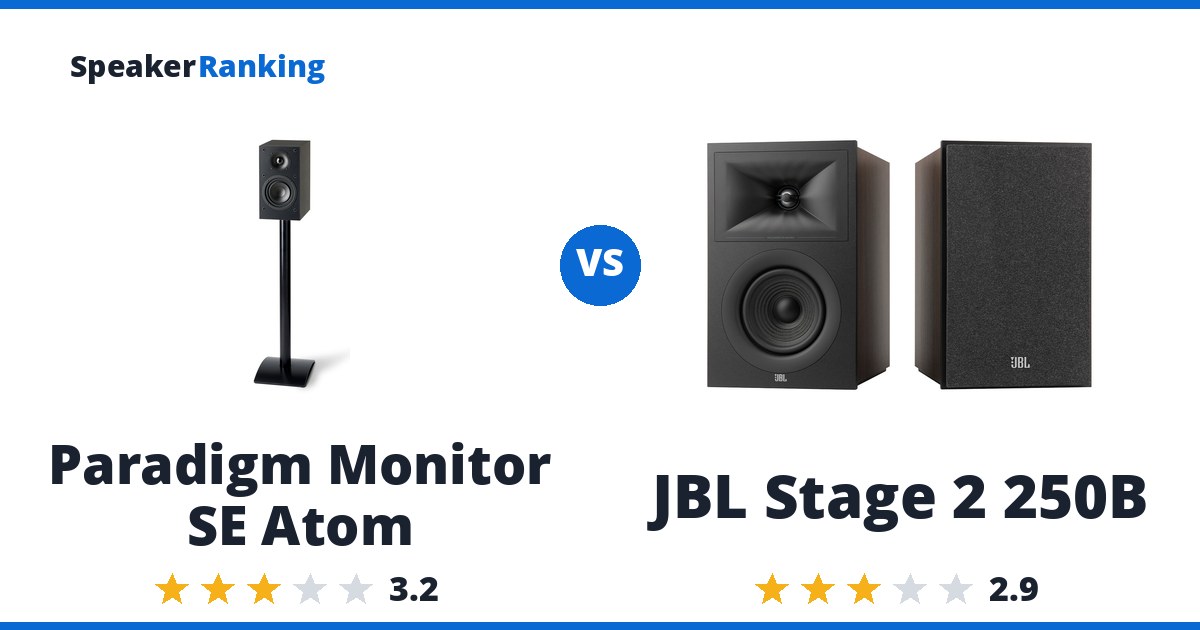
Specifications Side By Side
| Paradigm Monitor SE Atom | JBL Stage 2 250B | |
|---|---|---|
| Price | $318 | $349.95 |
| Ranked | #26 of 56 in Medium Size Bookshelf Speakers | #30 of 56 in Medium Size Bookshelf Speakers |
| Bass Extension (-3dB) | 82Hz (measured, Audio Science Review) | 64Hz (measured, Erin’s Audio Corner) |
| Bass Extension (-10dB) | 62Hz (measured, Audio Science Review) | 50Hz (measured, Erin’s Audio Corner) |
| Drivers | 1" X-PAL aluminum dome tweeter (ferrofluid, PPA lens), 5.5" mineral-filled polypropylene mid/bass | 1" anodized aluminum dome tweeter with HDI waveguide, 5.25" polycellulose woofer |
| Dimensions | 12.75H x 7.125W x 11D in | 12.6"H x 7.9"W x 9.5"D (321.0 x 200.0 x 241.0 mm) |
| Weight | 11.9 lbs / 5.4 kg each | 12.3 lbs / 5.6 kg (12.4 lb) per pair |
| Frequency Response | 61Hz - 21kHz +/-3dB (Manufacturer specified) | - |
| Sensitivity | 85dB (2.83V/1m, measured, Audio Science Review) | 86dB (2.83V/1m, measured by Erin’s Audio Corner) |
| Impedance | 8 ohms | 6 ohms nominal, 3.3 ohms minimum (measured, Erin’s Audio Corner) |
| Power Handling | 15-100W recommended | - |
| Woofer Cabinet | ported, rear | ported, rear |
| Output Power | - | 75W RMS |
Related Speaker Comparisons
More useful head-to-heads from the same speaker class:
- Klipsch RP-500M II vs Sony SS-CS5 M2
- JBL Studio 530 vs Sony SS-CS5 M2
- KEF Q150 vs Sony SS-CS5 M2
- KEF Q150 vs Paradigm Monitor SE Atom
- Wharfedale Diamond 220 vs Paradigm Monitor SE Atom
The Two Speakers In Full
 Paradigm Monitor SE Atom: $318 Amazon
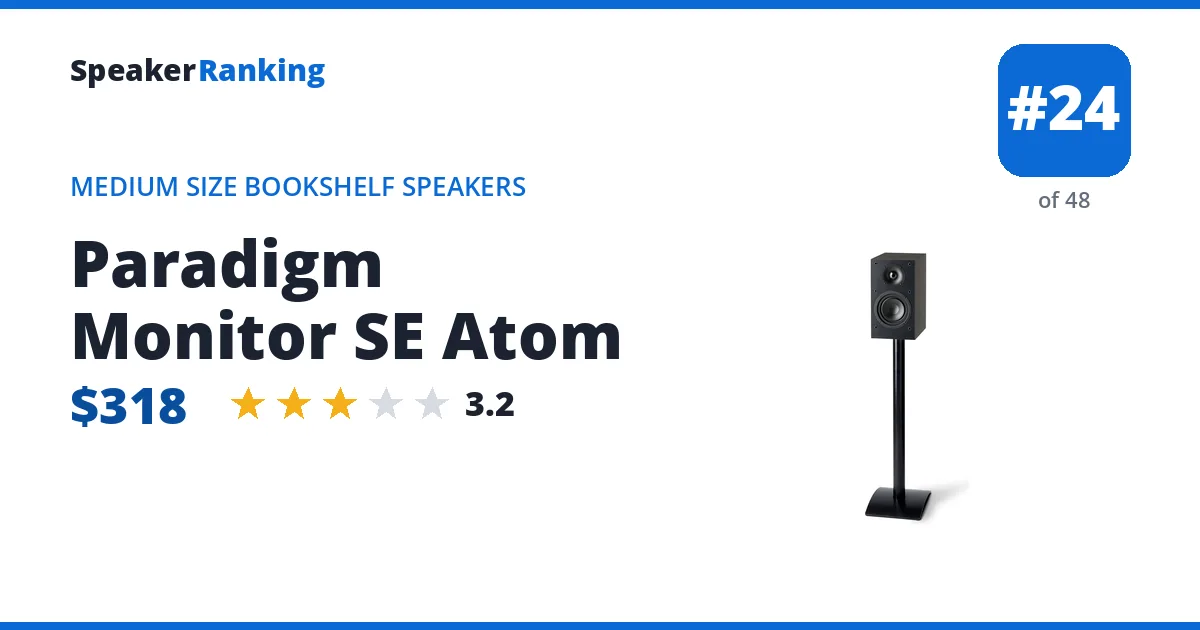
Pros: Good, consistent directivity across the on-axis, listening-window, and off-axis curves makes the Atom easier to equalize and less room-dependent than many budget speakers. Bass tuning is well judged, letting the woofer play loud on demanding tracks without bottoming out even without a subwoofer. Paradigm’s NRC research pedigree shows in the horizontal and vertical dispersion measurements.
Cons: On-axis response is uneven out of the box, with a 2-4kHz dip followed by a peak and a resonance around 15kHz that the reviewer said gives it a bright, “showroom” voicing without EQ correction. There’s no meaningful bass extension for full-range use, so a subwoofer is effectively required for anything beyond desktop or near-field listening.
Full Paradigm Monitor SE Atom review and specifications →
| Bass Extension (-10dB) | 62Hz (measured, Audio Science Review) |
|---|---|
| Bass Extension (-3dB) | 82Hz (measured, Audio Science Review) |
| Dimensions | 12.75H x 7.125W x 11D in |
| Drivers | 1" X-PAL aluminum dome tweeter (ferrofluid, PPA lens), 5.5" mineral-filled polypropylene mid/bass |
| Frequency Response | 61Hz - 21kHz +/-3dB (Manufacturer specified) |
| Impedance | 8 ohms |
| Power Handling | 15-100W recommended |
| Sensitivity | 85dB (2.83V/1m, measured, Audio Science Review) |
| Weight | 11.9 lbs / 5.4 kg each |
| Woofer Cabinet | ported, rear |
As an eBay Partner, we may be compensated if you make a purchase.
- Links
- Reviews, Comparisons and Sound Samples
- Head-to-Head Comparisons
- Paradigm Monitor SE Atom vs Sony SS-CS5 M2
- Paradigm Monitor SE Atom vs ELAC Debut 2.0 B5.2
- Paradigm Monitor SE Atom vs Dynaudio Emit M10
- Paradigm Monitor SE Atom vs JBL Studio 530
- Paradigm Monitor SE Atom vs ELAC BS U5
- Paradigm Monitor SE Atom vs Boston Acoustics A25
- Paradigm Monitor SE Atom vs Dynaudio X14
- Paradigm Monitor SE Atom vs Wharfedale Diamond 220
- See all 17 comparisons
 JBL Stage 2 250B: $349.95 Amazon
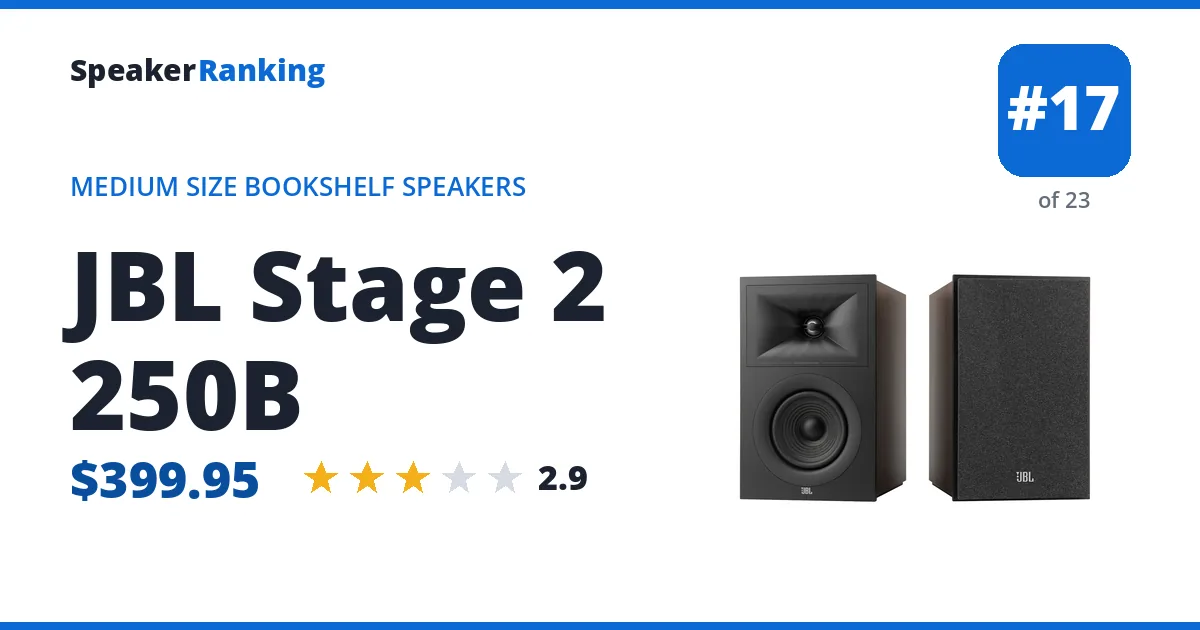
Pros: Consistent, EQ-able dips in the frequency response mean the tonal issues are at least correctable if you’re willing to use equalization. Horizontal dispersion is reasonably wide and controlled (~50-60 degrees). The tweeter itself holds up fine under compression testing - it’s the midwoofer that gives out first.
Cons: The reviewer was “even less enthusiastic” about this one than its disappointing floorstanding sibling. A confusing, hard-to-place tonal signature - a lower-midrange dip creates a recessed, lacking-attack character that’s then partly offset by a rebound around 2-4kHz, so it reads as recessed and forward at different times depending on the material. Treble falls off sharply above 6-7kHz, same issue as the larger 280F. Multitone distortion at 96dB is genuinely poor - well over 3%, reportedly around 10% at some frequencies. Limited bass extension (F3 64Hz, F10 50Hz) means a subwoofer is basically required if used as main speakers. Compression sets in early on the bass/midwoofer at higher output. The reviewer explicitly recommends the similarly-priced Polk Reserve R200/R100 instead for anyone who wants a more linear, EQ-free sound.
Full JBL Stage 2 250B review and specifications →
| Bass Extension (-10dB) | 50Hz (measured, Erin's Audio Corner) |
|---|---|
| Bass Extension (-3dB) | 64Hz (measured, Erin's Audio Corner) |
| Dimensions | 12.6"H x 7.9"W x 9.5"D (321.0 x 200.0 x 241.0 mm) |
| Drivers | 1" anodized aluminum dome tweeter with HDI waveguide, 5.25" polycellulose woofer |
| Impedance | 6 ohms nominal, 3.3 ohms minimum (measured, Erin's Audio Corner) |
| Output Power | 75W RMS |
| Sensitivity | 86dB (2.83V/1m, measured by Erin's Audio Corner) |
| Weight | 12.3 lbs / 5.6 kg (12.4 lb) per pair |
| Woofer Cabinet | ported, rear |
As an eBay Partner, we may be compensated if you make a purchase.
- Links
- Reviews, Comparisons and Sound Samples
- Head-to-Head Comparisons
- JBL Stage 2 250B vs ELAC BS U5
- JBL Stage 2 250B vs Dynaudio Emit M10
- JBL Stage 2 250B vs Dynaudio X14
- JBL Stage 2 250B vs Pioneer SP-BS22-LR (Philharmonic AAM Mod)
- JBL Stage 2 250B vs JBL L52 Classic
- JBL Stage 2 250B vs Sony SS-CS5 M2
- JBL Stage 2 250B vs ELAC Debut 2.0 B5.2
- JBL Stage 2 250B vs JBL Stage A120
- See all 18 comparisons