Short answer: the IK Multimedia iLoud MTM for nearfield accuracy, the Edifier R1280T for measured robustness. ASR’s Klippel-based measurements found the R1280T’s woofer took a demanding bass-heavy track without bottoming out, with distortion low and inaudible at 86dB SPL, but its on-axis response is jagged with 5kHz and 10kHz peaks. The iLoud MTM’s 100W-per-speaker MTM design and XLR input suit mixing, though its treble runs about 3dB hot.
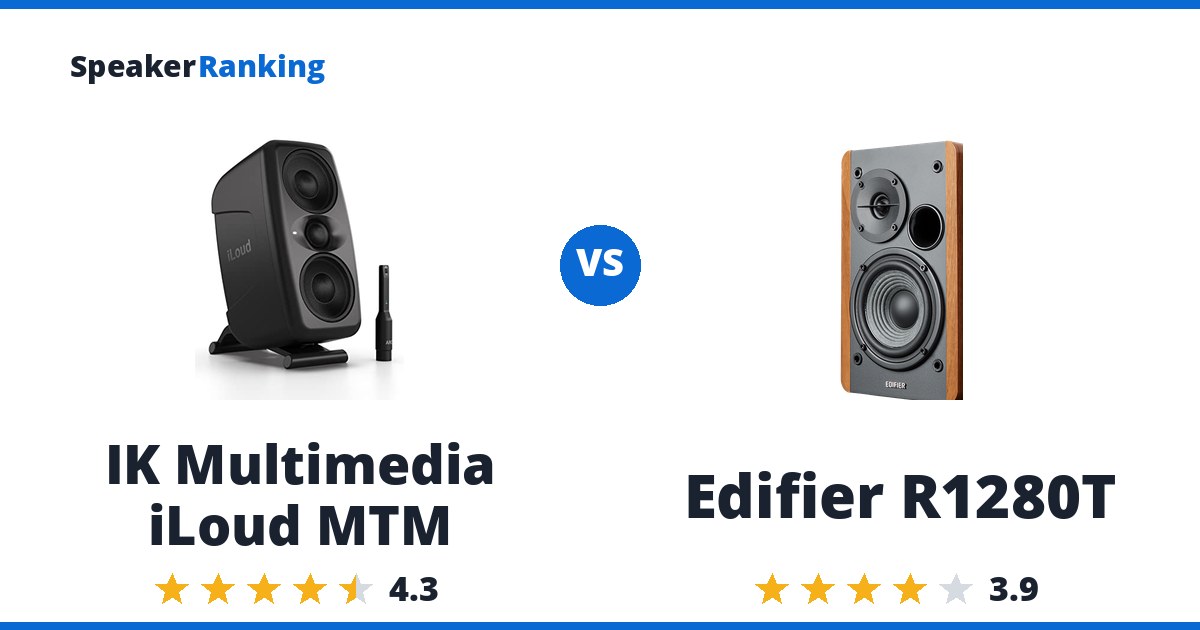
On the IK Multimedia iLoud MTM side: Compact MTM layout (two 3.5” midwoofers flanking a 1” tweeter) powered monitor with 100W per speaker and XLR input, well-suited to desktop/nearfield use with great linearity for mixing or mastering. Set against that: Native treble tuning runs hot (about 3dB boosted on-axis); the reviewer found the back-panel -3dB switch too aggressive and preferred roughly -1.5dB via external EQ instead.
What the Edifier R1280T gets right: ASR’s Klippel-based measurements found the woofer handled a demanding bass-heavy track without bottoming out or audible distortion, and distortion stayed low and inaudible at a normal 86dB SPL listening level. The catch: On-axis response is jagged rather than neutral, with a woofer resonance around 5kHz and a tweeter peak near 10kHz that also show up in the directivity data.
Buy the Edifier R1280T if you want one new; the IK Multimedia iLoud MTM is discontinued, so only look for it used.
Still deciding? The full Powered Home rankings cover every ranked option.
Specifications Side By Side
| IK Multimedia iLoud MTM | Edifier R1280T | |
|---|---|---|
| Price | $1,600 per pair Discontinued | $149.99 per pair |
| Ranked | #22 of 68 in Medium Size Powered Bookshelf Speakers | #62 of 68 in Medium Size Powered Bookshelf Speakers |
| Bass Extension (-3dB) | 50Hz (measured, Audio Science Review) | 63Hz (measured, Audio Science Review) |
| Bass Extension (-10dB) | 40Hz (measured, Audio Science Review) | 53.2Hz (derived, log-interpolated between spinorama.org -9dB/-12dB points) |
| Dimensions | 10.4”H x 5.1”W x 6.3”D (264.2 x 129.5 x 160 mm) | 9.2”H x 7.7”W x 5.7”D (234 x 196 x 146 mm) |
| Frequency Response | 50 Hz - 24 kHz (-3dB) (Manufacturer specified) | 52Hz - 20kHz (Manufacturer specified) |
| Inputs | XLR | 2x RCA Input |
| Weight | 5.5 lbs (2.5 kg) | 10.8 lbs (4.9 kg) |
| Drivers | 2x 3.5” (89mm) woofers | 4” (102mm) woofer |
| App | No | No |
| Bluetooth | No | No |
| EQ | Yes (Room adjustment) | No |
| Amplifier Power | 100w Per Speaker | 42w RMS Total |
| XLR Input | Yes | No |
| RCA Input | No | Yes |
| TRS Input | No | No |
| Optical Input | No | No |
| Coaxial Input | No | No |
| USB Input | No | No |
| HDMI Input | No | No |
| AES Input | No | No |
| Aux Input | No | No |
| Outputs | - | None |
| Spinorama Preference Score | - | 2.41 |
| Spinorama Preference Score with Perfect Sub | - | 5.02 |
Related Speaker Comparisons
How IK Multimedia iLoud MTM compares with other leading options:
- IK Multimedia iLoud MTM vs Genelec 8331A
- IK Multimedia iLoud MTM vs Neumann KH120 MKII
- IK Multimedia iLoud MTM vs Genelec 8030C
- IK Multimedia iLoud MTM vs Neumann KH80 DSP
- IK Multimedia iLoud MTM vs Dynaudio LYD 5
Prices on this page were last checked October 2, 2026 at 10:18 PM UTC. Product prices and availability are accurate as of that date/time and are subject to change; the price and availability shown on Amazon at the time of purchase will apply to the purchase of this product.
As an eBay Partner, we may be compensated if you make a purchase.
The Two Speakers In Full
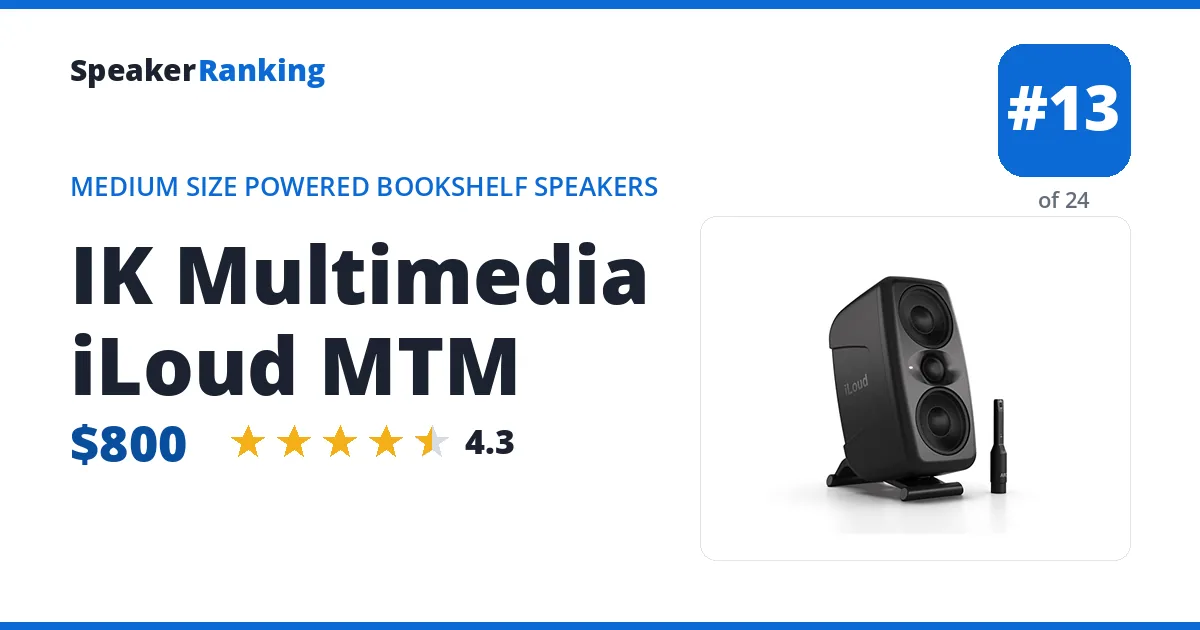
 IK Multimedia iLoud MTM: $1,600 per pair Discontinued Amazon eBay
Newer model: the IK Multimedia iLoud MTM MKII, ranked higher, rated 4.2/5.
Pros: ASR’s measurements of the original MTM give scores of 4.07 standalone and 6.26 with an ideal subwoofer, a 2.4dB midrange response span and a -3dB point around 53Hz. The small cabinet, balanced input and calibration capability make it useful for close listening where larger monitors would be impractical. Measured bass extension of 50Hz (-3dB).
Cons: The MTM arrangement makes listening height and orientation important, while bass below the low-50Hz region still needs support. The native response is not as smooth as the best compact reference monitors. Exact compression ceilings and correction examples from the MKII review should not be assigned to this original version; its score describes tonal response, not maximum clean volume. Treble runs about 3dB hot on-axis; the reviewer found the rear -3dB switch too aggressive and preferred about -1.5dB of external EQ. Discontinued.
Full IK Multimedia iLoud MTM review and specifications →
| AES Input | No |
|---|---|
| Amplifier Power | 100w Per Speaker |
| App | No |
| Aux Input | No |
| Bass Extension (-10dB) | 40Hz (measured, Audio Science Review) |
| Bass Extension (-3dB) | 50Hz (measured, Audio Science Review) |
| Bluetooth | No |
| Coaxial Input | No |
| Dimensions | 10.4”H x 5.1”W x 6.3”D (264.2 x 129.5 x 160 mm) |
| Drivers | 2x 3.5” (89mm) woofers |
| EQ | Yes (Room adjustment) |
| Frequency Response | 50 Hz - 24 kHz (-3dB) (Manufacturer specified) |
| HDMI Input | No |
| Inputs | XLR |
| Optical Input | No |
| RCA Input | No |
| TRS Input | No |
| USB Input | No |
| Weight | 5.5 lbs (2.5 kg) |
| XLR Input | Yes |
- Links
- Reviews, Comparisons and Sound Samples
- Audio Science Review Measurements More from Audio Science Review →
- DSAUDIO.review: IK Multimedia iLoud MTM vs Genelec 8020D Sound & Frequency Response Comparison More from DSAUDIOreview →
- DSAUDIOreview: IK Multimedia iLoud MTM vs iLoud Micro Sound & Frequency Response Comparison
- DSAUDIO.review: IK Multimedia iLoud MTM vs KRK Rokit 5 G4 Sound & Frequency Response Comparison
- DSAUDIO.review: IK Multimedia iLoud MTM vs Edifier S3000 Pro Sound & Frequency Response Comparison
- DSAUDIO.review: Neumann KH80 DSP vs IK Multimedia iLoud MTM Sound & Frequency Response Comparison
- DSAUDIO.review: Adam Audio A3X vs IK Multimedia iLoud MTM Sound & Frequency Response Comparison
- DSAUDIO.review: Yamaha HS8 vs IK Multimedia iLoud MTM Sound & Frequency Response Comparison
- Audio Science Review Measurements (spinorama.org)
- Head-to-Head Comparisons
- IK Multimedia iLoud MTM vs Kali Audio IN-5
- IK Multimedia iLoud MTM vs Kali Audio SM-5
- IK Multimedia iLoud MTM vs Pioneer DJ VM-50
- IK Multimedia iLoud MTM vs HEDD Type 05 A-CORE
- IK Multimedia iLoud MTM vs Airpulse A100
- IK Multimedia iLoud MTM vs IK Multimedia iLoud MTM MKII
- IK Multimedia iLoud MTM vs KEF LSX II LT
- IK Multimedia iLoud MTM vs Audioengine A5+ Classic
- See all 47 comparisons
 Edifier R1280T: $149.99 per pair Amazon eBay
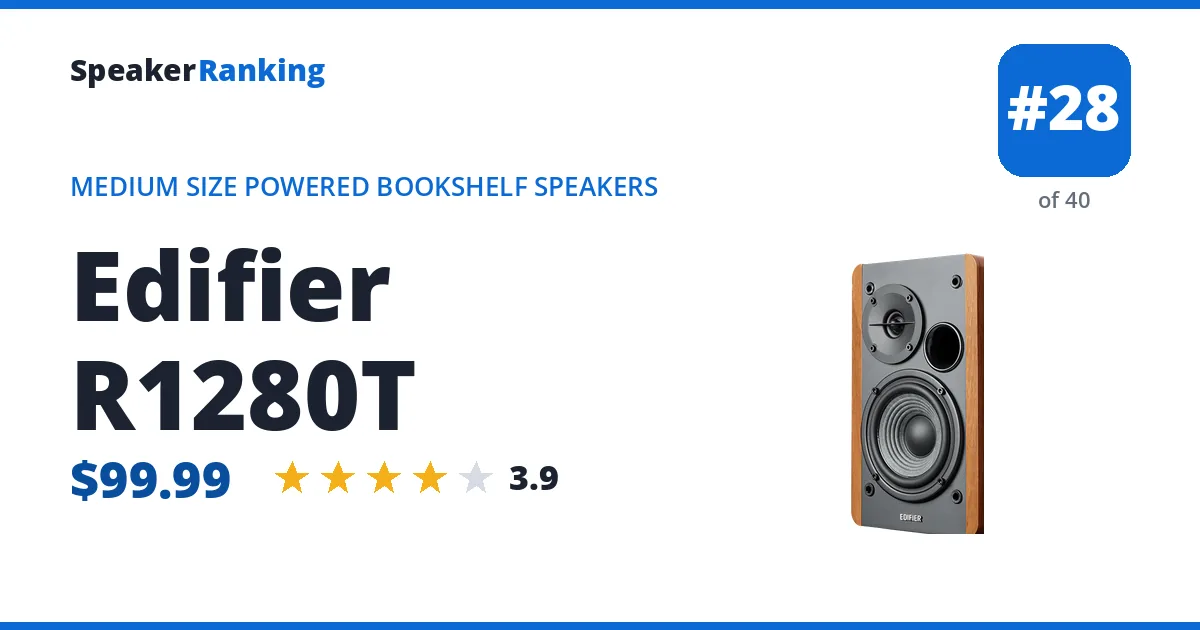
Pros: ASR’s review found useful moderate-level bass output from an inexpensive powered pair. Remote volume and bass/treble controls make it easy to use without separate amplification. Measured bass reaches -3dB around 63Hz. Measured bass extension of 63Hz (-3dB).
Cons: Preference scores of 2.41 standalone and 5.02 with an ideal subwoofer reflect substantial tonal limitations, not just missing bass. The response spans 5.5dB from 300Hz to 5kHz, and listening-window narrow-band deviation is 0.650. Resonances and treble unevenness affect reflected sound too. Listening height is important, and high-level compression changes the balance.
Full Edifier R1280T review and specifications →
| AES Input | No |
|---|---|
| Amplifier Power | 42w RMS Total |
| App | No |
| Aux Input | No |
| Bass Extension (-10dB) | 53.2Hz (derived, log-interpolated between spinorama.org -9dB/-12dB points) |
| Bass Extension (-3dB) | 63Hz (measured, Audio Science Review) |
| Bluetooth | No |
| Coaxial Input | No |
| Dimensions | 9.2”H x 7.7”W x 5.7”D (234 x 196 x 146 mm) |
| Drivers | 4” (102mm) woofer |
| EQ | No |
| Frequency Response | 52Hz - 20kHz (Manufacturer specified) |
| HDMI Input | No |
| Inputs | 2x RCA Input |
| Optical Input | No |
| Outputs | None |
| RCA Input | Yes |
| Spinorama Preference Score | 2.41 |
| Spinorama Preference Score with Perfect Sub | 5.02 |
| TRS Input | No |
| USB Input | No |
| Weight | 10.8 lbs (4.9 kg) |
| XLR Input | No |
- Links
- Reviews, Comparisons and Sound Samples
- Head-to-Head Comparisons
- Edifier R1280T vs Edifier R1280DB
- Edifier R1280T vs Midiplus MI5 II
- Edifier R1280T vs JBL One Series 104
- Edifier R1280T vs Edifier R1700BT
- Edifier R1280T vs Audioengine HD4
- Edifier R1280T vs Fluid Audio FX50 V2
- Edifier R1280T vs Kali Audio IN-UNF
- Edifier R1280T vs Edifier S1000MKII
- See all 60 comparisons