Short answer: the KEF LS50 Wireless II for off-axis consistency. Its Uni-Q array, a 130mm aluminum woofer with a 25mm MAT dome at its acoustic center, gives excellent, consistent off-axis dispersion and the tightest directivity spread here. The catch is the primary/secondary architecture: one speaker takes every input and the other needs a wireless or Ethernet link back to it, so placement is less flexible.
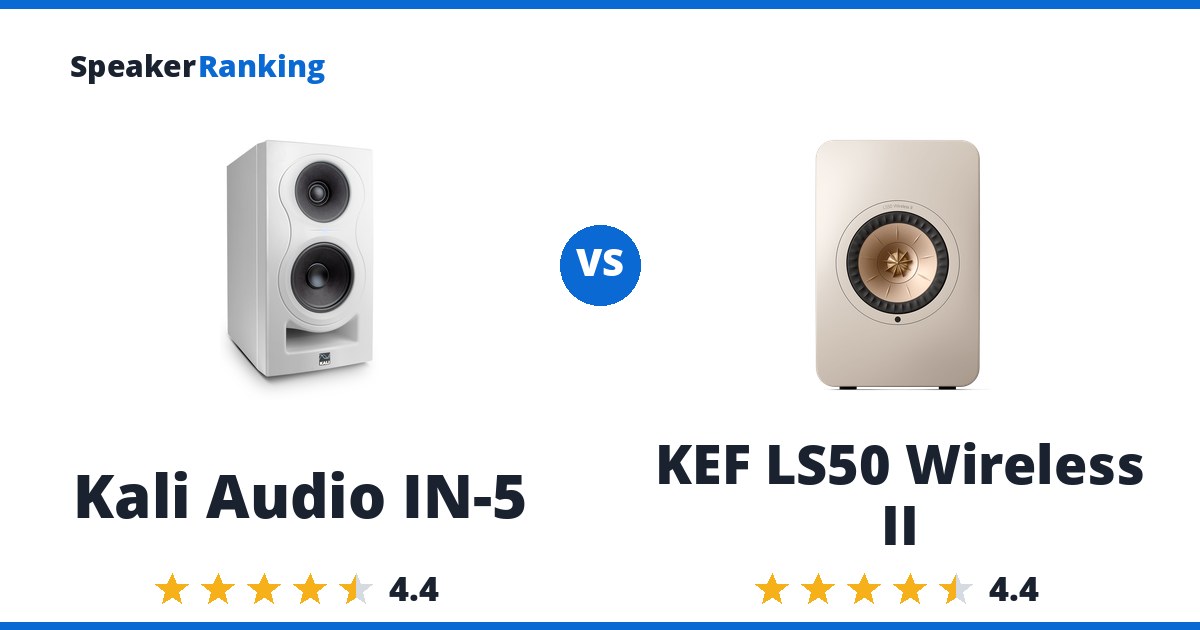
What the Kali Audio IN-5 gets right: Compact active three-way with a 4-inch coaxial midrange/tweeter above a dedicated 5-inch woofer, reducing intermodulation and maintaining strong horizontal/vertical pattern consistency. The tradeoff: At 96dB the midrange rises above 3% THD, largely second order, and the built-in limiter/compression shows the system is not designed for farfield theater levels.
Buy the Kali Audio IN-5 if the price is the priority over sound quality, or the KEF LS50 Wireless II if sound quality is the priority over the price.
Still deciding? The full Powered Home rankings cover every ranked option.
Specifications Side By Side
| Kali Audio IN-5 | KEF LS50 Wireless II | |
|---|---|---|
| Price | $698 per pair | $2,999.99 per pair |
| Ranked | #21 of 68 in Medium Size Powered Bookshelf Speakers | #14 of 68 in Medium Size Powered Bookshelf Speakers |
| Bass Extension (-3dB) | Approximately 45Hz (measured, Erin’s Audio Corner) | 51.3Hz (measured, spinorama.org) |
| Bass Extension (-10dB) | 40.0Hz (measured, Erin’s Audio Corner) | 41.5Hz (measured, spinorama.org) |
| Drivers | 1” tweeter coaxial with 4” midrange; 5” woofer | Uni-Q coincident array: 130mm aluminum woofer + 25mm MAT aluminum dome tweeter |
| Amplifier Power | 80W LF + 40W mid + 40W HF | 280W (LF) + 100W (HF) per speaker, bi-amped |
| Woofer Cabinet | ported, front | - |
| Spinorama Preference Score | 5.12 | 5.43 |
| Spinorama Preference Score with Perfect Sub | 7.13 | 7.51 |
| Inputs | XLR, TRS, RCA | HDMI eARC, optical, digital coaxial, 3.5mm analog, USB-A (service), Ethernet |
| XLR Input | Yes | No |
| RCA Input | Yes | No |
| TRS Input | Yes | No |
| Optical Input | No | Yes |
| Coaxial Input | No | Yes |
| USB Input | No | No |
| HDMI Input | No | Yes |
| AES Input | No | No |
| Aux Input | No | Yes |
| Bluetooth | No | Yes, 4.2 |
| Dimensions | 15” x 8.1” x 11.1” (382 x 206 x 282 mm) (H x W x D) | 12” x 7.9” x 12.2” (305 x 200 x 311 mm) each |
| Frequency Response | 39Hz - 25kHz (-10dB) (Manufacturer specified) | 45Hz - 28kHz ±3dB |
| Weight | 18.6 lbs (8.43 kg) each | 44.3 lbs (20.1 kg) for the pair |
| App | - | KEF Connect (placement EQ presets, source selection, firmware updates) |
| EQ | - | Yes, fixed placement presets (desk/bookshelf/wall-mount) - no automatic room correction |
| Maximum SPL | - | 108dB at 1m (manufacturer specified) |
| Subwoofer Output | - | Yes |
| Outputs | - | RCA subwoofer |
Related Speaker Comparisons
More top alternatives to KEF LS50 Wireless II:
- Genelec 8331A vs KEF LS50 Wireless II
- Neumann KH120 MKII vs KEF LS50 Wireless II
- Genelec 8030C vs KEF LS50 Wireless II
- Neumann KH80 DSP vs KEF LS50 Wireless II
- Dynaudio LYD 5 vs KEF LS50 Wireless II
Prices on this page were last checked October 3, 2026 at 10:26 PM UTC. Product prices and availability are accurate as of that date/time and are subject to change; the price and availability shown on Amazon at the time of purchase will apply to the purchase of this product.
As an eBay Partner, we may be compensated if you make a purchase.
The Two Speakers In Full
 Kali Audio IN-5: $698 per pair Amazon eBay
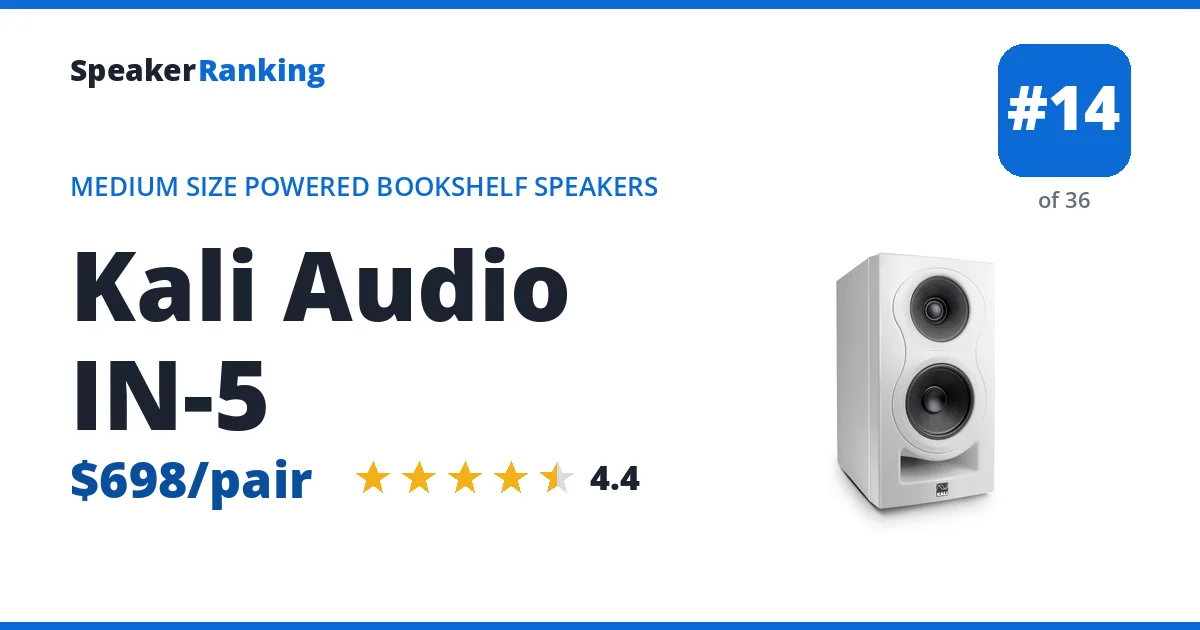
Pros: The active three-way layout separates bass duties from the coaxial mid/tweeter, giving flexible listening geometry. Erin’s data shows a 1.8dB midrange response span and -3dB bass around 45Hz, with scores of 5.12 standalone and 7.13 with an ideal subwoofer. Placement switches and balanced inputs help integrate it into a studio; moderate-level distortion is well controlled in the existing review. Measured bass extension of 45Hz (-3dB).
Cons: Local listening-window irregularities remain despite the small overall midrange span. The review reports midrange distortion rising above 3% at 96dB and a brighter perceived balance at closer distances. Limiting makes it unsuitable for demanding farfield playback. Coaxial construction improves geometry but does not remove response errors or guarantee unlimited output.
Full Kali Audio IN-5 review and specifications →
| AES Input | No |
|---|---|
| Amplifier Power | 80W LF + 40W mid + 40W HF |
| Aux Input | No |
| Bass Extension (-10dB) | 40.0Hz (measured, Erin’s Audio Corner) |
| Bass Extension (-3dB) | Approximately 45Hz (measured, Erin’s Audio Corner) |
| Bluetooth | No |
| Coaxial Input | No |
| Dimensions | 15” x 8.1” x 11.1” (382 x 206 x 282 mm) (H x W x D) |
| Drivers | 1” tweeter coaxial with 4” midrange; 5” woofer |
| Frequency Response | 39Hz - 25kHz (-10dB) (Manufacturer specified) |
| HDMI Input | No |
| Inputs | XLR, TRS, RCA |
| Optical Input | No |
| RCA Input | Yes |
| Spinorama Preference Score | 5.12 |
| Spinorama Preference Score with Perfect Sub | 7.13 |
| TRS Input | Yes |
| USB Input | No |
| Weight | 18.6 lbs (8.43 kg) each |
| Woofer Cabinet | ported, front |
| XLR Input | Yes |
- Links
- Reviews, Comparisons and Sound Samples
- Head-to-Head Comparisons
- Kali Audio IN-5 vs IK Multimedia iLoud MTM
- Kali Audio IN-5 vs Kali Audio SM-5
- Kali Audio IN-5 vs HEDD Type 05 A-CORE
- Kali Audio IN-5 vs Sigberg Audio SBS.1
- Kali Audio IN-5 vs Sigberg Audio SBS Gen 2
- Kali Audio IN-5 vs Mackie MR524
- Kali Audio IN-5 vs IK Multimedia iLoud MTM MKII
- Kali Audio IN-5 vs Pioneer DJ VM-50
- See all 61 comparisons
 KEF LS50 Wireless II: $2,999.99 per pair Amazon KEF Crutchfield eBay
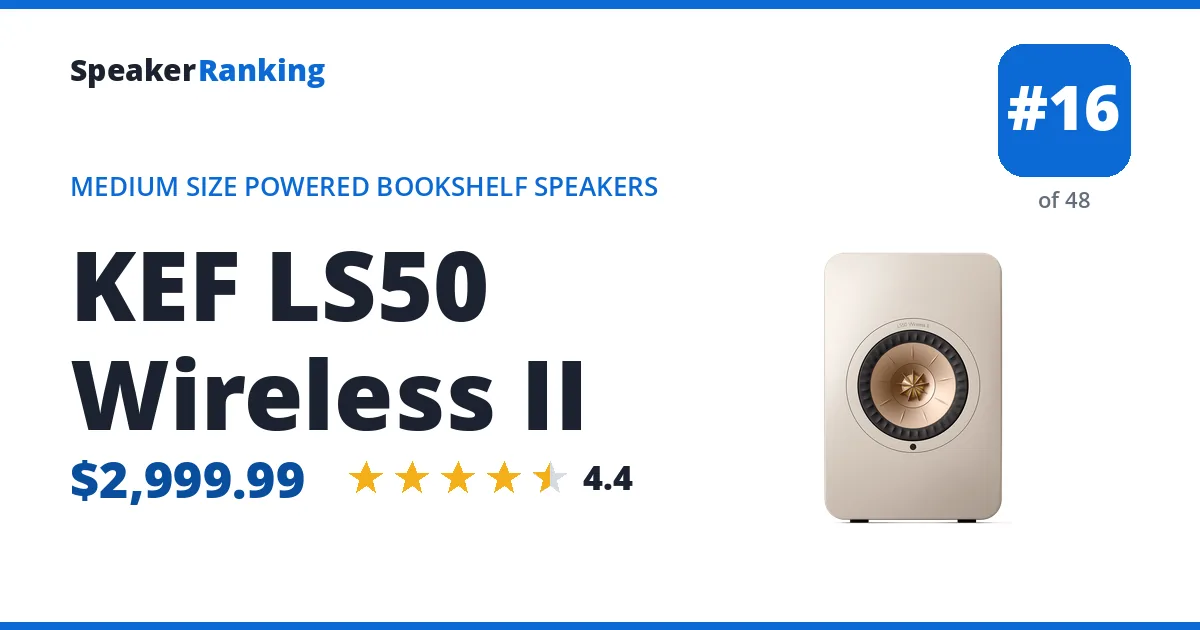
Pros: Erin’s measurements give preference scores of 5.43 standalone and 7.51 with an ideal subwoofer, with a -3dB point around 51Hz. The coincident Uni-Q layout helps preserve tonal consistency across horizontal and vertical listening positions. Low listening-window narrow-band deviation of 0.308 supports relatively clean midrange reproduction. HDMI eARC and streaming functions make it a capable all-in-one stereo system. Measured bass extension of 51.3Hz (-3dB).
Cons: The 3.0dB response span is good but not reference-leading, and dispersion still varies with frequency. Compact bass drivers limit deep-bass output. App placement adjustments are not the same as microphone-based automatic room correction. The price and primary/secondary architecture are practical trade-offs; neither driver geometry nor a single directivity statistic guarantees the best sound in every room.
Full KEF LS50 Wireless II review and specifications →
| AES Input | No |
|---|---|
| Amplifier Power | 280W (LF) + 100W (HF) per speaker, bi-amped |
| App | KEF Connect (placement EQ presets, source selection, firmware updates) |
| Aux Input | Yes |
| Bass Extension (-10dB) | 41.5Hz (measured, spinorama.org) |
| Bass Extension (-3dB) | 51.3Hz (measured, spinorama.org) |
| Bluetooth | Yes, 4.2 |
| Coaxial Input | Yes |
| Dimensions | 12” x 7.9” x 12.2” (305 x 200 x 311 mm) each |
| Drivers | Uni-Q coincident array: 130mm aluminum woofer + 25mm MAT aluminum dome tweeter |
| EQ | Yes, fixed placement presets (desk/bookshelf/wall-mount) - no automatic room correction |
| Frequency Response | 45Hz - 28kHz ±3dB |
| HDMI Input | Yes |
| Inputs | HDMI eARC, optical, digital coaxial, 3.5mm analog, USB-A (service), Ethernet |
| Maximum SPL | 108dB at 1m (manufacturer specified) |
| Optical Input | Yes |
| Outputs | RCA subwoofer |
| RCA Input | No |
| Spinorama Preference Score | 5.43 |
| Spinorama Preference Score with Perfect Sub | 7.51 |
| Subwoofer Output | Yes |
| TRS Input | No |
| USB Input | No |
| Weight | 44.3 lbs (20.1 kg) for the pair |
| XLR Input | No |
- Links
- Reviews, Comparisons and Sound Samples
- Head-to-Head Comparisons
- KEF LS50 Wireless II vs JBL 305P MKII
- KEF LS50 Wireless II vs Vanatoo Transparent One Encore Plus
- KEF LS50 Wireless II vs Klipsch The Fives
- KEF LS50 Wireless II vs IK Multimedia iLoud MTM MKII
- KEF LS50 Wireless II vs Genelec 8020D
- KEF LS50 Wireless II vs Devialet Phantom II 98 dB
- KEF LS50 Wireless II vs Genelec 8320A
- KEF LS50 Wireless II vs Kali Audio SM-5
- See all 45 comparisons