Short answer: the Airpulse A100. It ranks #26 of 68 powered bookshelf speakers by sound quality, rated 4.0/5, at $999.99; the JBL 705P ranks #32, rated 3.9/5, and costs $1,998, so there is little reason to consider the other one.
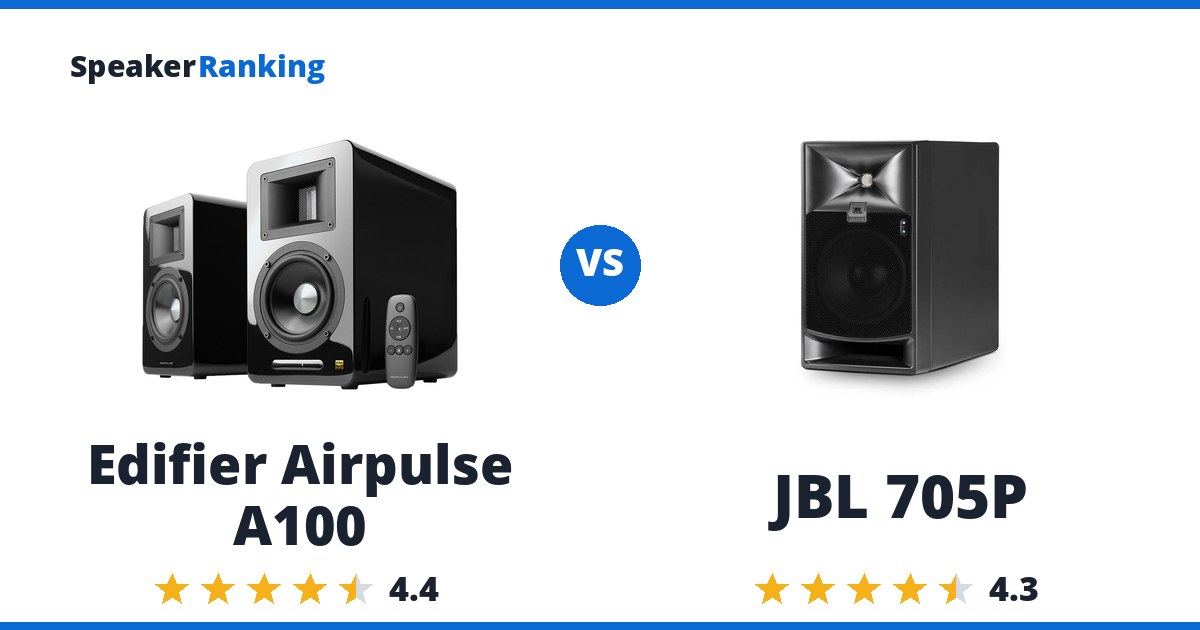
On the Edifier Airpulse A100 side: Horn-loaded ribbon tweeter (inherited from Airpulse’s flagship 7001 monitor, designed by Phil Jones) paired with a 5” hard-anodized aluminum cone woofer - a distinctive, low-mass driver combination rarely seen below $999.99. The catch: On-axis deviation trails the pricier options in this group, and there’s no app-based EQ or DSP - bass/treble trim is limited to physical rear-panel knobs not reachable from the remote.
The case for the JBL 705P: CEA2034 spinorama shows flat response with excellent directivity, similar to its larger 708P sibling. Set against that: A cancellation around 750Hz (likely port-related) and a bit of boosted response at the 1.75kHz crossover show up in the on-axis curve.
Buy the Airpulse A100. It is rated higher for sound quality than the JBL 705P and costs less, so it is the default pick unless a specific strength of the other one matters more to you.
Want more options? Browse the full Powered Home rankings.
Specifications Side By Side
| Airpulse A100 | JBL 705P | |
|---|---|---|
| Price | $999.99 per pair | $1998 per pair |
| Ranked | #26 of 68 in Medium Size Powered Bookshelf Speakers | #32 of 68 in Medium Size Powered Bookshelf Speakers |
| Bass Extension (-10dB) | 53.2Hz (measured, spinorama.org) | 38.9Hz (derived, log-interpolated between spinorama.org -9dB/-12dB points) |
| Bass Extension (-3dB) | 63.0Hz (measured, spinorama.org) | 47.6Hz (measured, Audio Science Review) |
| Inputs | RCA (aux), USB, optical, coaxial, Bluetooth aptX | XLR/TRS combo (analog), XLR AES3 (digital) |
| Drivers | Horn-loaded ribbon tweeter, 5” hard-anodized aluminum cone woofer | 5” woofer, 2409H 1” compression driver |
| App | None (physical bass/treble knobs, IR remote) | No |
| Bluetooth | Yes (SBC, aptX) | No |
| Bluetooth Codecs | SBC, aptX | - |
| EQ | Yes, rear-panel bass/treble trim knobs | No |
| Weight | 24.3 lbs (11 kg) each | 12.6 lbs (5.7 kg) each |
| Amplifier Power | 100W total (40W+40W woofer, 10W+10W tweeter) | 500W total (250W woofer, 250W tweeter) |
| Dimensions | 6.3” x 11.1” x 10” (160 x 283 x 255 mm) each | 10.6”H x 5.9”W x 10.8”D (268 x 151 x 274 mm) |
| Frequency Response | 52Hz - 40kHz | 39Hz - 36kHz (Manufacturer specified) |
| Spinorama Preference Score | 4.56 | 4.70 |
| Spinorama Preference Score with Perfect Sub | 7.08 | 6.71 |
| XLR Input | No | Yes |
| RCA Input | Yes | No |
| TRS Input | No | Yes |
| Optical Input | Yes | No |
| Coaxial Input | Yes | No |
| USB Input | Yes | No |
| HDMI Input | No | No |
| AES Input | No | Yes |
| Aux Input | Yes | No |
| DSP | - | No |
Related Speaker Comparisons
More worthwhile head-to-heads for Airpulse A100:
- Airpulse A100 vs Genelec 8331A
- Neumann KH120 MKII vs Airpulse A100
- Genelec 8030C vs Airpulse A100
- Neumann KH80 DSP vs Airpulse A100
- Dynaudio LYD 5 vs Airpulse A100
Prices on this page were last checked October 3, 2026 at 10:26 PM UTC. Product prices and availability are accurate as of that date/time and are subject to change; the price and availability shown on Amazon at the time of purchase will apply to the purchase of this product.
As an eBay Partner, we may be compensated if you make a purchase.
The Two Speakers In Full
 Airpulse A100: $999.99 per pair Amazon B&H Photo Video eBay
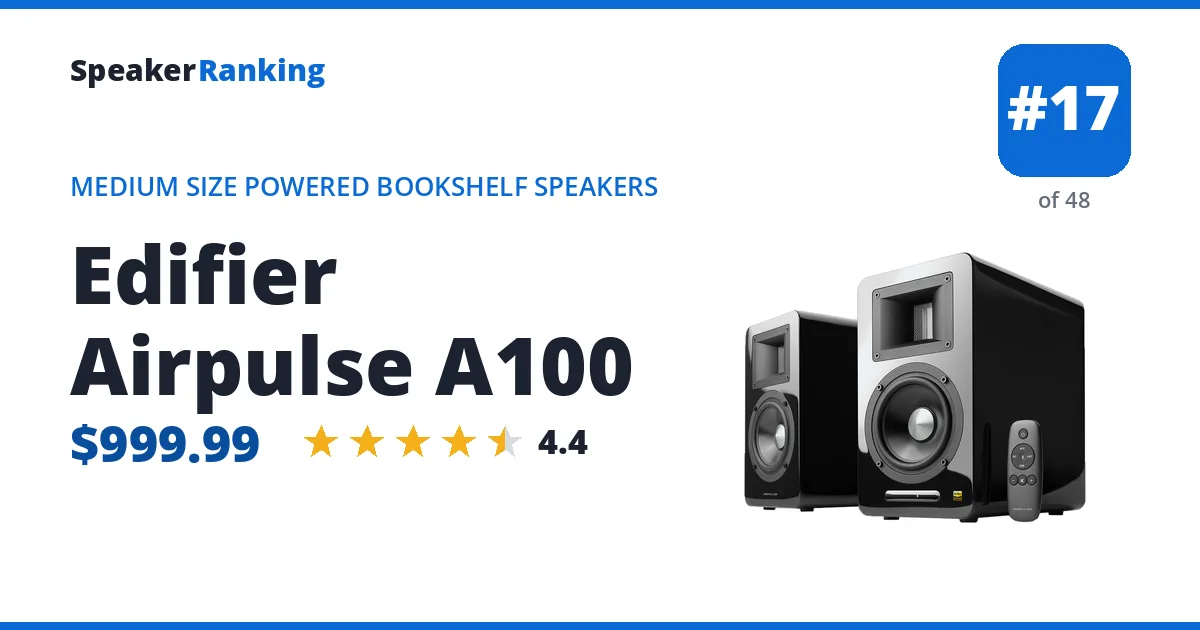
Pros: ASR’s Klippel data gives a 2.9dB midrange span and scores of 4.56 standalone and 7.08 with an ideal subwoofer. The ribbon tweeter and five-inch woofer provide a distinctive compact powered system, with remote control and a subwoofer output simplifying everyday use. Measured bass extension of 63.0Hz (-3dB).
Cons: Bass reaches -3dB around 63Hz, so lower notes need a subwoofer for full weight. Listening-window narrow-band deviation of 0.419 shows more local tonal variation than the leading monitors. Rear tone controls are less flexible than parametric EQ or room correction. Neither the ribbon tweeter nor a directivity-index summary establishes uniquely wide or perfectly controlled dispersion. The remote cannot reach the rear bass and treble knobs, and there is no app EQ.
Full Airpulse A100 review and specifications →
| AES Input | No |
|---|---|
| Amplifier Power | 100W total (40W+40W woofer, 10W+10W tweeter) |
| App | None (physical bass/treble knobs, IR remote) |
| Aux Input | Yes |
| Bass Extension (-10dB) | 53.2Hz (measured, spinorama.org) |
| Bass Extension (-3dB) | 63.0Hz (measured, spinorama.org) |
| Bluetooth | Yes (SBC, aptX) |
| Bluetooth Codecs | SBC, aptX |
| Coaxial Input | Yes |
| Dimensions | 6.3” x 11.1” x 10” (160 x 283 x 255 mm) each |
| Drivers | Horn-loaded ribbon tweeter, 5” hard-anodized aluminum cone woofer |
| EQ | Yes, rear-panel bass/treble trim knobs |
| Frequency Response | 52Hz - 40kHz |
| HDMI Input | No |
| Inputs | RCA (aux), USB, optical, coaxial, Bluetooth aptX |
| Optical Input | Yes |
| RCA Input | Yes |
| Spinorama Preference Score | 4.56 |
| Spinorama Preference Score with Perfect Sub | 7.08 |
| TRS Input | No |
| USB Input | Yes |
| Weight | 24.3 lbs (11 kg) each |
| XLR Input | No |
- Links
- Reviews, Comparisons and Sound Samples
- Head-to-Head Comparisons
 JBL 705P: $1998 per pair B&H Photo Video eBay
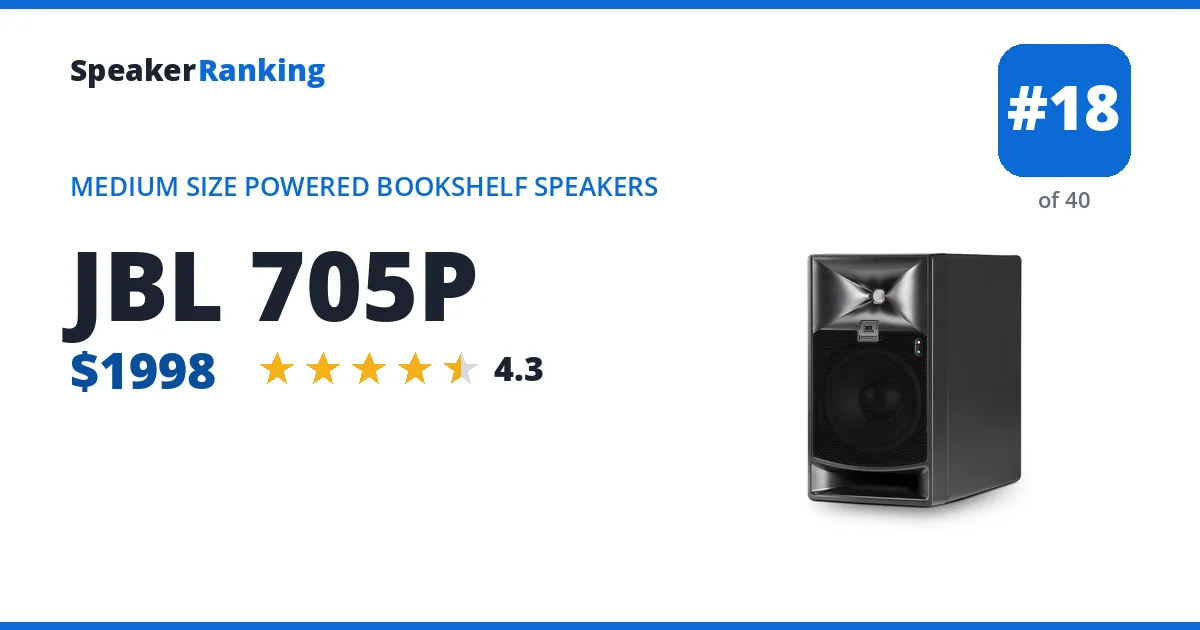
Pros: ASR’s data gives bass reaching -3dB around 48Hz and a 6.71 ideal-subwoofer preference score. Its waveguided compression driver and dedicated amplification are suited to studio use, and the broad response trend is close to level. It has useful low-frequency reach for a five-inch monitor. Measured bass extension of 47.6Hz (-3dB).
Cons: The standalone score is 4.70, and a localized cancellation near 750Hz contributes to the large 7.8dB midrange response span. A crossover-region rise also prevents reference-flat reproduction. An average flat trend does not erase these features, and amplifier wattage is not a measured clean-SPL rating. The data does not support calling it uniformly flat simply because it shares technology with larger JBL models.
Full JBL 705P review and specifications →
| AES Input | Yes |
|---|---|
| Amplifier Power | 500W total (250W woofer, 250W tweeter) |
| App | No |
| Aux Input | No |
| Bass Extension (-10dB) | 38.9Hz (derived, log-interpolated between spinorama.org -9dB/-12dB points) |
| Bass Extension (-3dB) | 47.6Hz (measured, Audio Science Review) |
| Bluetooth | No |
| Coaxial Input | No |
| DSP | No |
| Dimensions | 10.6”H x 5.9”W x 10.8”D (268 x 151 x 274 mm) |
| Drivers | 5” woofer, 2409H 1” compression driver |
| EQ | No |
| Frequency Response | 39Hz - 36kHz (Manufacturer specified) |
| HDMI Input | No |
| Inputs | XLR/TRS combo (analog), XLR AES3 (digital) |
| Optical Input | No |
| RCA Input | No |
| Spinorama Preference Score | 4.70 |
| Spinorama Preference Score with Perfect Sub | 6.71 |
| TRS Input | Yes |
| USB Input | No |
| Weight | 12.6 lbs (5.7 kg) each |
| XLR Input | Yes |
- Links
- Reviews, Comparisons and Sound Samples
- Head-to-Head Comparisons