Short answer: the JBL 705P for measured directivity, the IK Multimedia iLoud MTM MKII for room correction. The 705P’s CEA2034 spinorama shows flat response with excellent directivity like its larger 708P sibling, though its on-axis curve has a cancellation around 750Hz and boosted response at the 1.75kHz crossover. The MTM MKII brings a 100W-per-speaker MTM layout and an ARC room-correction mic, but its treble runs about 3dB hot on-axis.
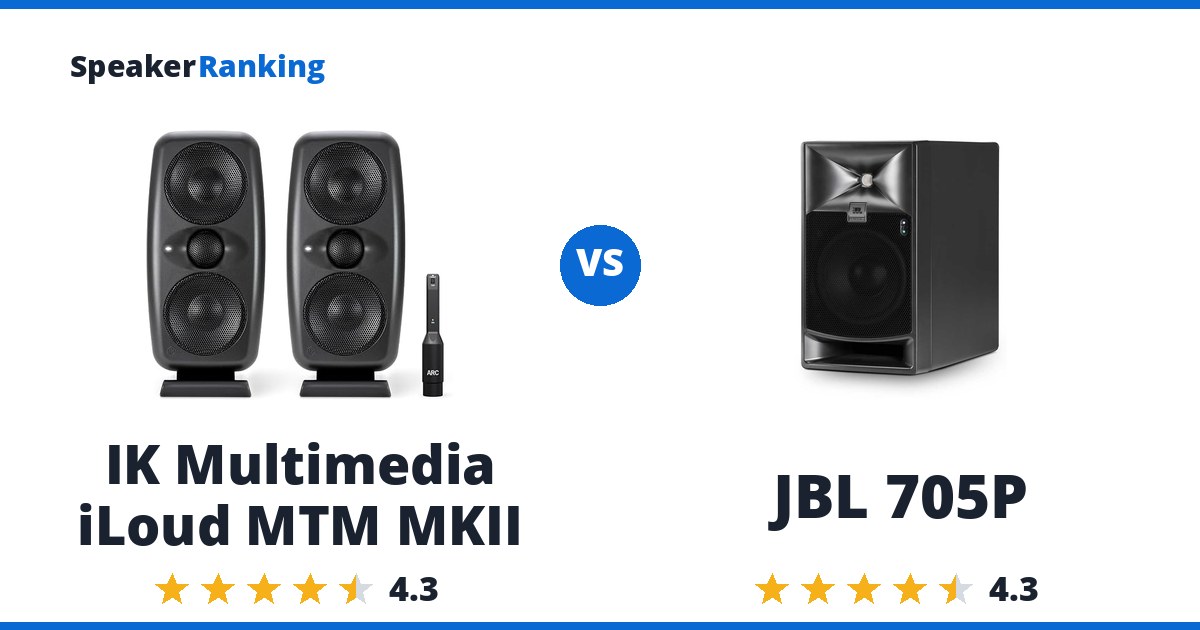
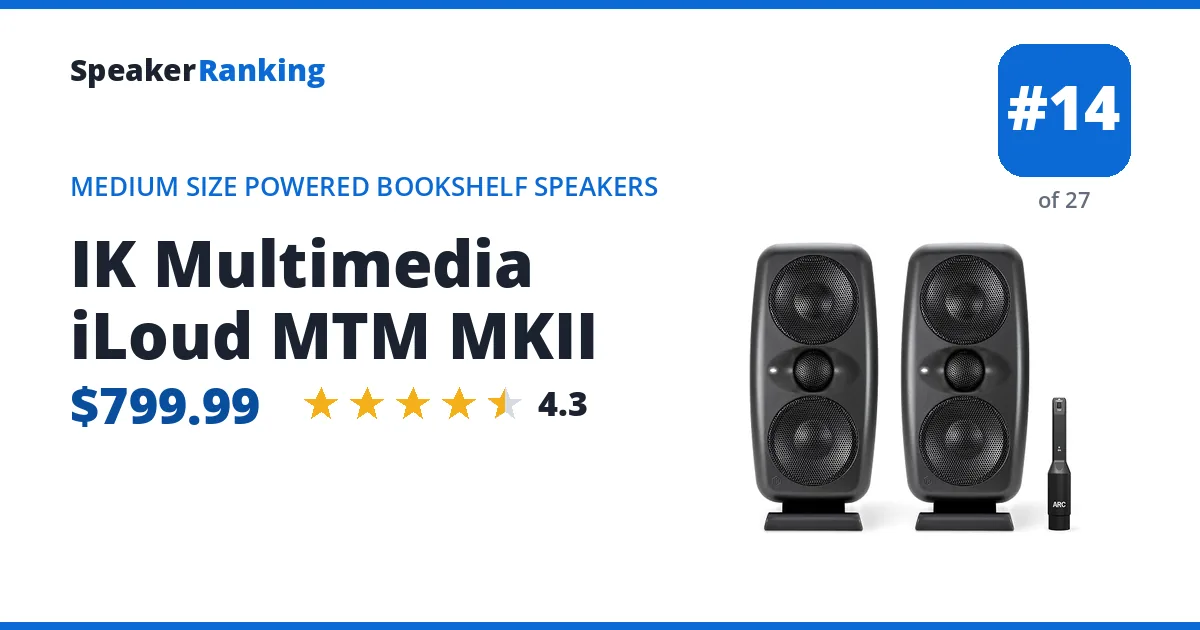
The case for the IK Multimedia iLoud MTM MKII: Compact MTM layout (two 3.5” midwoofers flanking a 1” tweeter) powered monitor rated at 100W per speaker with XLR input, sold as a pair with an ARC room-correction microphone included. The tradeoff: Native treble tuning still runs about 3dB hot on-axis; the back-panel -3dB treble switch overcorrects, and roughly -1.5dB via external EQ works better.
Buy the IK Multimedia iLoud MTM MKII. It is rated higher for sound quality than the JBL 705P and costs less, so only choose the other one for a particular feature it does better.
Still deciding? The full Powered Home rankings cover every ranked option.
Specifications Side By Side
| IK Multimedia iLoud MTM MKII | JBL 705P | |
|---|---|---|
| Price | $799.99 per pair | $1998 per pair |
| Ranked | #17 of 68 in Medium Size Powered Bookshelf Speakers | #32 of 68 in Medium Size Powered Bookshelf Speakers |
| Dimensions | 10.4”H x 5.1”W x 6.3”D (264.2 x 129.5 x 160 mm) | 10.6”H x 5.9”W x 10.8”D (268 x 151 x 274 mm) |
| Frequency Response | 48 Hz - 28 kHz (±2dB) (Manufacturer specified) | 39Hz - 36kHz (Manufacturer specified) |
| Bass Extension (-3dB) | 52.7Hz (measured, Erin’s Audio Corner) | 47.6Hz (measured, Audio Science Review) |
| Bass Extension (-10dB) | 46.3Hz (measured, Erin’s Audio Corner) | 38.9Hz (derived, log-interpolated between spinorama.org -9dB/-12dB points) |
| Inputs | XLR | XLR/TRS combo (analog), XLR AES3 (digital) |
| Drivers | 2x 3.5” (89mm) woofers, 1” silk dome tweeter | 5” woofer, 2409H 1” compression driver |
| App | Yes (X-MONITOR speaker emulation) | No |
| Bluetooth | No | No |
| EQ | Yes (Room adjustment) | No |
| Amplifier Power | 100w Per Speaker | 500W total (250W woofer, 250W tweeter) |
| Weight | 5.5 lbs (2.5 kg) each | 12.6 lbs (5.7 kg) each |
| Maximum SPL | 112.5dB peak (manufacturer specified) | - |
| Spinorama Preference Score | 5.22 | 4.70 |
| Spinorama Preference Score with Perfect Sub | 7.44 | 6.71 |
| XLR Input | Yes | Yes |
| RCA Input | No | No |
| TRS Input | No | Yes |
| Optical Input | No | No |
| Coaxial Input | No | No |
| USB Input | No | No |
| HDMI Input | No | No |
| AES Input | No | Yes |
| Aux Input | No | No |
| DSP | - | No |
Related Speaker Comparisons
More top alternatives to IK Multimedia iLoud MTM MKII:
- IK Multimedia iLoud MTM MKII vs Genelec 8331A
- IK Multimedia iLoud MTM MKII vs Neumann KH120 MKII
- IK Multimedia iLoud MTM MKII vs Genelec 8030C
- Neumann KH80 DSP vs IK Multimedia iLoud MTM MKII
- IK Multimedia iLoud MTM MKII vs Reflector Audio Square Two
Prices on this page were last checked October 2, 2026 at 10:18 PM UTC. Product prices and availability are accurate as of that date/time and are subject to change; the price and availability shown on Amazon at the time of purchase will apply to the purchase of this product.
As an eBay Partner, we may be compensated if you make a purchase.
The Two Speakers In Full
 IK Multimedia iLoud MTM MKII: $799.99 per pair Amazon eBay
Older model: the IK Multimedia iLoud MTM (ranked lower, rated 4.1/5).
Pros: Erin’s MKII measurements give a 2.2dB midrange span, a -3dB point around 53Hz, and preference scores of 5.22 standalone and 7.44 with an ideal subwoofer. The compact layout and included calibration microphone suit a close desktop setup. Existing tests show useful room-peak correction and good harmonic-distortion behavior at moderate levels. Measured bass extension of 52.7Hz (-3dB).
Cons: Some excess treble remains in the native tuning. The two-woofer MTM arrangement narrows the vertical listening window, so ear height and orientation matter. Multitone distortion rises strongly when pushed toward 96dB/1m; the review favors moderate listening levels, and a subwoofer does not eliminate all midrange output limits. These are MKII results, not measurements of the original MTM. Treble runs about 3dB hot on-axis; the rear -3dB treble switch overcorrects, and about -1.5dB of external EQ works better.
Full IK Multimedia iLoud MTM MKII review and specifications →
| AES Input | No |
|---|---|
| Amplifier Power | 100w Per Speaker |
| App | Yes (X-MONITOR speaker emulation) |
| Aux Input | No |
| Bass Extension (-10dB) | 46.3Hz (measured, Erin’s Audio Corner) |
| Bass Extension (-3dB) | 52.7Hz (measured, Erin’s Audio Corner) |
| Bluetooth | No |
| Coaxial Input | No |
| Dimensions | 10.4”H x 5.1”W x 6.3”D (264.2 x 129.5 x 160 mm) |
| Drivers | 2x 3.5” (89mm) woofers, 1” silk dome tweeter |
| EQ | Yes (Room adjustment) |
| Frequency Response | 48 Hz - 28 kHz (±2dB) (Manufacturer specified) |
| HDMI Input | No |
| Inputs | XLR |
| Maximum SPL | 112.5dB peak (manufacturer specified) |
| Optical Input | No |
| RCA Input | No |
| Spinorama Preference Score | 5.22 |
| Spinorama Preference Score with Perfect Sub | 7.44 |
| TRS Input | No |
| USB Input | No |
| Weight | 5.5 lbs (2.5 kg) each |
| XLR Input | Yes |
- Links
- Reviews, Comparisons and Sound Samples
- Head-to-Head Comparisons
- IK Multimedia iLoud MTM MKII vs Sigberg Audio SBS Gen 2
- IK Multimedia iLoud MTM MKII vs Vanatoo Transparent One Encore Plus
- IK Multimedia iLoud MTM MKII vs HEDD Type 05 A-CORE
- IK Multimedia iLoud MTM MKII vs Kali Audio SM-5
- IK Multimedia iLoud MTM MKII vs KEF LS50 Wireless II
- IK Multimedia iLoud MTM MKII vs Kali Audio IN-5
- IK Multimedia iLoud MTM MKII vs JBL 305P MKII
- IK Multimedia iLoud MTM MKII vs Klipsch The Fives
- See all 62 comparisons
 JBL 705P: $1998 per pair B&H Photo Video eBay
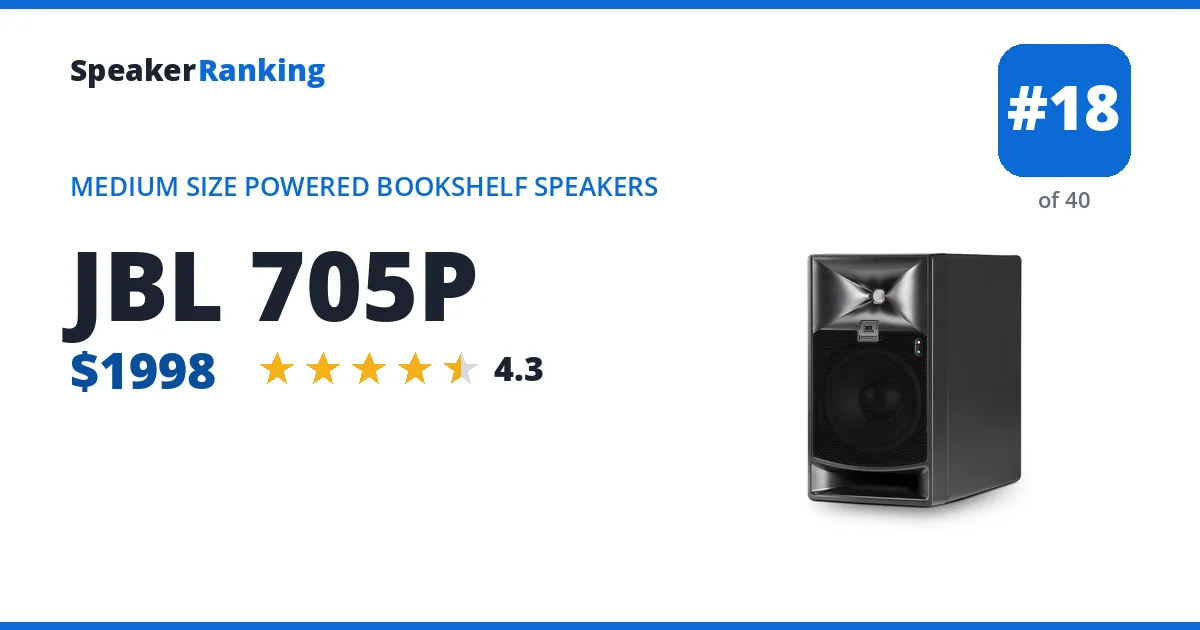
Pros: ASR’s data gives bass reaching -3dB around 48Hz and a 6.71 ideal-subwoofer preference score. Its waveguided compression driver and dedicated amplification are suited to studio use, and the broad response trend is close to level. It has useful low-frequency reach for a five-inch monitor. Measured bass extension of 47.6Hz (-3dB).
Cons: The standalone score is 4.70, and a localized cancellation near 750Hz contributes to the large 7.8dB midrange response span. A crossover-region rise also prevents reference-flat reproduction. An average flat trend does not erase these features, and amplifier wattage is not a measured clean-SPL rating. The data does not support calling it uniformly flat simply because it shares technology with larger JBL models.
Full JBL 705P review and specifications →
| AES Input | Yes |
|---|---|
| Amplifier Power | 500W total (250W woofer, 250W tweeter) |
| App | No |
| Aux Input | No |
| Bass Extension (-10dB) | 38.9Hz (derived, log-interpolated between spinorama.org -9dB/-12dB points) |
| Bass Extension (-3dB) | 47.6Hz (measured, Audio Science Review) |
| Bluetooth | No |
| Coaxial Input | No |
| DSP | No |
| Dimensions | 10.6”H x 5.9”W x 10.8”D (268 x 151 x 274 mm) |
| Drivers | 5” woofer, 2409H 1” compression driver |
| EQ | No |
| Frequency Response | 39Hz - 36kHz (Manufacturer specified) |
| HDMI Input | No |
| Inputs | XLR/TRS combo (analog), XLR AES3 (digital) |
| Optical Input | No |
| RCA Input | No |
| Spinorama Preference Score | 4.70 |
| Spinorama Preference Score with Perfect Sub | 6.71 |
| TRS Input | Yes |
| USB Input | No |
| Weight | 12.6 lbs (5.7 kg) each |
| XLR Input | Yes |
- Links
- Reviews, Comparisons and Sound Samples
- Head-to-Head Comparisons