Short answer: the JBL Studio 530 over the KEF Q100. The Q100’s 5.25” Uni-Q coaxial driver keeps the tweeter and woofer point-source aligned and its 86dB sensitivity is easy to drive, but its spinorama shows broad deviations: a lift from 700Hz-1.5kHz and again from 5kHz up, plus a cancellation notch around 1.4kHz. The Studio 530 ranks #49 of 101 against the Q100’s #79 of 101, though it has a 1.4kHz tweeter resonance.
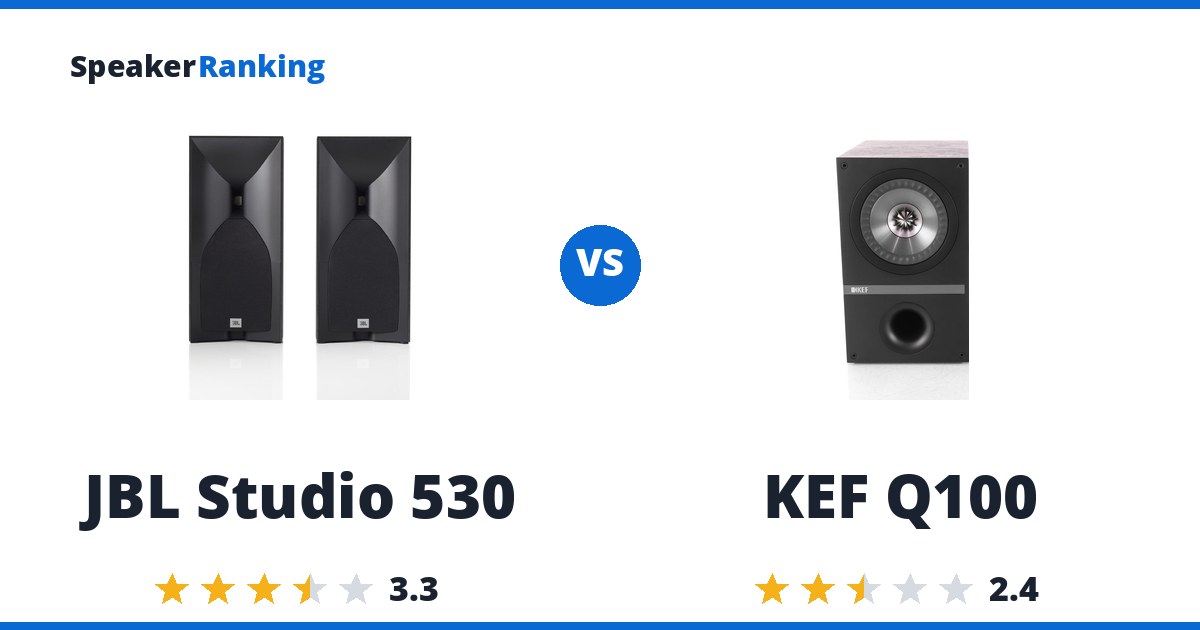
Buy the JBL Studio 530 only if you find one used in good condition; both are discontinued, and it is the better rated of the two. For a new speaker, start with the Ascend Acoustics HTM-200SE2 instead.
Want more options? Browse the full Passive Home rankings.
Specifications Side By Side
| JBL Studio 530 | KEF Q100 | |
|---|---|---|
| Price | $399 per pair Discontinued | $550 per pair Discontinued |
| Ranked | #49 of 101 in Medium Size Bookshelf Speakers | #79 of 101 in Medium Size Bookshelf Speakers |
| Bass Extension (-3dB) | 73.2Hz (measured, Audio Science Review) | 85Hz (measured, Audio Science Review) |
| Bass Extension (-10dB) | 40Hz (derived, log-interpolated between spinorama.org -9dB/-12dB points) | 65Hz (measured, Audio Science Review) |
| Crossover Frequency | 1.5kHz | - |
| Dimensions | 18.4”H x 8.4”W x 8.7”D (467 x 214 x 222 mm) | 11.8”H x 7.1”W x 10.7”D (300 x 180 x 272 mm) |
| Impedance | 6 ohms nominal (4 ohms minimum, measured by Audio Science Review) | 8 ohms nominal |
| Sensitivity | ~85dB (measured by Audio Science Review) | 85dB (2.83V/1m, measured, Audio Science Review) |
| Drivers | 5.25” (130mm) PolyPlas™ cone woofer with SFG magnet, 1” (25mm) compression driver with Teonex® diaphragm on Bi-Radial® horn | 5.25” Uni-Q aluminum coaxial driver, 1” aluminum dome tweeter |
| Weight | 17 lbs (7.7 kg) each | 13 lbs (5.9 kg) each |
| Woofer Cabinet | ported | ported, rear |
| Spinorama Preference Score | 5.21 (spinorama.org) | 4.96 (spinorama.org) |
| Spinorama Preference Score with Perfect Sub | 7.29 (spinorama.org) | 7.24 (spinorama.org) |
| DIY Kit | No | No |
| Frequency Response | - | 49Hz - 40kHz (+/-3dB) (Manufacturer specified) |
Related Speaker Comparisons
How JBL Studio 530 compares with other leading options:
- JBL Studio 530 vs Ascend Sierra 1 v2
- KEF LS50 Meta vs JBL Studio 530
- JBL Studio 530 vs Arendal 1961 Monitor
- JBL Studio 530 vs Moondrop M4P MTM
- Revel M105 vs JBL Studio 530
Prices on this page were last checked October 3, 2026 at 10:26 PM UTC. Product prices and availability are accurate as of that date/time and are subject to change; the price and availability shown on Amazon at the time of purchase will apply to the purchase of this product.
As an eBay Partner, we may be compensated if you make a purchase.
The Two Speakers In Full
 JBL Studio 530: $399 per pair Discontinued eBay
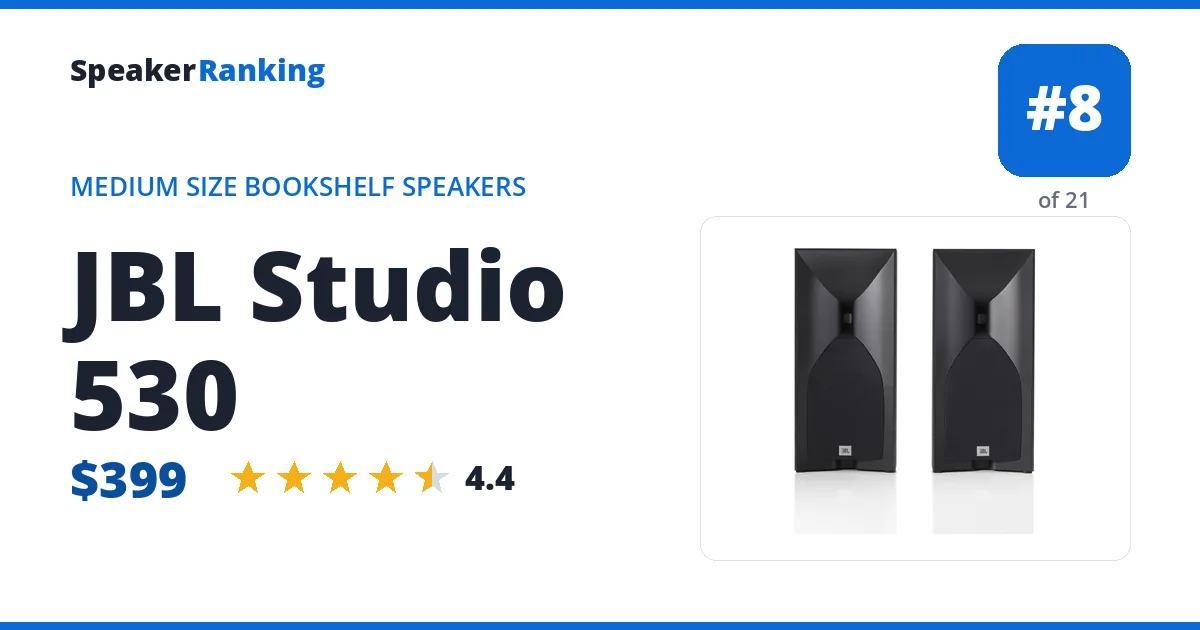
Pros: CEA2034 spinorama shows a fairly flat on-axis response. Predicted in-room response is very smooth aside from the high-frequency roll-off. Measured bass extension of 73.2Hz (-3dB), with a measured sensitivity of 85dB.
Cons: A peak around 1.4kHz is attributed to a tweeter resonance, and shows up as a distinct spike in harmonic distortion at that frequency along with a second resonance-driven bump around 2kHz. Response rolls off in the high frequencies and the tuning is a bit bass-shy overall. Cumulative spectral decay (waterfall) shows the same 1kHz-region resonances lingering in time. Discontinued.
Full JBL Studio 530 review and specifications →
| Bass Extension (-10dB) | 40Hz (derived, log-interpolated between spinorama.org -9dB/-12dB points) |
|---|---|
| Bass Extension (-3dB) | 73.2Hz (measured, Audio Science Review) |
| Crossover Frequency | 1.5kHz |
| DIY Kit | No |
| Dimensions | 18.4”H x 8.4”W x 8.7”D (467 x 214 x 222 mm) |
| Drivers | 5.25” (130mm) PolyPlas™ cone woofer with SFG magnet, 1” (25mm) compression driver with Teonex® diaphragm on Bi-Radial® horn |
| Impedance | 6 ohms nominal (4 ohms minimum, measured by Audio Science Review) |
| Sensitivity | ~85dB (measured by Audio Science Review) |
| Spinorama Preference Score | 5.21 (spinorama.org) |
| Spinorama Preference Score with Perfect Sub | 7.29 (spinorama.org) |
| Weight | 17 lbs (7.7 kg) each |
| Woofer Cabinet | ported |
- Links
- Reviews, Comparisons and Sound Samples
- Head-to-Head Comparisons
- JBL Studio 530 vs ELAC Debut 2.0 B5.2
- JBL Studio 530 vs Sony SS-CS5 M2
- JBL Studio 530 vs Paradigm Monitor SE Atom
- JBL Studio 530 vs JBL Stage 250B
- JBL Studio 530 vs Boston Acoustics A25
- JBL Studio 530 vs Dynaudio Emit M10
- JBL Studio 530 vs ELAC BS U5
- JBL Studio 530 vs Polk Audio XT15
- See all 37 comparisons
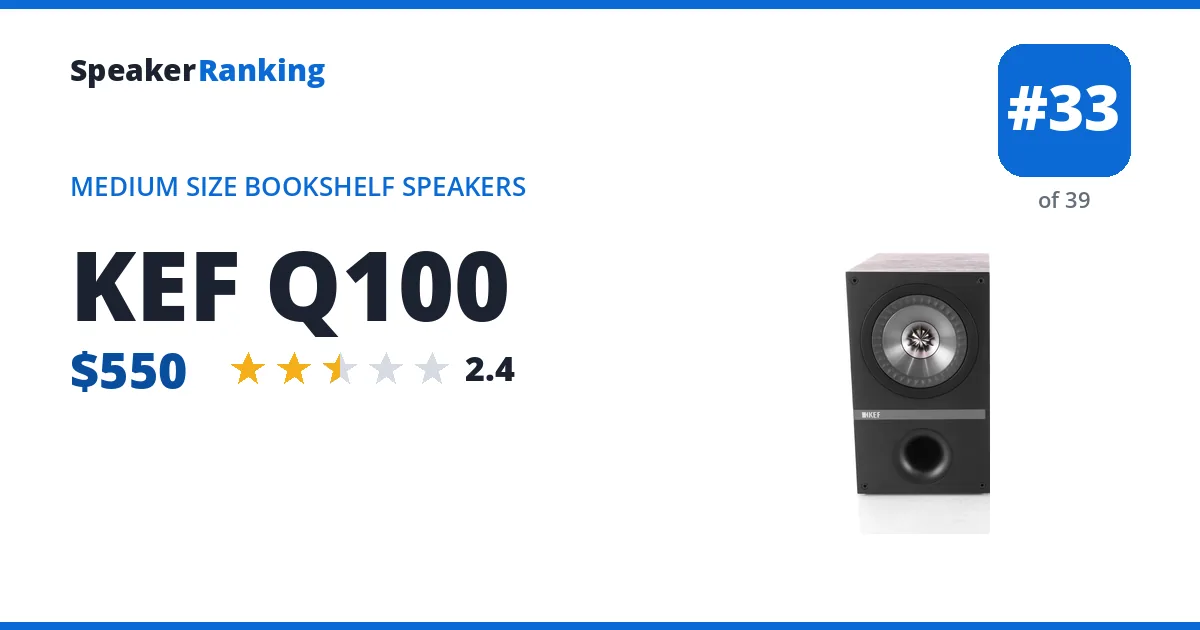
 KEF Q100: $550 per pair Discontinued eBay
Newer model: the KEF Q1 Meta, ranked higher, rated 3.6/5.
Pros: 5.25” Uni-Q coaxial driver keeps the tweeter and woofer point-source aligned for consistent imaging. 86dB sensitivity is reasonably easy to drive. Measured bass extension of 85Hz (-3dB), with a measured sensitivity of 85dB.
Cons: CEA2034 spinorama shows broad, audible deviations from flat rather than narrow peaks: a lift from 700Hz-1.5kHz and again from 5kHz up, plus a cancellation notch around 1.4kHz from port/cabinet interaction. Bass sensitivity drops to about 80dB and impedance falls below 4 ohms in the bass, demanding a capable amplifier. The reviewer heard boomy, buzzing bass that improved somewhat with the port plugged, and could not recommend it, calling the famous reputation more about looks than sound. Discontinued.
Full KEF Q100 review and specifications →
| Bass Extension (-10dB) | 65Hz (measured, Audio Science Review) |
|---|---|
| Bass Extension (-3dB) | 85Hz (measured, Audio Science Review) |
| DIY Kit | No |
| Dimensions | 11.8”H x 7.1”W x 10.7”D (300 x 180 x 272 mm) |
| Drivers | 5.25” Uni-Q aluminum coaxial driver, 1” aluminum dome tweeter |
| Frequency Response | 49Hz - 40kHz (+/-3dB) (Manufacturer specified) |
| Impedance | 8 ohms nominal |
| Sensitivity | 85dB (2.83V/1m, measured, Audio Science Review) |
| Spinorama Preference Score | 4.96 (spinorama.org) |
| Spinorama Preference Score with Perfect Sub | 7.24 (spinorama.org) |
| Weight | 13 lbs (5.9 kg) each |
| Woofer Cabinet | ported, rear |
- Reviews, Comparisons and Sound Samples
- Head-to-Head Comparisons