Short answer: the Wharfedale Super Denton for better sound quality, the ELAC Debut 2.0 B5.2 for the lower price. The Wharfedale Super Denton ranks #11 of 56 bookshelf speakers at $1499. The ELAC Debut 2.0 B5.2 ranks #24 at $329, $1170 cheaper.
The case for the Wharfedale Super Denton: A 3-way design with a 1” soft dome tweeter, a 2” soft dome midrange offset to the side of a centered 6.5” woven Kevlar woofer - a more compact alternative to Wharfedale’s own Linton 85 with a similar overall character. The tradeoff: A mid-range scoop from about 200-800Hz and a separate upper-midrange scoop were both audible in direct ABX comparison against a reference-neutral speaker, giving aggressive-sounding material a more subdued character.
What the ELAC Debut 2.0 B5.2 gets right: Good horizontal directivity: the off-axis curves track the on-axis response closely, so the broad tonal error responds predictably to EQ. The catch: Erin measured a broad +3dB step beginning around 1.5kHz; the resulting elevated upper range sounds tonally uneven even though it is not a narrow, sharp resonance.
Buy the Wharfedale Super Denton if sound quality matters more than the price. Buy the ELAC Debut 2.0 B5.2 if the price matters more than sound quality.
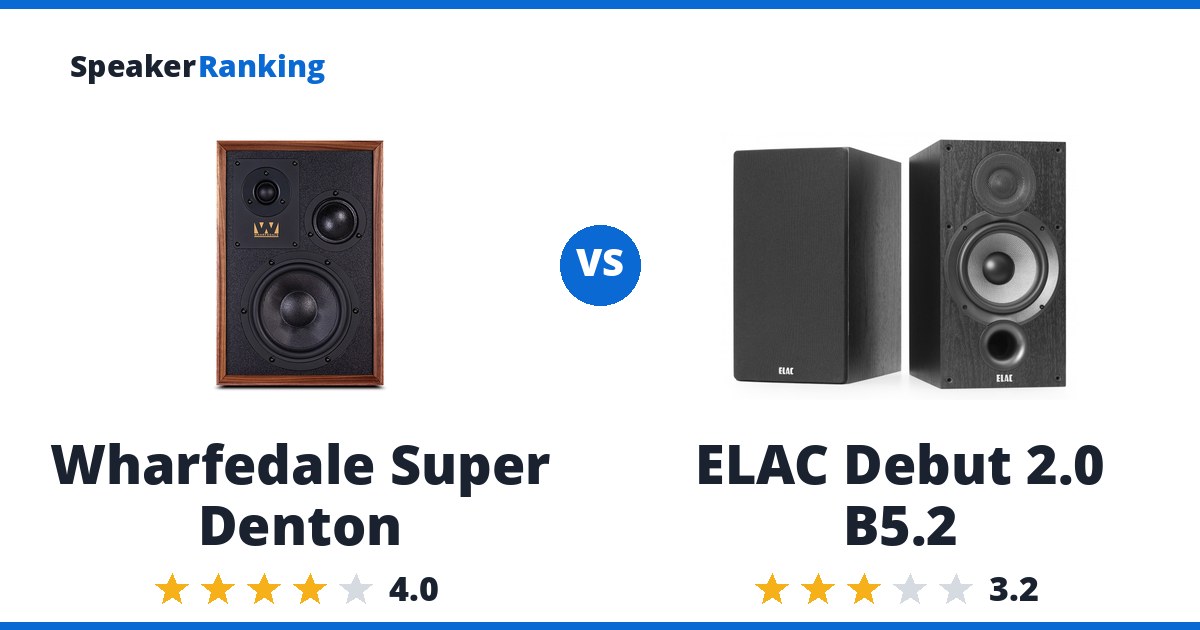
Specifications Side By Side
| Wharfedale Super Denton | ELAC Debut 2.0 B5.2 | |
|---|---|---|
| Price | $1499 | $329.00 |
| Ranked | #11 of 56 in Medium Size Bookshelf Speakers | #24 of 56 in Medium Size Bookshelf Speakers |
| Drivers | 1" soft dome tweeter, 2" soft dome midrange, 6.5" woven Kevlar woofer | 5.25" aramid-fiber woofer, 1" cloth-dome tweeter |
| Sensitivity | 86.6dB (measured by Erin’s Audio Corner) | About 83dB after recommended EQ (measured, Erin’s Audio Corner; 86dB manufacturer specified) |
| Woofer Cabinet | ported | ported, front |
| Dimensions | 14.2"H x 9.7"W x 10.8"D (360 x 246 x 275 mm) | 13.4"H x 7.1"W x 9.2"D (341 x 180 x 234 mm) |
| Weight | 20.3 lbs / 9.2 kg (20.2 lbs) each | 13 lbs / 5.9 kg each |
| Impedance | 6 ohms nominal, 3 ohms minimum (measured, Erin’s Audio Corner) | 6 ohms nominal (manufacturer specified) |
| Frequency Response | 52Hz - 20kHz (±3dB, manufacturer specified); -6dB to 40Hz | - |
| Bass Extension (-3dB) | 61Hz (measured, Erin’s Audio Corner) | 60Hz (measured, Erin’s Audio Corner) |
| Bass Extension (-10dB) | 41Hz (measured, Erin’s Audio Corner) | 40Hz (measured, Erin’s Audio Corner) |
| Crossover Frequency | 940Hz, 4.6kHz | - |
Related Speaker Comparisons
More useful head-to-heads from the same speaker class:
- Revel M105 vs Sony SS-CS5 M2
- Sony SS-CS5 M2 vs Dynaudio X14
- Revel M105 vs Klipsch RP-500M II
- Revel M105 vs ELAC Debut 2.0 B5.2
- ELAC Debut 2.0 B5.2 vs Dynaudio X14
The Two Speakers In Full
 Wharfedale Super Denton: $1499 Crutchfield
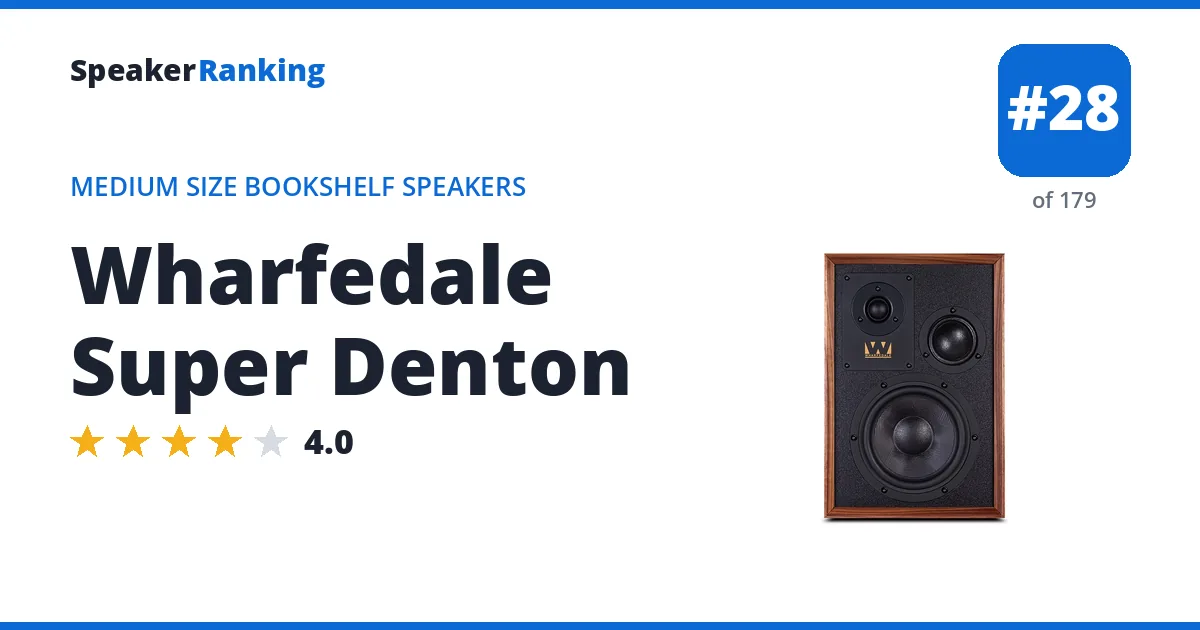
Pros: A 3-way design with a 1” soft dome tweeter, a 2” soft dome midrange offset to the side of a centered 6.5” woven Kevlar woofer - a more compact alternative to Wharfedale’s own Linton 85 with a similar overall character. Measured sensitivity around 86.6-87dB with on-axis linearity within about ±3dB. No cabinet or box resonances turned up in impedance testing, and there are no spike feet to install. Harmonic distortion looks good at both 86dB and 96dB, with about 20dB of usable dynamic range up to 96dB before compression starts to affect the midrange more noticeably near 102dB. Because bass rolls off starting around 60Hz, placing it closer to a wall (about 1-2 feet) than usual boosts low-end punch without the midbass bloat a deeper-extending speaker would get from the same placement. In the reviewer’s own comparison, its estimated in-room response actually measured more linear than the pricier Linton 85’s, despite being a bit less linear on-axis.
Cons: A mid-range scoop from about 200-800Hz and a separate upper-midrange scoop were both audible in direct ABX comparison against a reference-neutral speaker, giving aggressive-sounding material a more subdued character. A resonance around 660-700Hz shows up in measurement, though the reviewer couldn’t reliably hear it with real music in his own blind-ish A/B testing. The offset tweeter-and-midrange layout makes horizontal off-axis response noticeably asymmetric - response drops as much as 8dB more to one side than the other at wider angles - so the reviewer recommends aiming the speakers directly at the listener (not toed out, which loses upper treble) and suggests sidewall absorption to control uneven reflections. Must be listened to with the grille on - measurements are noticeably worse with it off (wider 2-4kHz dip, extra treble bump). Horizontal soundstage width felt a bit narrower than the reviewer personally prefers, likely related to the same offset driver layout. Multitone distortion gets high in the midrange at 96dB/1m, a concern mainly in larger rooms where you’d need to play louder.
Full Wharfedale Super Denton review and specifications →
| Bass Extension (-10dB) | 41Hz (measured, Erin's Audio Corner) |
|---|---|
| Bass Extension (-3dB) | 61Hz (measured, Erin's Audio Corner) |
| Crossover Frequency | 940Hz, 4.6kHz |
| Dimensions | 14.2"H x 9.7"W x 10.8"D (360 x 246 x 275 mm) |
| Drivers | 1" soft dome tweeter, 2" soft dome midrange, 6.5" woven Kevlar woofer |
| Frequency Response | 52Hz - 20kHz (±3dB, manufacturer specified); -6dB to 40Hz |
| Impedance | 6 ohms nominal, 3 ohms minimum (measured, Erin's Audio Corner) |
| Sensitivity | 86.6dB (measured by Erin's Audio Corner) |
| Weight | 20.3 lbs / 9.2 kg (20.2 lbs) each |
| Woofer Cabinet | ported |
As an eBay Partner, we may be compensated if you make a purchase.
- Links
- Reviews, Comparisons and Sound Samples
- Head-to-Head Comparisons
- Wharfedale Super Denton vs Klipsch RP-500M II
- Wharfedale Super Denton vs Wharfedale Diamond 12.1
- Wharfedale Super Denton vs Revel M105
- Wharfedale Super Denton vs Arendal 1961 Monitor
- Wharfedale Super Denton vs KEF Q150
- Wharfedale Super Denton vs KEF LS50 Meta
- Wharfedale Super Denton vs Ascend Sierra 1 v2
- Wharfedale Super Denton vs Wharfedale Diamond 220
- See all 15 comparisons
 ELAC Debut 2.0 B5.2: $329.00 Amazon
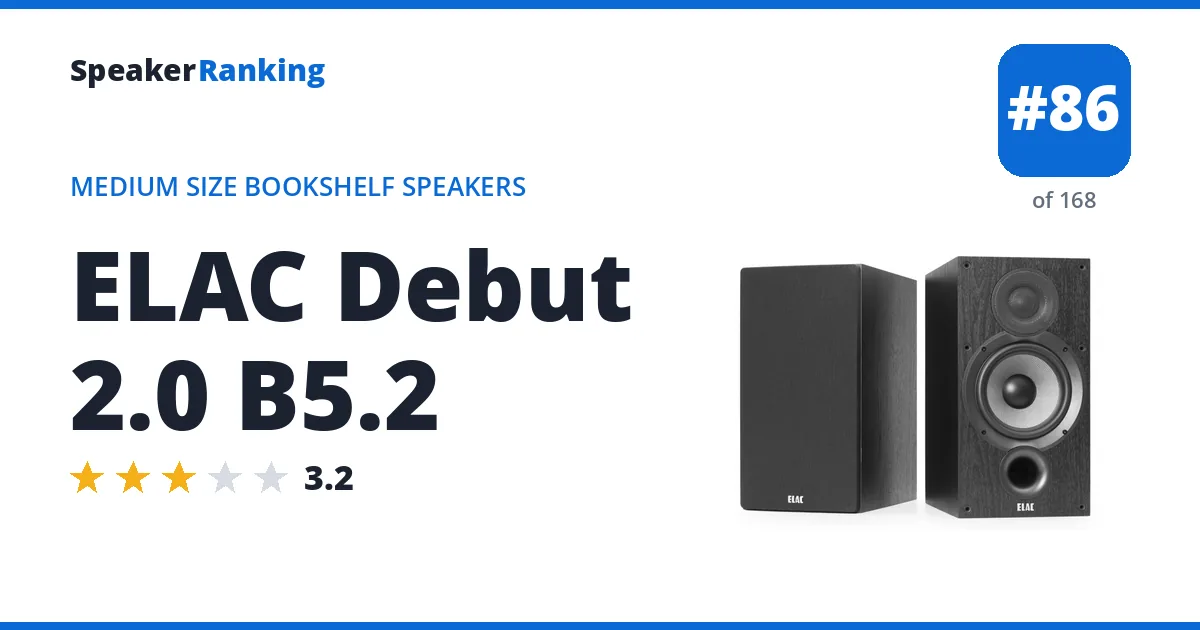
Pros: Good horizontal directivity: the off-axis curves track the on-axis response closely, so the broad tonal error responds predictably to EQ. Erin demonstrated that a single high-shelf filter centered near 1.6kHz, about -2dB with Q near 2, substantially improves linearity. Moderate roughly +/-50-60 degree horizontal coverage balances room interaction and image focus. The front port makes close-to-wall placement practical. Erin measured F3 near 60Hz and F10 near 40Hz, useful extension for a compact 5.25-inch two-way. Harmonic distortion is mostly below 1% at 86dB/1m, and low-frequency distortion is better than its size might suggest. Compact cabinet and inexpensive pair pricing make it a workable EQ-assisted desktop or small-room system.
Cons: Erin measured a broad +3dB step beginning around 1.5kHz; the resulting elevated upper range sounds tonally uneven even though it is not a narrow, sharp resonance. Native response spans roughly -2.6 to +4dB around the mean, so this is not a neutral speaker without correction. Sensitivity is only about 83dB after correcting the shelf, demanding materially more amplifier voltage than ELAC’s 86dB specification implies. Vertical response changes substantially outside roughly +/-10 degrees of tweeter height. Dynamic compression is the larger limitation: at the highest sweep level it loses roughly 1-1.5dB through the midrange, and even the 86dB trace shows unusual nonlinearity that may involve crossover heating. At about 96dB, multitone distortion rises audibly around 600Hz; an 80-120Hz subwoofer crossover helps but does not turn it into a high-output design. Erin recommends the larger B6.2 instead when EQ is unavailable.
Full ELAC Debut 2.0 B5.2 review and specifications →
| Bass Extension (-10dB) | 40Hz (measured, Erin's Audio Corner) |
|---|---|
| Bass Extension (-3dB) | 60Hz (measured, Erin's Audio Corner) |
| Dimensions | 13.4"H x 7.1"W x 9.2"D (341 x 180 x 234 mm) |
| Drivers | 5.25" aramid-fiber woofer, 1" cloth-dome tweeter |
| Impedance | 6 ohms nominal (manufacturer specified) |
| Sensitivity | About 83dB after recommended EQ (measured, Erin's Audio Corner; 86dB manufacturer specified) |
| Weight | 13 lbs / 5.9 kg each |
| Woofer Cabinet | ported, front |
As an eBay Partner, we may be compensated if you make a purchase.
- Links
- Reviews, Comparisons and Sound Samples
- Head-to-Head Comparisons
- ELAC Debut 2.0 B5.2 vs Sony SS-CS5 M2
- ELAC Debut 2.0 B5.2 vs JBL Studio 530
- ELAC Debut 2.0 B5.2 vs Boston Acoustics A25
- ELAC Debut 2.0 B5.2 vs Paradigm Monitor SE Atom
- ELAC Debut 2.0 B5.2 vs Dynaudio Emit M10
- ELAC Debut 2.0 B5.2 vs ELAC BS U5
- ELAC Debut 2.0 B5.2 vs Wharfedale Diamond 220
- ELAC Debut 2.0 B5.2 vs JBL Stage 2 250B
- See all 18 comparisons