Short answer: the Radiant Acoustics Clarity 4.2 for better sound quality, the Q Acoustics 5020 for the lower price. The Radiant Acoustics Clarity 4.2 ranks #23 of 87 bookshelf speakers at $2998. The Q Acoustics 5020 ranks #73 at $1199, $1799 cheaper.
What the Q Acoustics 5020 offers: Attractively finished compact standmount with a 5-inch Continuous Curved Cone woofer and carefully engineered cabinet details. Erin found distortion well controlled at normal levels: below 1% down to about 50Hz at 86dB/1m. Its 87dB measured sensitivity is unremarkable rather than hard to drive, and it maintains acceptable output for typical 80-85dB listening. The rear port can be plugged for placement flexibility. Watch for: Erin found the tonal balance distinctly too crisp, forward and treble-heavy: the top end is roughly 3-5dB elevated while the 1-3kHz region is recessed, so vocals change level unnaturally as they move through their range. The shallow woofer crossover and steeper tweeter slope contribute to the off-axis discontinuity, while the port has a strong 1kHz resonance. Bass is limited: Erin measured F3 103Hz and F10 48Hz; at 96dB distortion reaches about 3% by 100Hz, and he bottomed the woofer when pushed hard. He preferred the less-expensive 3020i’s linearity and did not recommend the 5020 for neutral listening without EQ.
What the Radiant Acoustics Clarity 4.2 offers: Compact bookshelf design using a 4” Purifi mid-woofer with matching Purifi passive radiators and an AMT tweeter on a purpose-designed waveguide, built with genuine heft - aluminum baffle, extensive internal bracing and damping. Surprisingly wide horizontal dispersion (about ±70° through the midrange and into the treble), more enveloping than its larger 6.2 sibling despite the smaller cabinet. More linear on-axis than the bigger Clarity 6.2, which needs 15-20° of toe-out to tame a rising treble; the 4.2 can be listened to closer to on-axis without that same correction. Wider-than-typical vertical dispersion (roughly +30°/-20°) for a two-way design, since its smaller woofer keeps the tweeter-to-woofer distance short. Genuinely deep bass extension for its size (F3 44Hz, reaching about 40Hz in-room), though it comes at a real cost to sensitivity. No resonance issues visible in impedance measurements. Watch for: Low sensitivity (rated 78dB, measured 78.5dB) is the trade-off for its bass extension - needs a fair amount of amplifier power, around 100W recommended for small-to-medium rooms versus the manufacturer’s own 60W baseline. Designed specifically for smaller rooms; the reviewer had to move testing out of his open-plan living room and into a smaller bedroom to avoid running into compression. A dip in the upper midrange gives a mild lack of attack and clarity, and a peak around 5kHz occasionally added a touch of extra sibilance. Multitone distortion crosses the reviewer’s 3% threshold at 96dB, making about 88dB a better average listening level; a slight upper-midrange bump persists even with an 80Hz high-pass filter applied. Dynamic range is limited: fine at 86dB, but the woofer starts giving up headroom by 96dB and drops off significantly by 102dB. Compared to its pricier sibling Clarity 6.2, has notably less dynamic range and higher multitone distortion, reflecting the smaller driver complement. A niche product size-wise - the reviewer couldn’t identify a clear direct competitor in the same size/price/SPL class.
Buy the Q Acoustics 5020 if the price matters more than sound quality. Buy the Radiant Acoustics Clarity 4.2 if sound quality matters more than the price.
If sound quality matters at all to you, skip the Q Acoustics 5020. It ranks near the bottom of the 87 bookshelf speakers, so look higher up the list instead.
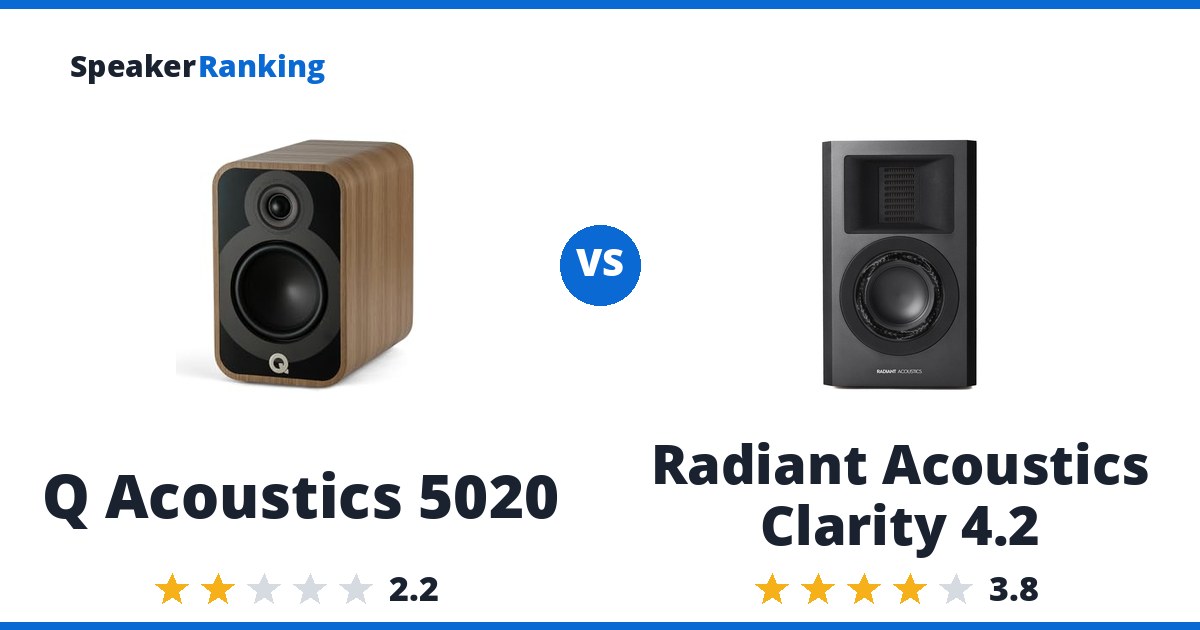
Specifications Side By Side
| Q Acoustics 5020 | Radiant Acoustics Clarity 4.2 | |
|---|---|---|
| Price | $1,199.00 | $2,998 |
| Ranked | #73 of 87 in Medium Size Bookshelf Speakers | #23 of 87 in Medium Size Bookshelf Speakers |
| Drivers | 5" (125mm) C3 mid/bass driver, 1" (25mm) tweeter | (2) 4" (102mm) woofer + AMT tweeter |
| Crossover Frequency | 2.5kHz (manufacturer specified) | - |
| Dimensions | 11.2"H x 7.1"W x 11.5"D | 9.5"H x 6.3"W x 9.4"D (241 x 160 x 239 mm) |
| Weight | 15.4 lbs (15.4 lbs / 7.0kg) each | 28.7 lbs / 13 kg (per pair: 57.3 lbs / 26 kg) |
| Impedance | 6 ohms nominal, 3.3 ohms minimum (manufacturer specified) | 4 ohms |
| Sensitivity | 87.1dB (2.83V/1m, measured, Erin’s Audio Corner; 87.9dB manufacturer specified) | 78 dB |
| Bass Extension (-3dB) | 103Hz (measured, Erin’s Audio Corner) | 44 Hz (measured, Erin’s Audio Corner) |
| Bass Extension (-10dB) | 48Hz (measured, Erin’s Audio Corner) | 35 Hz (measured, Erin’s Audio Corner) |
| Frequency Response | 53Hz - 30kHz (-6dB, manufacturer specified) | 40 Hz - 25 kHz |
| Recommended Power | 25W - 100W (manufacturer specified) | 50-200W |
| Woofer Cabinet | rear-ported | passive radiator |
| Woofer | - | 4" (102mm) PURIFI USHINDI |
| Tweeter | - | AMT (Air Motion Transformer) |
| Amplifier Required | - | Yes |
Related Speaker Comparisons
More useful head-to-heads from the same speaker class:
- KEF LS50 Meta vs Tekton Troubadour
- KEF Q150 vs Verdant Audio Bambusa AL-1
- Arendal 1961 Monitor vs Tekton Troubadour
- Arendal 1961 Monitor vs Radiant Acoustics Clarity 4.2
- JBL L52 Classic vs Radiant Acoustics Clarity 4.2
Prices on this page were last checked August 25, 2026 at 6:19 AM UTC. Product prices and availability are accurate as of that date/time and are subject to change; the price and availability shown on Amazon at the time of purchase will apply to the purchase of this product.
As an eBay Partner, we may be compensated if you make a purchase.
The Two Speakers In Full
 Q Acoustics 5020: $1,199.00 Amazon eBay
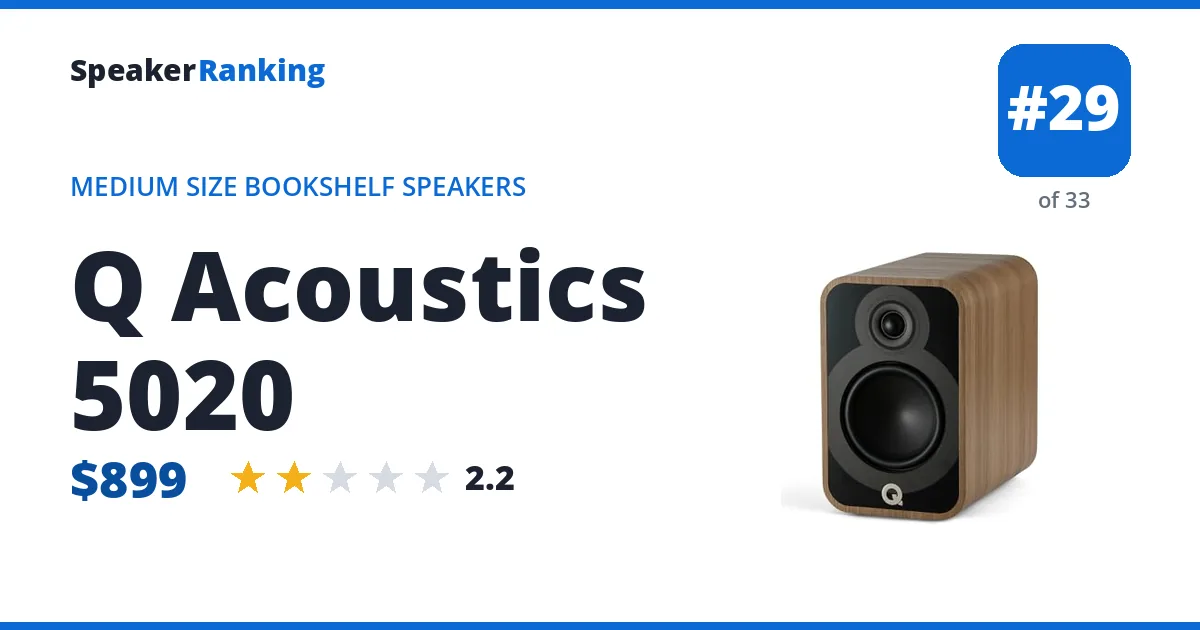
Pros: Attractively finished compact standmount with a 5-inch Continuous Curved Cone woofer and carefully engineered cabinet details. Erin found distortion well controlled at normal levels: below 1% down to about 50Hz at 86dB/1m. Its 87dB measured sensitivity is unremarkable rather than hard to drive, and it maintains acceptable output for typical 80-85dB listening. The rear port can be plugged for placement flexibility.
Cons: Erin found the tonal balance distinctly too crisp, forward and treble-heavy: the top end is roughly 3-5dB elevated while the 1-3kHz region is recessed, so vocals change level unnaturally as they move through their range. The shallow woofer crossover and steeper tweeter slope contribute to the off-axis discontinuity, while the port has a strong 1kHz resonance. Bass is limited: Erin measured F3 103Hz and F10 48Hz; at 96dB distortion reaches about 3% by 100Hz, and he bottomed the woofer when pushed hard. He preferred the less-expensive 3020i’s linearity and did not recommend the 5020 for neutral listening without EQ.
Full Q Acoustics 5020 review and specifications →
| Bass Extension (-10dB) | 48Hz (measured, Erin's Audio Corner) |
|---|---|
| Bass Extension (-3dB) | 103Hz (measured, Erin's Audio Corner) |
| Crossover Frequency | 2.5kHz (manufacturer specified) |
| Dimensions | 11.2"H x 7.1"W x 11.5"D |
| Drivers | 5" (125mm) C3 mid/bass driver, 1" (25mm) tweeter |
| Frequency Response | 53Hz - 30kHz (-6dB, manufacturer specified) |
| Impedance | 6 ohms nominal, 3.3 ohms minimum (manufacturer specified) |
| Recommended Power | 25W - 100W (manufacturer specified) |
| Sensitivity | 87.1dB (2.83V/1m, measured, Erin's Audio Corner; 87.9dB manufacturer specified) |
| Weight | 15.4 lbs (15.4 lbs / 7.0kg) each |
| Woofer Cabinet | rear-ported |
- Links
- Reviews, Comparisons and Sound Samples
- Head-to-Head Comparisons
- Q Acoustics 5020 vs Micca RB42
- Q Acoustics 5020 vs Verdant Audio Bambusa AL-1
- Q Acoustics 5020 vs JBL Stage A130
- Q Acoustics 5020 vs Fluance Signature HFS
- Q Acoustics 5020 vs Q Acoustics 3020i
- Q Acoustics 5020 vs JBL Control 1 Pro
- Q Acoustics 5020 vs KEF Q100
- Q Acoustics 5020 vs Polk T15
- See all 35 comparisons
 Radiant Acoustics Clarity 4.2: $2,998 Radiant Acoustics eBay
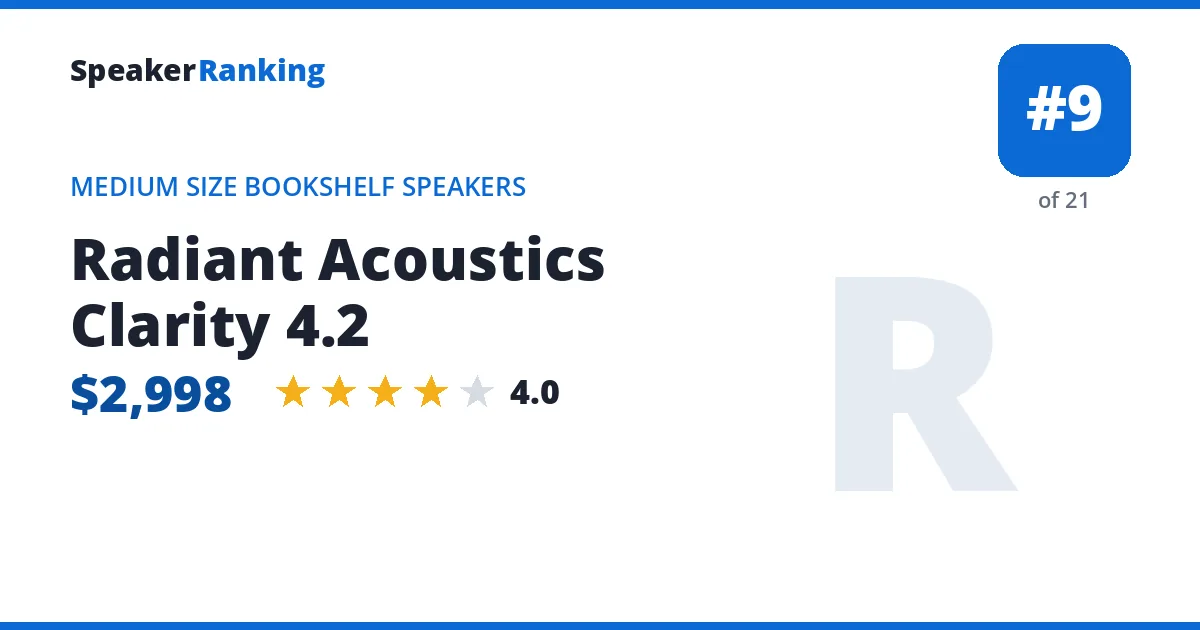
Pros: Compact bookshelf design using a 4” Purifi mid-woofer with matching Purifi passive radiators and an AMT tweeter on a purpose-designed waveguide, built with genuine heft - aluminum baffle, extensive internal bracing and damping. Surprisingly wide horizontal dispersion (about ±70° through the midrange and into the treble), more enveloping than its larger 6.2 sibling despite the smaller cabinet. More linear on-axis than the bigger Clarity 6.2, which needs 15-20° of toe-out to tame a rising treble; the 4.2 can be listened to closer to on-axis without that same correction. Wider-than-typical vertical dispersion (roughly +30°/-20°) for a two-way design, since its smaller woofer keeps the tweeter-to-woofer distance short. Genuinely deep bass extension for its size (F3 44Hz, reaching about 40Hz in-room), though it comes at a real cost to sensitivity. No resonance issues visible in impedance measurements.
Cons: Low sensitivity (rated 78dB, measured 78.5dB) is the trade-off for its bass extension - needs a fair amount of amplifier power, around 100W recommended for small-to-medium rooms versus the manufacturer’s own 60W baseline. Designed specifically for smaller rooms; the reviewer had to move testing out of his open-plan living room and into a smaller bedroom to avoid running into compression. A dip in the upper midrange gives a mild lack of attack and clarity, and a peak around 5kHz occasionally added a touch of extra sibilance. Multitone distortion crosses the reviewer’s 3% threshold at 96dB, making about 88dB a better average listening level; a slight upper-midrange bump persists even with an 80Hz high-pass filter applied. Dynamic range is limited: fine at 86dB, but the woofer starts giving up headroom by 96dB and drops off significantly by 102dB. Compared to its pricier sibling Clarity 6.2, has notably less dynamic range and higher multitone distortion, reflecting the smaller driver complement. A niche product size-wise - the reviewer couldn’t identify a clear direct competitor in the same size/price/SPL class.
Full Radiant Acoustics Clarity 4.2 review and specifications →
| Amplifier Required | Yes |
|---|---|
| Bass Extension (-10dB) | 35 Hz (measured, Erin's Audio Corner) |
| Bass Extension (-3dB) | 44 Hz (measured, Erin's Audio Corner) |
| Dimensions | 9.5"H x 6.3"W x 9.4"D (241 x 160 x 239 mm) |
| Drivers | (2) 4" (102mm) woofer + AMT tweeter |
| Frequency Response | 40 Hz - 25 kHz |
| Impedance | 4 ohms |
| Recommended Power | 50-200W |
| Sensitivity | 78 dB |
| Tweeter | AMT (Air Motion Transformer) |
| Weight | 28.7 lbs / 13 kg (per pair: 57.3 lbs / 26 kg) |
| Woofer | 4" (102mm) PURIFI USHINDI |
| Woofer Cabinet | passive radiator |
- Links
- Reviews, Comparisons and Sound Samples
- Head-to-Head Comparisons
- Radiant Acoustics Clarity 4.2 vs Wharfedale Diamond 12.1
- Radiant Acoustics Clarity 4.2 vs KEF Q150
- Radiant Acoustics Clarity 4.2 vs Wharfedale Super Denton
- Radiant Acoustics Clarity 4.2 vs Klipsch RP-500M II
- Radiant Acoustics Clarity 4.2 vs Moondrop M4P MTM
- Radiant Acoustics Clarity 4.2 vs Arendal 1961 Monitor
- Radiant Acoustics Clarity 4.2 vs KEF LS50 Meta
- Radiant Acoustics Clarity 4.2 vs Ascend Sierra 1 v2
- See all 22 comparisons