Short answer: the KEF Q150. It ranks #26 of 87 bookshelf speakers by sound quality at $350; the PMC twenty.21 ranks #86 and costs $2000, so there is not much of a tradeoff to weigh.
What the KEF Q150 offers: Two-way coaxial (Uni-Q) design with a 1” dome tweeter and 5.25” mid-range time-aligned in a single driver assembly, available in ported or sealed configuration. Exceptional soundstage depth, a hallmark of KEF’s coaxial designs that the reviewer says few other speakers match. Bass extension reaches into kick-drum territory, respectable for a compact bookshelf speaker. Resonances present in measurements are consistent across on- and off-axis readings, meaning they can be effectively corrected with EQ. Distortion profile is essentially the same whether run sealed or ported, since a subwoofer crossover point sits above where the differences would matter anyway. At its sale price (around $300, sometimes seen at $400), the reviewer considers it a clear step up from his previous budget favorite in this range, the Emotiva B1+, mainly due to the superior soundstage depth. Watch for: A high-frequency lift in the estimated in-room response makes it sound noticeably brighter in an untreated room than in a heavily acoustically-treated one - a real preference factor depending on your room’s furnishings. A mild dip in the 1-2kHz region reduces vocal fullness somewhat. Unexplained resonances appear in measurements and persist in both sealed and ported configurations, pointing to enclosure or panel vibration rather than the port. Horizontal radiation is narrower than the reviewer generally prefers from KEF’s lineup, with directivity that widens somewhat around 1.2kHz (near a resonance) and again above about 5kHz. Compression testing at high output (102dB) shows significant nonlinearity, especially at lower frequencies - noticeably worse than a comparable Arendal bookshelf speaker costing over twice as much, which held up better until 80Hz. Not intended for loud listening without a subwoofer - the woofer will over-exert itself without a high-pass filter, and the reviewer recommends crossing over at 80-120Hz. At full retail price (around $600/pair), the value proposition is far less certain than at sale pricing.
What the PMC twenty.21 offers: Transmission-line loaded design with a proprietary PMC/SEAS SONOLEX soft dome tweeter and doped mid/bass driver, reflecting PMC’s high-end British studio-monitor pedigree. Watch for: Amir was blunt: “The PMC Twenty.21 is a failure in design,” asking, “Did different people design different parts of the speaker and never talked to each other?” On-axis response is highly problematic, and the lack of a tweeter waveguide causes severe beamwidth compression that makes the speaker highly room-sensitive. Dual bass peaks indicate improper port tuning, with the port bump at 100Hz compounding rather than compensating for existing woofer peaks. Distortion is elevated throughout, spiking further at 96dB SPL near 200Hz from port noise. Initial listening was “screechy bright” enough to trigger the reviewer’s tinnitus, with harsh, lispy vocals and tubby, unnatural bass; only heavy manual EQ made it acceptable. At $2,000, Amir suspects the tuning was done “by ear” rather than with measurements.
Buy the KEF Q150. It ranks higher for sound quality than the PMC twenty.21 and costs less, so there is no real case for the other one.
If sound quality matters at all to you, skip the PMC twenty.21. It ranks near the bottom of the 87 bookshelf speakers, so look higher up the list instead.
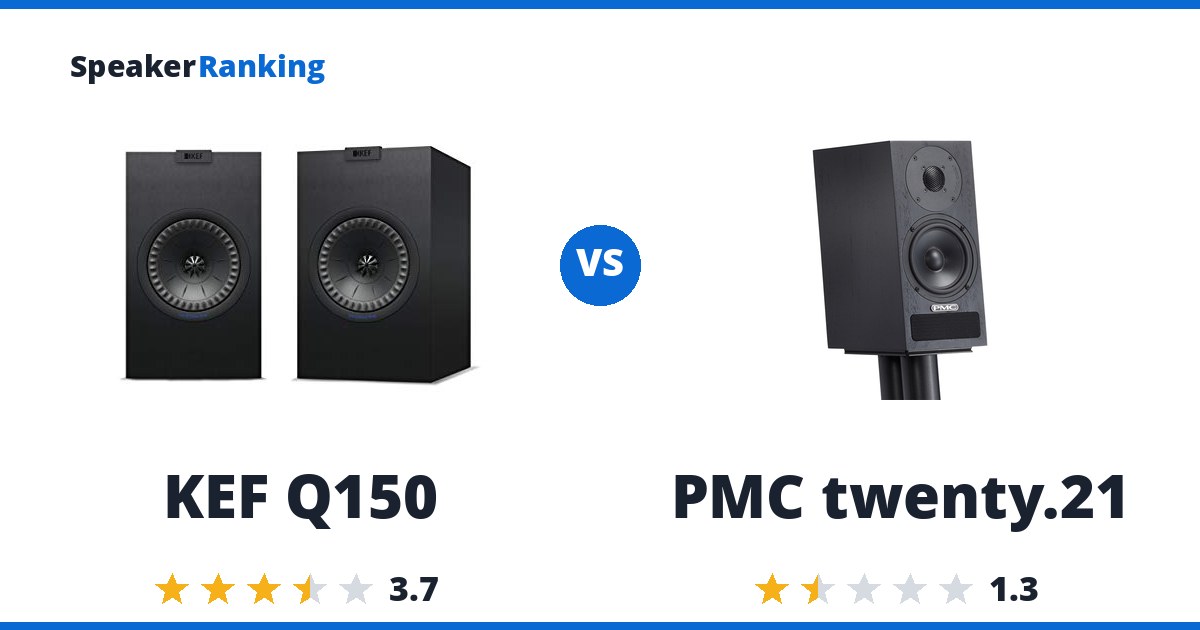
Specifications Side By Side
| KEF Q150 | PMC twenty.21 | |
|---|---|---|
| Price | $350 Discontinued | $2,000 discontinued, superseded by twenty5.21 |
| Ranked | #26 of 87 in Medium Size Bookshelf Speakers | #86 of 87 in Medium Size Bookshelf Speakers |
| Bass Extension (-10dB) | 44Hz (measured, Erin’s Audio Corner) | 48.7Hz (measured, Audio Science Review) |
| Bass Extension (-3dB) | 51Hz (measured, Erin’s Audio Corner) | 68.8Hz (measured, Audio Science Review) |
| Dimensions | 11.9"H x 7.1"W x 10.9"D (303 x 180 x 278 mm) | 12.8"H x 6"W x 10.9"D (325 x 152 x 277 mm) (+6mm grille) |
| Impedance | 8 ohms nominal, about 4.7 ohms minimum (measured, Erin’s Audio Corner) | 8 ohms |
| Sensitivity | ~85dB (300Hz-3kHz on-axis, measured, Erin’s Audio Corner) | 83dB (1W/1m, manufacturer specified) |
| Drivers | 130mm (5.25") aluminium Uni-Q woofer, 25mm (1") vented aluminium dome tweeter | 5.5" (140mm) doped mid/bass driver with cast alloy chassis, 27mm PMC/SEAS SONOLEX soft dome tweeter (ferrofluid cooled) |
| Discontinued | Yes | - |
| Weight | 12.3 lbs / 5.6 kg each | 11 lbs / 5 kg each |
| Woofer Cabinet | ported, rear | transmission line, 1.72m effective length |
| Frequency Response | - | 50Hz - 25kHz, +/-4.4dB (Manufacturer specified) |
Related Speaker Comparisons
More useful head-to-heads from the same speaker class:
- KEF LS50 Meta vs Klipsch R-41M
- KEF LS50 Meta vs Ascend Sierra Luna Duo
- KEF LS50 Meta vs Parts Express C-Note
- KEF Q150 vs Vandersteen VLR Wood
- KEF Q150 vs Amphion Argon1
Prices on this page were last checked August 25, 2026 at 6:19 AM UTC. Product prices and availability are accurate as of that date/time and are subject to change; the price and availability shown on Amazon at the time of purchase will apply to the purchase of this product.
As an eBay Partner, we may be compensated if you make a purchase.
The Two Speakers In Full
 KEF Q150: $350 Discontinued Amazon eBay
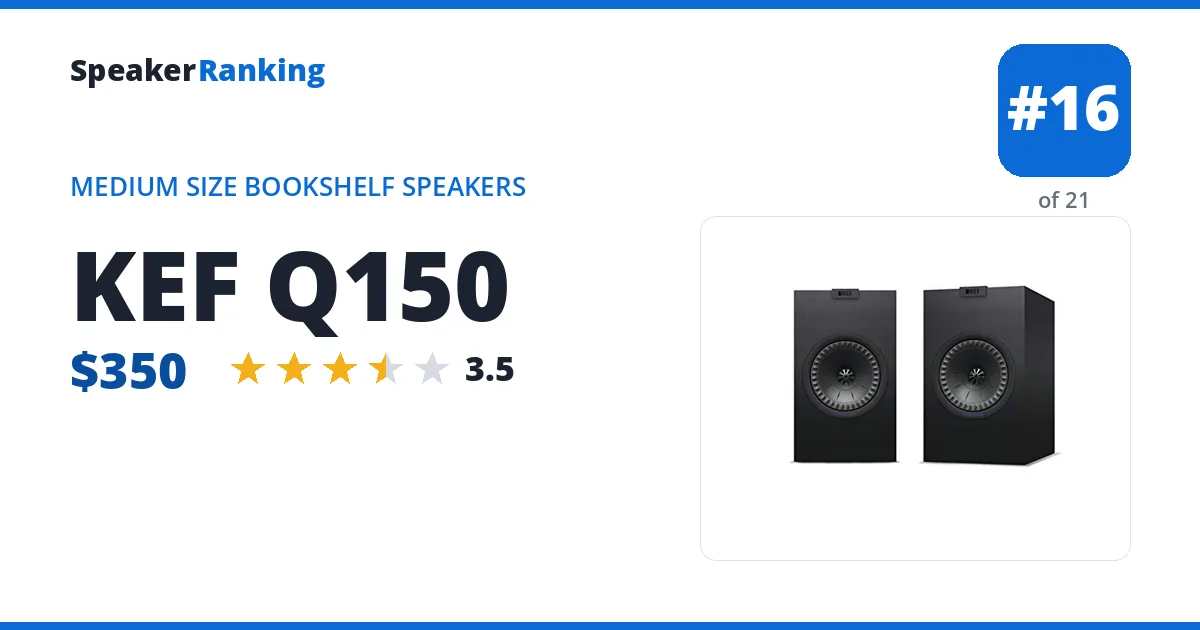
Pros: Two-way coaxial (Uni-Q) design with a 1” dome tweeter and 5.25” mid-range time-aligned in a single driver assembly, available in ported or sealed configuration. Exceptional soundstage depth, a hallmark of KEF’s coaxial designs that the reviewer says few other speakers match. Bass extension reaches into kick-drum territory, respectable for a compact bookshelf speaker. Resonances present in measurements are consistent across on- and off-axis readings, meaning they can be effectively corrected with EQ. Distortion profile is essentially the same whether run sealed or ported, since a subwoofer crossover point sits above where the differences would matter anyway. At its sale price (around $300, sometimes seen at $400), the reviewer considers it a clear step up from his previous budget favorite in this range, the Emotiva B1+, mainly due to the superior soundstage depth.
Cons: A high-frequency lift in the estimated in-room response makes it sound noticeably brighter in an untreated room than in a heavily acoustically-treated one - a real preference factor depending on your room’s furnishings. A mild dip in the 1-2kHz region reduces vocal fullness somewhat. Unexplained resonances appear in measurements and persist in both sealed and ported configurations, pointing to enclosure or panel vibration rather than the port. Horizontal radiation is narrower than the reviewer generally prefers from KEF’s lineup, with directivity that widens somewhat around 1.2kHz (near a resonance) and again above about 5kHz. Compression testing at high output (102dB) shows significant nonlinearity, especially at lower frequencies - noticeably worse than a comparable Arendal bookshelf speaker costing over twice as much, which held up better until 80Hz. Not intended for loud listening without a subwoofer - the woofer will over-exert itself without a high-pass filter, and the reviewer recommends crossing over at 80-120Hz. At full retail price (around $600/pair), the value proposition is far less certain than at sale pricing. Discontinued.
Full KEF Q150 review and specifications →
| Bass Extension (-10dB) | 44Hz (measured, Erin's Audio Corner) |
|---|---|
| Bass Extension (-3dB) | 51Hz (measured, Erin's Audio Corner) |
| Dimensions | 11.9"H x 7.1"W x 10.9"D (303 x 180 x 278 mm) |
| Discontinued | Yes |
| Drivers | 130mm (5.25") aluminium Uni-Q woofer, 25mm (1") vented aluminium dome tweeter |
| Impedance | 8 ohms nominal, about 4.7 ohms minimum (measured, Erin's Audio Corner) |
| Sensitivity | ~85dB (300Hz-3kHz on-axis, measured, Erin's Audio Corner) |
| Weight | 12.3 lbs / 5.6 kg each |
| Woofer Cabinet | ported, rear |
- Links
- Reviews, Comparisons and Sound Samples
- Erin’s Audio Corner: Kef’s Cheapest Bookshelf. Is the Q150 worth your money? More from Erin’s Audio Corner →
- Erin’s Audio Corner Website KEF Q150
- GR-Research: KEF Q150… can it get any BETTER? More from GR-Research →
- Erin’s Audio Corner: 5 AWESOME SPEAKERS Under $1000 You Won’t Regret
- Erin’s Audio Corner: Budget Stereo Systems You Will Love
- Erin’s Audio Corner Measurements (spinorama.org)
- Reddit Search for KEF Q150 Review
- Head-to-Head Comparisons
 PMC twenty.21: $2,000 discontinued, superseded by twenty5.21 eBay
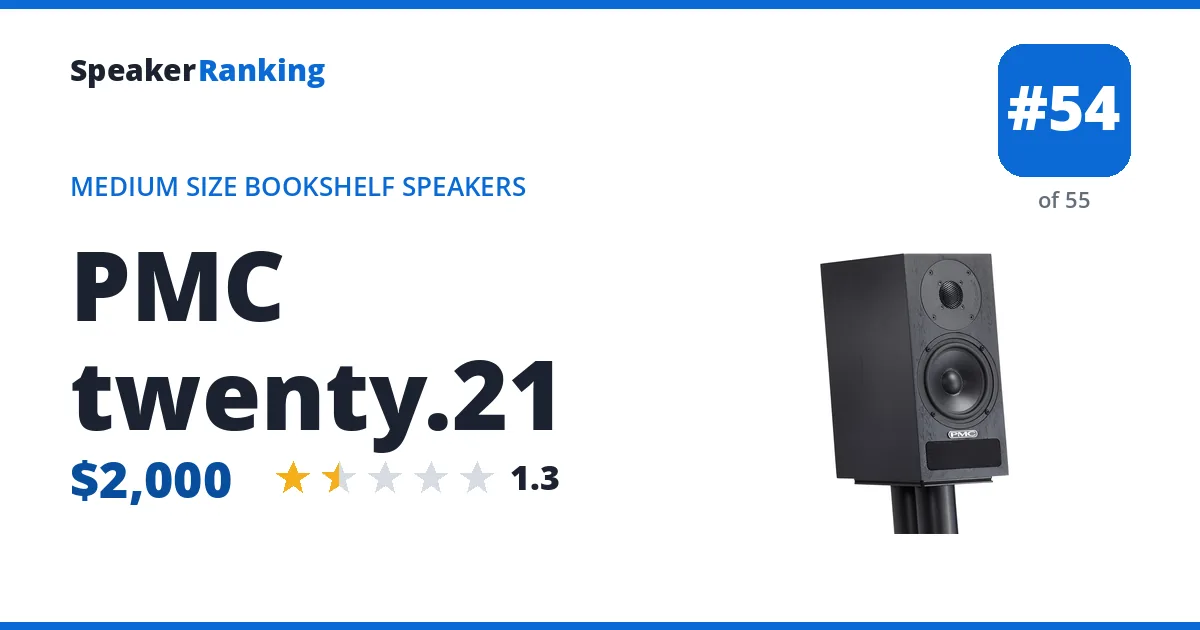
Pros: Transmission-line loaded design with a proprietary PMC/SEAS SONOLEX soft dome tweeter and doped mid/bass driver, reflecting PMC’s high-end British studio-monitor pedigree.
Cons: Amir was blunt: “The PMC Twenty.21 is a failure in design,” asking, “Did different people design different parts of the speaker and never talked to each other?” On-axis response is highly problematic, and the lack of a tweeter waveguide causes severe beamwidth compression that makes the speaker highly room-sensitive. Dual bass peaks indicate improper port tuning, with the port bump at 100Hz compounding rather than compensating for existing woofer peaks. Distortion is elevated throughout, spiking further at 96dB SPL near 200Hz from port noise. Initial listening was “screechy bright” enough to trigger the reviewer’s tinnitus, with harsh, lispy vocals and tubby, unnatural bass; only heavy manual EQ made it acceptable. At $2,000, Amir suspects the tuning was done “by ear” rather than with measurements.
Full PMC twenty.21 review and specifications →
| Bass Extension (-10dB) | 48.7Hz (measured, Audio Science Review) |
|---|---|
| Bass Extension (-3dB) | 68.8Hz (measured, Audio Science Review) |
| Dimensions | 12.8"H x 6"W x 10.9"D (325 x 152 x 277 mm) (+6mm grille) |
| Drivers | 5.5" (140mm) doped mid/bass driver with cast alloy chassis, 27mm PMC/SEAS SONOLEX soft dome tweeter (ferrofluid cooled) |
| Frequency Response | 50Hz - 25kHz, +/-4.4dB (Manufacturer specified) |
| Impedance | 8 ohms |
| Sensitivity | 83dB (1W/1m, manufacturer specified) |
| Weight | 11 lbs / 5 kg each |
| Woofer Cabinet | transmission line, 1.72m effective length |
- Links
- Reviews, Comparisons and Sound Samples
- Head-to-Head Comparisons