Short answer: the StarkSound Beta 5 for better sound quality, the Monolith Encore C6 for the lower price. The StarkSound Beta 5 ranks #35 of 84 bookshelf speakers at $499. The Monolith Encore C6 ranks #47 at $250, $249 cheaper.
What the StarkSound Beta 5 offers: Impressive bass extension for the price - F3 at 52Hz, F10 at 37Hz, reaching down to 40-50Hz in-room with solid kick-drum impact. Watch for: Sensitivity undershoots its own spec - rated 86dB, measured closer to 83dB.
What the Monolith Encore C6 offers: Better behaved off-axis than its horizontal MTM layout suggests: Erin found only about 2dB midrange loss at 20° and useful coverage through roughly 30°. Watch for: F3 is 76Hz, so a subwoofer and 80Hz crossover are required.
Buy the StarkSound Beta 5 if sound quality matters more than the price. Buy the Monolith Encore C6 if the price matters more than sound quality.
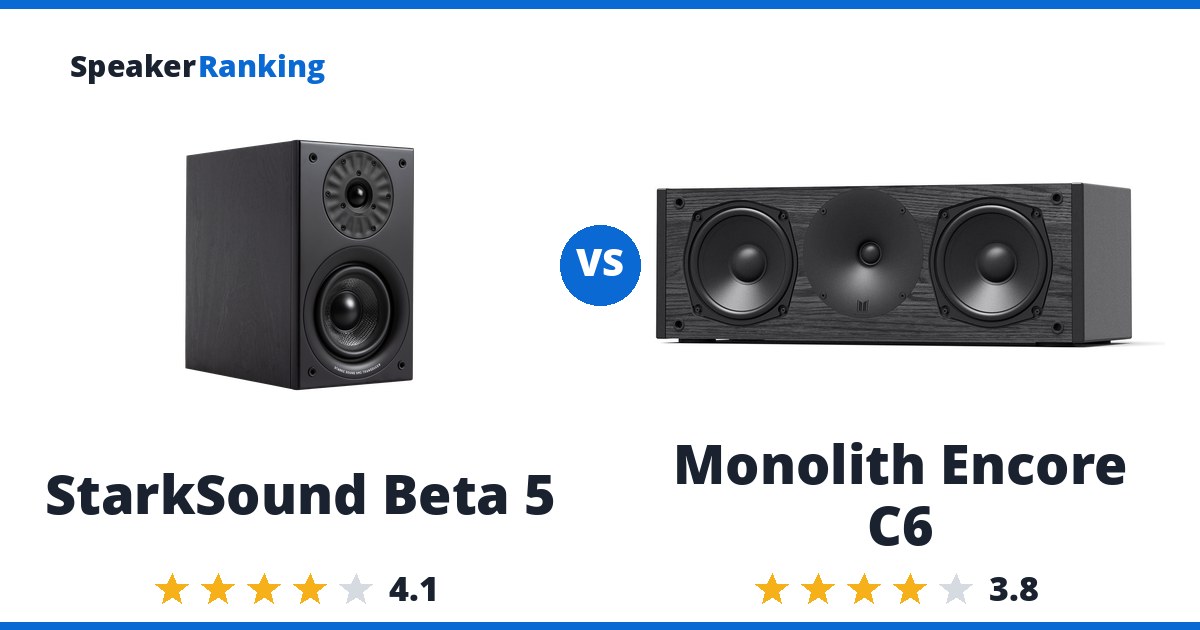
Specifications Side By Side
| StarkSound Beta 5 | Monolith Encore C6 | |
|---|---|---|
| Price | $499 | $250 |
| Ranked | #35 of 84 in Large Size Bookshelf Speakers | #47 of 84 in Large Size Bookshelf Speakers |
| Bass Extension (-10dB) | 37Hz (measured, Erin’s Audio Corner) | - |
| Bass Extension (-3dB) | 52Hz (measured, Erin’s Audio Corner) | 76Hz (measured, Erin’s Audio Corner) |
| Dimensions | 11.9" x 7.2" x 13" (302 x 182 x 330 mm) | - |
| Impedance | 4 ohms nominal | 4 ohms nominal |
| Sensitivity | 83dB (2.83V/1m, measured by Erin’s Audio Corner) | 86.3dB/2.83V/1m (measured, Erin’s Audio Corner) |
| Drivers | 1.15" tweeter, 5.25" dry-carbon woofer | Dual 6.5-inch pulp woofers; 25mm waveguided silk dome |
| Weight | 15 lbs / 6.8 kg | - |
| Woofer Cabinet | Bass reflex, rear ported | - |
| Frequency Response | 45Hz - 23kHz (-3dB, Manufacturer specified) | - |
| Crossover Frequency | 2200Hz | - |
| Max Volume | 108dB (1m, Manufacturer specified) | - |
| Recommended Power | 30W - 150W | - |
| Enclosure | - | Vented MDF |
Related Speaker Comparisons
More useful head-to-heads from the same speaker class:
- Emotiva Airmotiv XB2 vs Monolith Encore B6
- ELAC DB63 vs Revel Concerta2 M16
- Revel M106 vs Revel Concerta2 M16
- Emotiva Airmotiv XB2 vs Monolith Encore C6
- StarkSound Beta 5 vs Monolith Encore B6
The Two Speakers In Full
 StarkSound Beta 5: $499
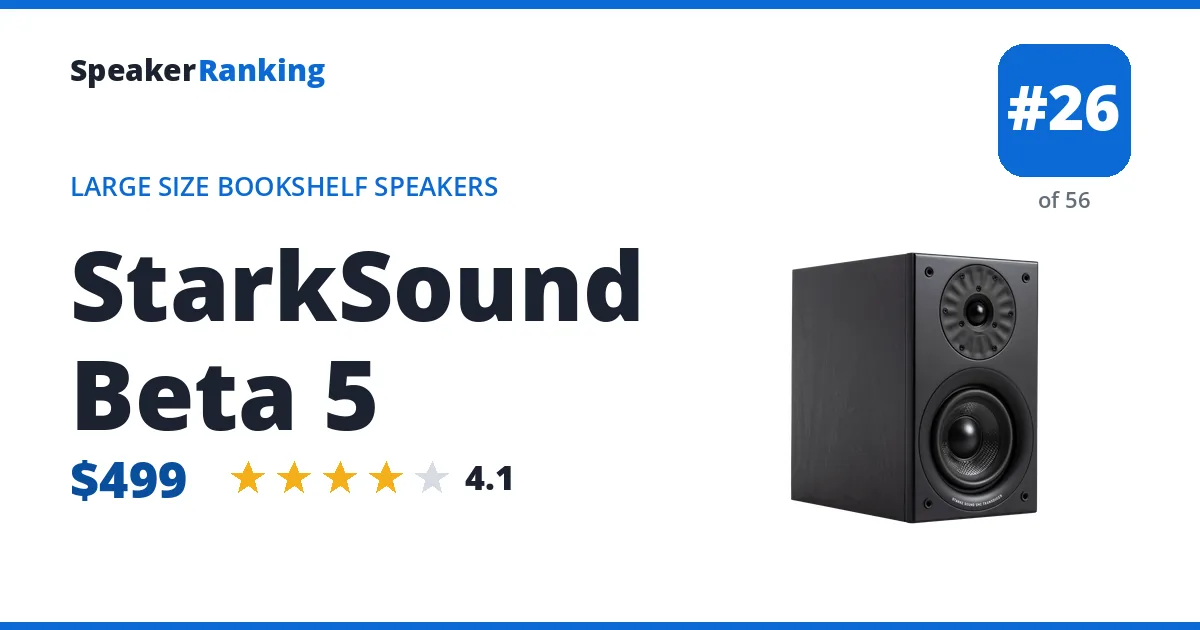
Pros: Impressive bass extension for the price - F3 at 52Hz, F10 at 37Hz, reaching down to 40-50Hz in-room with solid kick-drum impact. Good harmonic distortion control at both moderate and loud listening levels. Solid build with a thick polycarbonate baffle meant to reduce cabinet resonance.
Cons: Sensitivity undershoots its own spec - rated 86dB, measured closer to 83dB. A resonance artifact shows up independently in the on-axis response, burst decay, and impedance measurements, hurting directivity. Multitone distortion spikes to about 10% in the 800Hz-1kHz range, tied to woofer excursion - a subwoofer crossover helps. Needs to sit close to the wall (about 10 inches) or be EQ’d if placed further out, since the midrange sounds thin and the treble boosted otherwise.
Full StarkSound Beta 5 review and specifications →
| Bass Extension (-10dB) | 37Hz (measured, Erin's Audio Corner) |
|---|---|
| Bass Extension (-3dB) | 52Hz (measured, Erin's Audio Corner) |
| Crossover Frequency | 2200Hz |
| Dimensions | 11.9" x 7.2" x 13" (302 x 182 x 330 mm) |
| Drivers | 1.15" tweeter, 5.25" dry-carbon woofer |
| Frequency Response | 45Hz - 23kHz (-3dB, Manufacturer specified) |
| Impedance | 4 ohms nominal |
| Max Volume | 108dB (1m, Manufacturer specified) |
| Recommended Power | 30W - 150W |
| Sensitivity | 83dB (2.83V/1m, measured by Erin's Audio Corner) |
| Weight | 15 lbs / 6.8 kg |
| Woofer Cabinet | Bass reflex, rear ported |
As an eBay Partner, we may be compensated if you make a purchase.
- Links
- Reviews, Comparisons and Sound Samples
- Head-to-Head Comparisons
 Monolith Encore C6: $250 Amazon Monoprice
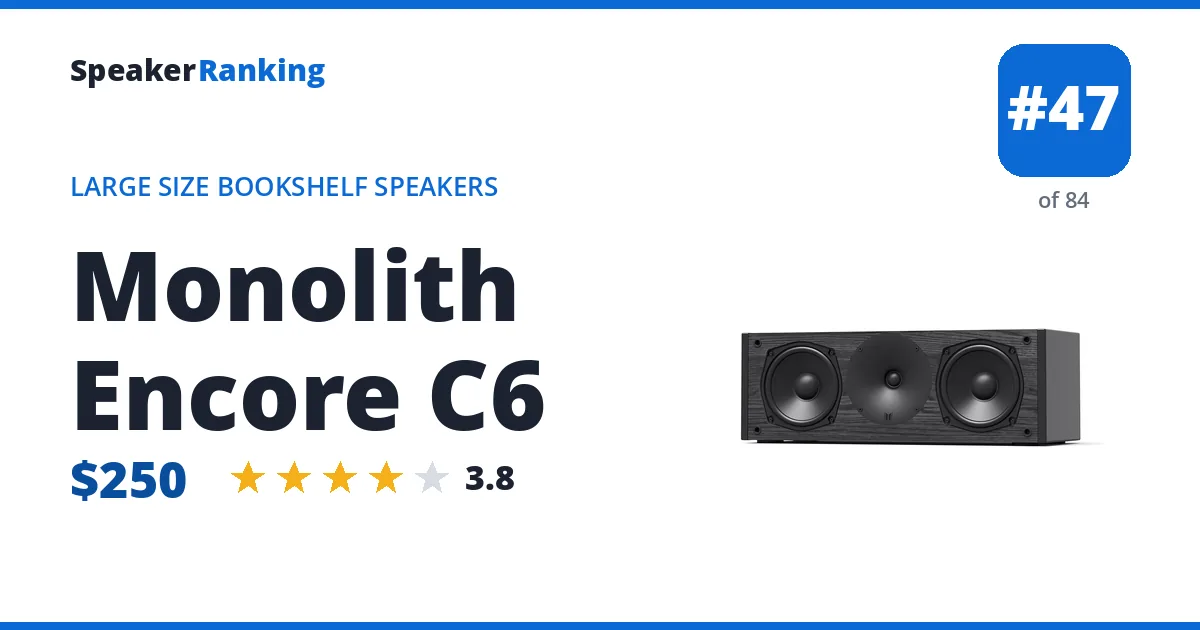
Pros: Better behaved off-axis than its horizontal MTM layout suggests: Erin found only about 2dB midrange loss at 20° and useful coverage through roughly 30°. The early-reflections directivity index is sufficiently smooth that Erin’s miniDSP correction produced a notably flat result. Measured sensitivity is a useful 86.3dB, and the dual 6.5-inch format supplies good dialogue headroom for a low-cost center.
Cons: F3 is 76Hz, so a subwoofer and 80Hz crossover are required. Unequalized response is not especially flat and carries elevated treble; Erin recommended it primarily when EQ is available. Like every horizontally spaced MTM, midrange interference worsens beyond the central seats even though this example is better than expected. Four-ohm nominal impedance calls for a capable AVR or amplifier.
Full Monolith Encore C6 review and specifications →
| Bass Extension (-3dB) | 76Hz (measured, Erin's Audio Corner) |
|---|---|
| Drivers | Dual 6.5-inch pulp woofers; 25mm waveguided silk dome |
| Enclosure | Vented MDF |
| Impedance | 4 ohms nominal |
| Sensitivity | 86.3dB/2.83V/1m (measured, Erin's Audio Corner) |
As an eBay Partner, we may be compensated if you make a purchase.
- Links
- Reviews, Comparisons and Sound Samples
- Head-to-Head Comparisons