Short answer: the Neumi Silk 4 for measured value, the Polk Audio XT15 for efficiency. The Silk 4 pairs a 4” midwoofer with a 1” dome tweeter and waveguide on a second-order crossover, earning an impressively high 4.4 preference score, but its measured 82.6dB sensitivity rules out large rooms, far-field listening, and high volume. The XT15 is the more amplifier-friendly pick, with bass rolling off at 77.6Hz (-3dB) and 54.2Hz (-10dB).
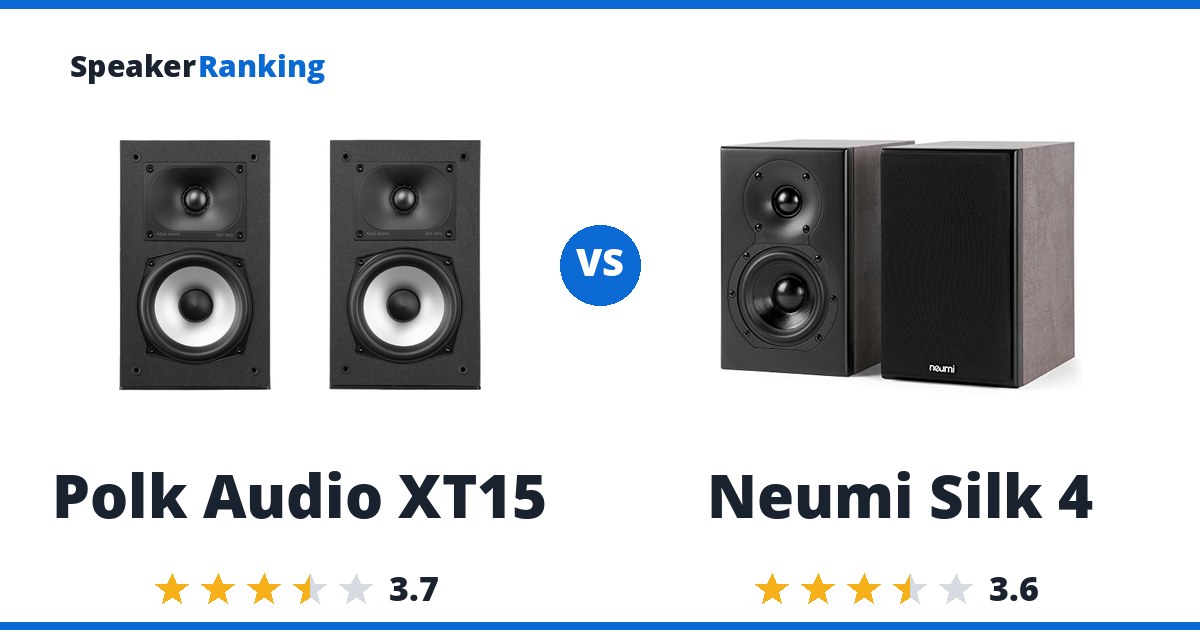
Buy the Polk Audio XT15. It is rated higher for sound quality than the Neumi Silk 4 and costs less, so only choose the other one for a particular feature it does better.
Want more options? Browse the full Passive Home rankings.
Specifications Side By Side
| Polk Audio XT15 | Neumi Silk 4 | |
|---|---|---|
| Price | $179.00 per pair | $199.99 per pair |
| Ranked | #29 of 92 in Medium Size Bookshelf Speakers | #32 of 92 in Medium Size Bookshelf Speakers |
| Bass Extension (-10dB) | 54.2Hz (measured, spinorama.org) | 55Hz (measured, Erin’s Audio Corner) |
| Bass Extension (-3dB) | 77.6Hz (measured, spinorama.org) | 83Hz (measured, Erin’s Audio Corner) |
| Dimensions | 16.51 x 18.24cm (6.5 x 7.18 in), 4.08kg (9 lb) each | 8.9”H x 5.5”W x 8.2”D (226.1 x 139.7 x 208.3 mm) |
| Impedance | 4/8-ohm compatible | 6 ohms nominal, 5.7 ohms minimum (measured, Erin’s Audio Corner) |
| Sensitivity | 86dB (1W/1m) | 82.6dB (measured, Erin’s Audio Corner) |
| Drivers | 1” Terylene dome tweeter, 5.25” bi-laminate paper woofer | 4” treated paper cone, rubber surround, cast aluminum basket, vented pole woofer, 1” silk dome, dispersion-optimized waveguide, neodymium magnet tweeter |
| Weight | 9 lbs (4.08 kg) each | 6.2 lbs (2.8 kg) each |
| Woofer Cabinet | Ported | ported, rear |
| Spinorama Preference Score | 4.56 | 4.44 |
| Spinorama Preference Score with Perfect Sub | 7.31 | 7.10 |
| DIY Kit | No | No |
Related Speaker Comparisons
How Polk Audio XT15 compares with other leading options:
- Polk Audio XT15 vs Audio First Fidelia
- Polk Audio XT15 vs Philharmonic Ceramic Mini
- Ascend Sierra 1 v2 vs Polk Audio XT15
- KEF LS50 Meta vs Polk Audio XT15
- Polk Audio XT15 vs XMechanik Mechano23 DIY
Prices on this page were last checked October 3, 2026 at 10:26 PM UTC. Product prices and availability are accurate as of that date/time and are subject to change; the price and availability shown on Amazon at the time of purchase will apply to the purchase of this product.
As an eBay Partner, we may be compensated if you make a purchase.
The Two Speakers In Full
 Polk Audio XT15: $179.00 per pair Amazon B&H Photo Video Crutchfield eBay
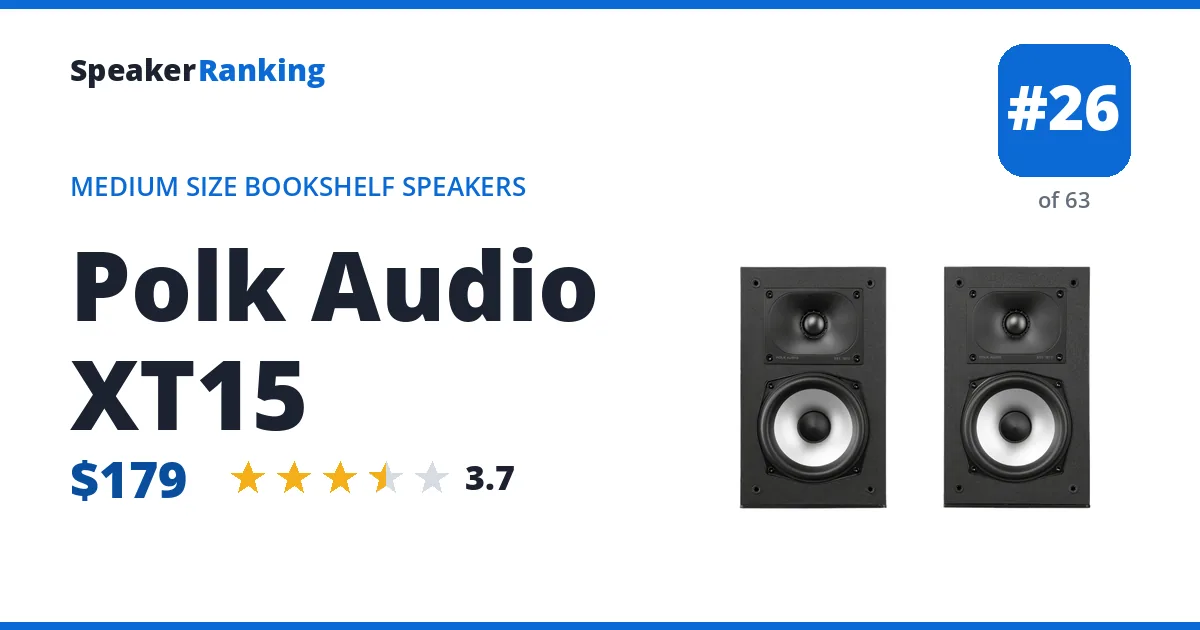
Pros: Very low $179/pair entry price for a Hi-Res Audio Certified 2-way design that’s Dolby Atmos and DTS:X compatible, and works with either 4- or 8-ohm amplifier outputs so it drops into almost any AVR without matching concerns. Off axis sound tracks the on axis response reasonably consistently for the price. Measured bass extension of 77.6Hz (-3dB).
Cons: Bass rolls off early, at 77.6Hz (-3dB) and 54.2Hz (-10dB). On-axis response is relatively uneven, with an average deviation of about 0.45dB, and its listening window is less smooth than pricier speakers. Modest 86dB sensitivity wants a reasonably powered amp channel. The 5.25” bi-laminate paper woofer is Polk’s entry-tier driver, not the polypropylene/Turbine cones used in its pricier Signature Elite/Reserve lines.
Full Polk Audio XT15 review and specifications →
| Bass Extension (-10dB) | 54.2Hz (measured, spinorama.org) |
|---|---|
| Bass Extension (-3dB) | 77.6Hz (measured, spinorama.org) |
| DIY Kit | No |
| Dimensions | 16.51 x 18.24cm (6.5 x 7.18 in), 4.08kg (9 lb) each |
| Drivers | 1” Terylene dome tweeter, 5.25” bi-laminate paper woofer |
| Impedance | 4/8-ohm compatible |
| Sensitivity | 86dB (1W/1m) |
| Spinorama Preference Score | 4.56 |
| Spinorama Preference Score with Perfect Sub | 7.31 |
| Weight | 9 lbs (4.08 kg) each |
| Woofer Cabinet | Ported |
- Links
- Reviews, Comparisons and Sound Samples
- Head-to-Head Comparisons
- Polk Audio XT15 vs Wharfedale Diamond 220
- Polk Audio XT15 vs KEF Q150
- Polk Audio XT15 vs Boston Acoustics A25
- Polk Audio XT15 vs Radiant Acoustics Clarity 4.2
- Polk Audio XT15 vs Neumi BS5
- Polk Audio XT15 vs Wharfedale Diamond 12.1
- Polk Audio XT15 vs Wharfedale Super Denton
- Polk Audio XT15 vs Klipsch RP-500M II
- See all 42 comparisons
 Neumi Silk 4: $199.99 per pair Amazon eBay
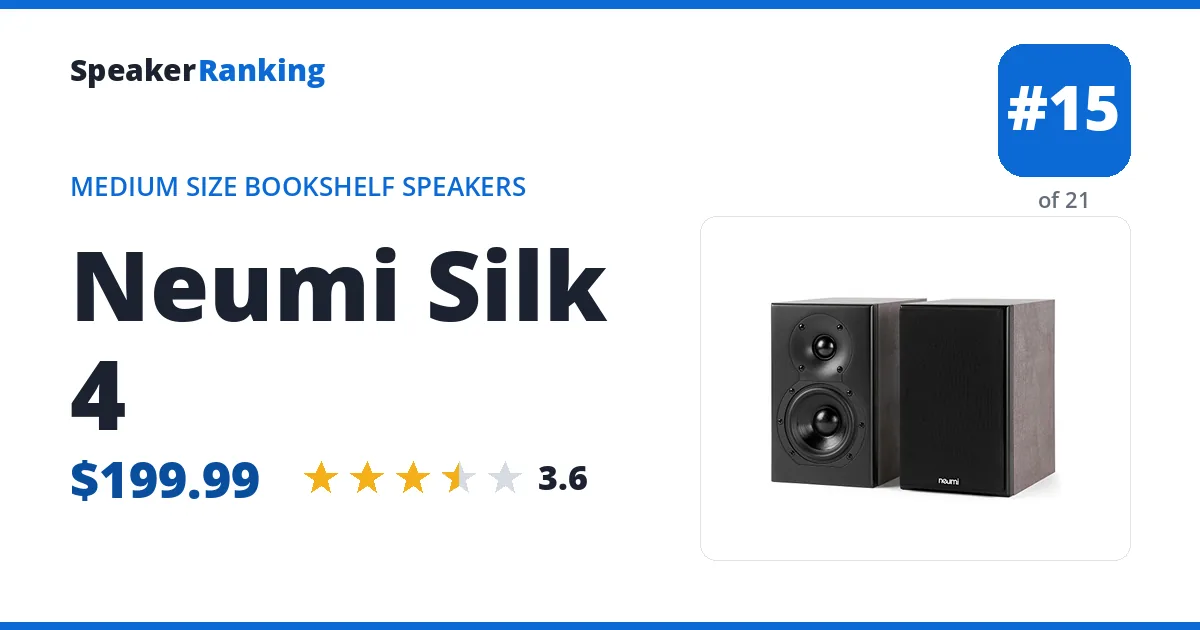
Pros: A 4” midwoofer paired with a 1” dome tweeter and waveguide, with a second-order crossover, achieving an impressively high preference score of 4.4 for the price. Distortion stays below 1% up to about 120Hz and below 3% above roughly 50-60Hz at 86dB. High-frequency compression is surprisingly good (better than some speakers costing 2-3x as much) and at 96dB/1m for a pair, output still reaches about 93dB at 3 meters, plenty loud for most listeners. F3 of 83Hz and F10 of 55Hz with in-room extension to about 70Hz. Takes very well to EQ correction, and the reviewer provides a specific fix (a notch around 650Hz, Q of about 6) that cleans up its main resonance. Measured bass extension of 83Hz (-3dB), with a measured sensitivity of 82.6dB.
Cons: Very low sensitivity (measured 82.6dB), meaning it isn’t suited for large rooms, far-field listening, or high volume. A resonance around 650Hz (likely port- or cabinet-related) creates an audible 1-2dB midrange thickness/boxiness on certain tracks, tied to a probable baffle-step compensation shortfall: about 1dB more energy in the midrange from the factory would likely have resolved it. Multitone distortion becomes audible around the same 600Hz-1kHz region at 96dB. Horizontal radiation narrows to about ±50° with the waveguide, on the narrower side of what the reviewer prefers. A diffraction-related dip around 5kHz at 5° below the tweeter axis creates a small hole in the response if placed on a desk below ear level. Nominal impedance of about 6 ohms with a low sensitivity means it benefits from a subwoofer pairing (the reviewer suggests an 80Hz crossover) for a complete small-room or surround setup.
Full Neumi Silk 4 review and specifications →
| Bass Extension (-10dB) | 55Hz (measured, Erin’s Audio Corner) |
|---|---|
| Bass Extension (-3dB) | 83Hz (measured, Erin’s Audio Corner) |
| DIY Kit | No |
| Dimensions | 8.9”H x 5.5”W x 8.2”D (226.1 x 139.7 x 208.3 mm) |
| Drivers | 4” treated paper cone, rubber surround, cast aluminum basket, vented pole woofer, 1” silk dome, dispersion-optimized waveguide, neodymium magnet tweeter |
| Impedance | 6 ohms nominal, 5.7 ohms minimum (measured, Erin’s Audio Corner) |
| Sensitivity | 82.6dB (measured, Erin’s Audio Corner) |
| Spinorama Preference Score | 4.44 |
| Spinorama Preference Score with Perfect Sub | 7.10 |
| Weight | 6.2 lbs (2.8 kg) each |
| Woofer Cabinet | ported, rear |
- Links
- Reviews, Comparisons and Sound Samples
- Head-to-Head Comparisons