Short answer: the Neumann KH 310 A for directivity, the Focal Solo6 ST6 for driver technology. The KH 310 A delivers a near-perfect on-axis response with superb directivity control and minimal off-axis variation, held back only by an unexplained dip around 80Hz. The Solo6 ST6’s beryllium inverted-dome tweeter over a 6.5” W composite sandwich-cone woofer is a low-mass, low-distortion pairing, but its higher bass alignment Q can add fullness.
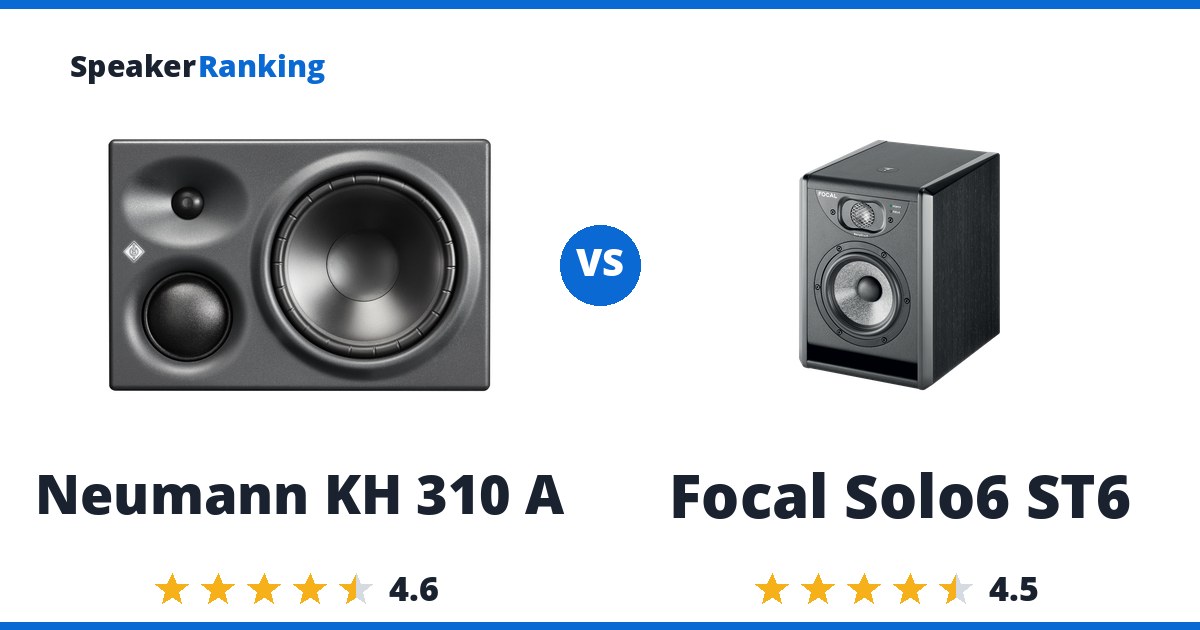
The case for the Neumann KH 310 A: CEA2034 spinorama shows a near-perfect on-axis response with superb directivity control and minimal off-axis variation. The tradeoff: An unidentified dip around 80Hz shows up in the measurements, which Neumann was asked to investigate.
On the Focal Solo6 ST6 side: Beryllium inverted-dome tweeter over a 6.5” ‘W’ composite sandwich-cone woofer - a low-mass, low-distortion driver combination rarely found below far pricier monitors. Set against that: Bass alignment Q is on the higher side, which can correlate with a touch of extra bass fullness/looseness versus a more critically-damped alignment.
Buy the Neumann KH 310 A. It is rated higher for sound quality, and the $2,000 you would save on the Focal Solo6 ST6 does not close the gap.
Want more options? Browse the full Powered Home rankings.
Specifications Side By Side
| Neumann KH 310 A | Focal Solo6 ST6 | |
|---|---|---|
| Price | $4,998 per pair | $2,998 per pair |
| Ranked | #18 of 79 in Large Size Powered Bookshelf Speakers | #35 of 79 in Large Size Powered Bookshelf Speakers |
| Bass Extension (-3dB) | 35.2Hz (measured, Audio Science Review) | 46.9Hz (measured, spinorama.org) |
| Bass Extension (-10dB) | 28.3Hz (derived, log-interpolated between spinorama.org -9dB/-12dB points) | 38.1Hz (measured, spinorama.org) |
| Frequency Response | 34Hz - 21kHz (+/-3dB) (Manufacturer specified) | 40Hz - 40kHz (±3dB) (Manufacturer specified) |
| Drivers | 8.25” woofer, 3” midrange, 1” tweeter | 1” Beryllium inverted-dome tweeter, 6.5” “W” composite sandwich-cone woofer |
| App | No | - |
| EQ | No | - |
| DSP | No | - |
| Amplifier Power | 290W total (150W woofer, 70W mid, 70W tweeter) | 130W total (80W LF + 50W HF); Bi-amped (Class G LF + Class AB HF) |
| Spinorama Preference Score | 6.21 | 5.32 |
| Spinorama Preference Score with Perfect Sub | 7.70 | 7.34 |
| Inputs | XLR (balanced analog) | XLR |
| XLR Input | Yes | Yes |
| RCA Input | No | No |
| TRS Input | No | No |
| Optical Input | No | No |
| Coaxial Input | No | No |
| USB Input | No | No |
| HDMI Input | No | No |
| AES Input | No | No |
| Aux Input | No | No |
| Bluetooth | No | No |
| Dimensions | 10” x 15.1” x 11.5” (253 x 383 x 292 mm) (H x W x D) | 24.6 x 33.4 x 29.5cm (9.7 x 13.1 x 11.6 in) each, 13kg (28.6 lb) each |
| Weight | 28.7 lbs (13.0 kg) | 28.7 lbs (13 kg) |
| Maximum SPL | - | 110dB peak at 1m |
Related Speaker Comparisons
More top alternatives to Neumann KH 310 A:
- AsciLab C8C vs Neumann KH 310 A
- Neumann KH 310 A vs Mesanovic CDM65
- Genelec 8351B vs Neumann KH 310 A
- Neumann KH420 vs Neumann KH 310 A
- Genelec 8361A vs Neumann KH 310 A
Prices on this page were last checked October 4, 2026 at 9:58 PM UTC. Product prices and availability are accurate as of that date/time and are subject to change; the price and availability shown on Amazon at the time of purchase will apply to the purchase of this product.
As an eBay Partner, we may be compensated if you make a purchase.
The Two Speakers In Full
 Neumann KH 310 A: $4,998 per pair B&H Photo Video eBay
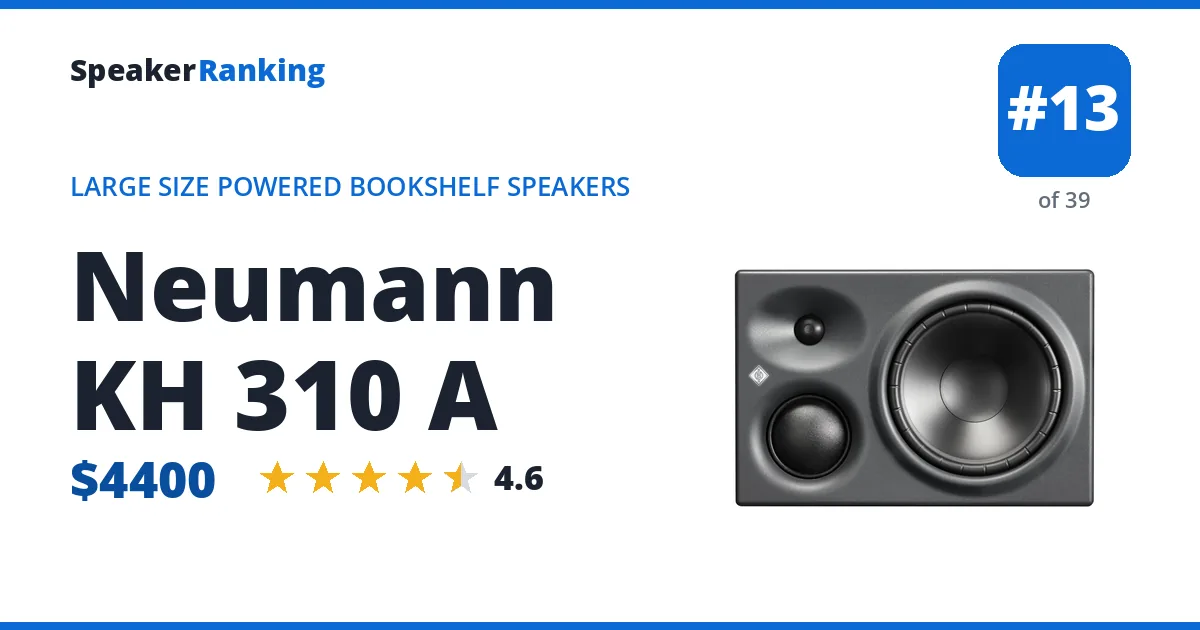
Pros: The sealed three-way design combines 35.2Hz measured -3dB extension with low distortion in the review’s demanding playback tests. Its 2.2dB response span from 300Hz to 5kHz and 7.70 ideal-subwoofer score support balanced monitoring with useful full-range capability. Measured bass extension of 35.2Hz (-3dB).
Cons: Its measured tonal balance is not as even as the KH 150 or the best coaxial alternatives. Correct orientation and listening height matter for the separated drivers. The analog system lacks the integrated calibration workflow of newer DSP models, so room correction requires additional equipment. An unexplained dip around 80Hz shows in the measurements.
Full Neumann KH 310 A review and specifications →
| AES Input | No |
|---|---|
| Amplifier Power | 290W total (150W woofer, 70W mid, 70W tweeter) |
| App | No |
| Aux Input | No |
| Bass Extension (-10dB) | 28.3Hz (derived, log-interpolated between spinorama.org -9dB/-12dB points) |
| Bass Extension (-3dB) | 35.2Hz (measured, Audio Science Review) |
| Bluetooth | No |
| Coaxial Input | No |
| DSP | No |
| Dimensions | 10” x 15.1” x 11.5” (253 x 383 x 292 mm) (H x W x D) |
| Drivers | 8.25” woofer, 3” midrange, 1” tweeter |
| EQ | No |
| Frequency Response | 34Hz - 21kHz (+/-3dB) (Manufacturer specified) |
| HDMI Input | No |
| Inputs | XLR (balanced analog) |
| Optical Input | No |
| RCA Input | No |
| Spinorama Preference Score | 6.21 |
| Spinorama Preference Score with Perfect Sub | 7.70 |
| TRS Input | No |
| USB Input | No |
| Weight | 28.7 lbs (13.0 kg) |
| XLR Input | Yes |
- Links
- Reviews, Comparisons and Sound Samples
- Head-to-Head Comparisons
- Neumann KH 310 A vs Genelec 1032C
- Neumann KH 310 A vs Genelec 8350A
- Neumann KH 310 A vs HEDD Type 20 MK2
- Neumann KH 310 A vs LOGProfessional Alpha
- Neumann KH 310 A vs Adam Audio S2V
- Neumann KH 310 A vs Genelec S360
- Neumann KH 310 A vs Buchardt A10
- Neumann KH 310 A vs JBL 308P MKII
- See all 37 comparisons
 Focal Solo6 ST6: $2,998 per pair B&H Photo Video eBay
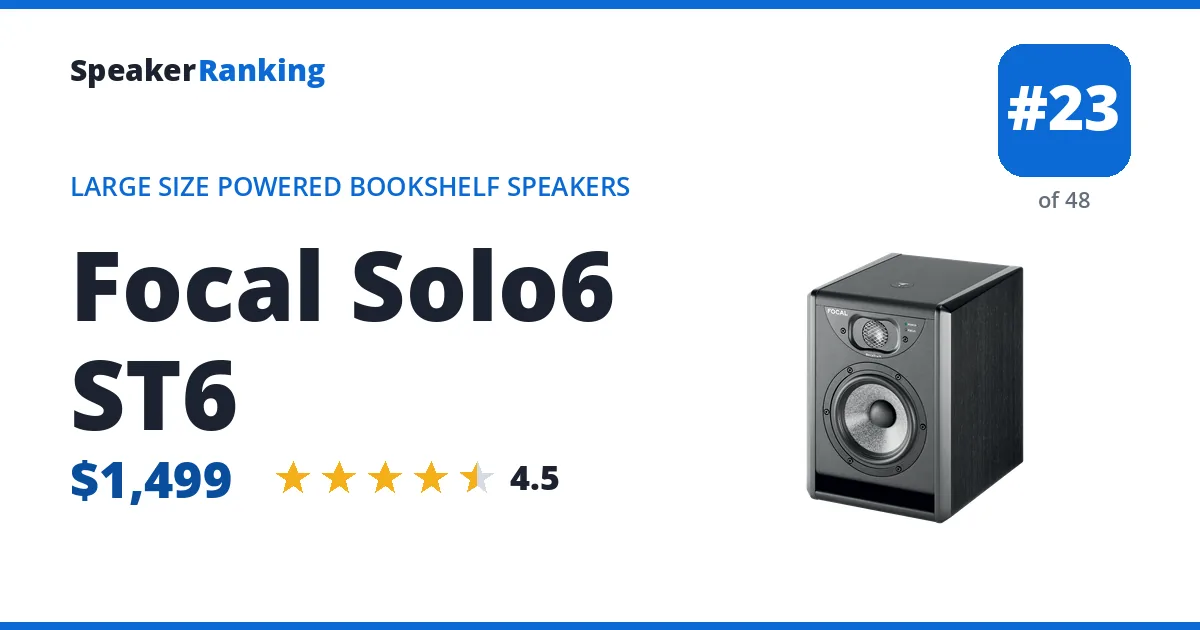
Pros: ASR measured a tight 1.6dB response span from 300Hz to 5kHz and a 7.34 ideal-subwoofer score, supporting accurate midrange monitoring. The beryllium tweeter and Focus mode offer a useful professional workflow, with Focus serving as an alternate mix-check presentation. Its beryllium inverted-dome tweeter and 6.5-inch W composite sandwich-cone woofer are a low-mass, low-distortion pairing. Measured bass extension of 46.9Hz (-3dB).
Cons: The measured -3dB point is 46.9Hz, so deep-bass work benefits from a subwoofer. The standard-mode score does not apply to Focus mode. There is no automatic room-calibration system, and premium driver materials alone do not establish superior sound.
Full Focal Solo6 ST6 review and specifications →
| AES Input | No |
|---|---|
| Amplifier Power | 130W total (80W LF + 50W HF); Bi-amped (Class G LF + Class AB HF) |
| Aux Input | No |
| Bass Extension (-10dB) | 38.1Hz (measured, spinorama.org) |
| Bass Extension (-3dB) | 46.9Hz (measured, spinorama.org) |
| Bluetooth | No |
| Coaxial Input | No |
| Dimensions | 24.6 x 33.4 x 29.5cm (9.7 x 13.1 x 11.6 in) each, 13kg (28.6 lb) each |
| Drivers | 1” Beryllium inverted-dome tweeter, 6.5” “W” composite sandwich-cone woofer |
| Frequency Response | 40Hz - 40kHz (±3dB) (Manufacturer specified) |
| HDMI Input | No |
| Inputs | XLR |
| Maximum SPL | 110dB peak at 1m |
| Optical Input | No |
| RCA Input | No |
| Spinorama Preference Score | 5.32 |
| Spinorama Preference Score with Perfect Sub | 7.34 |
| TRS Input | No |
| USB Input | No |
| Weight | 28.7 lbs (13 kg) |
| XLR Input | Yes |
- Links
- Reviews, Comparisons and Sound Samples
- Head-to-Head Comparisons