Short answer: the Klipsch The Sevens, if you are buying new. The Emotiva Airmotiv 6s ranks higher than it (#49 vs #65 of 68 powered bookshelf speakers, 4.0/5 vs 3.7/5) but is discontinued, so only consider it used; the Klipsch The Sevens is still sold new at $999.99.
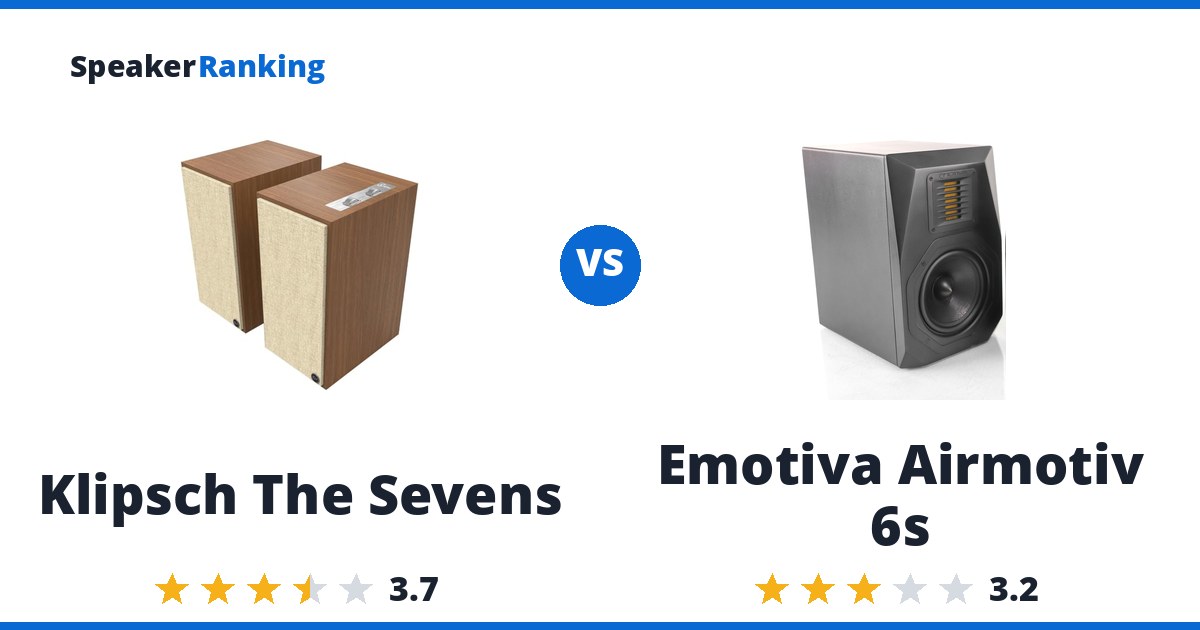
What the Klipsch The Sevens gets right: Genuinely good bass - reaches about 40 Hz in-room with a solid, controlled thump and no real strain, backed by measured extension to F3 49Hz/F10 36Hz. The catch: Notably narrower horizontal radiation than its stablemate, the Klipsch The Nines.
The case for the Emotiva Airmotiv 6s: CEA2034 spinorama shows lots of bass energy below 300Hz and the ability to play louder than a JBL 305P MKII comparison unit. The tradeoff: A suckout between 300-600Hz on the listening window is followed by a peak from 600Hz up.
Buy the Klipsch The Sevens new; the Emotiva Airmotiv 6s is no longer sold new, so it only makes sense as a used find.
Still deciding? The full Powered Home rankings cover every ranked option.
Specifications Side By Side
| Klipsch The Sevens | Emotiva Airmotiv 6s | |
|---|---|---|
| Price | $999.99 per pair | $800 per pair Discontinued |
| Ranked | #65 of 68 in Large Size Powered Bookshelf Speakers | #49 of 68 in Large Size Powered Bookshelf Speakers |
| Drivers | 6.5” high-excursion woofer, 1” titanium tweeter on Tractrix horn | 6.5” AirMotiv low-frequency transducer, 60x32mm AirMotiv tweeter |
| Amplifier Power | 200W total (400W peak) | 210W total (100W tweeter, 110W woofer) |
| Inputs | HDMI, Phono, 3.5mm, USB, Optical, Bluetooth | XLR, RCA |
| Bluetooth Codecs | SBC, AAC, aptX, aptX HD | - |
| Dimensions | 16.375”H x 8.125”W x 13.1875”D | 13.5” x 8.5” x 12.8” (343 x 216 x 324 mm) (H x W x D) |
| Weight | 22.3 lbs (10.1 kg) (primary), 19.8 lbs (9 kg) (secondary) | 24.9 lbs (11.3 kg) each |
| Bass Extension (-3dB) | 49Hz (measured, Erin’s Audio Corner) | 49.1Hz (measured, Audio Science Review) |
| Bass Extension (-10dB) | 36Hz (measured, Erin’s Audio Corner) | 37.6Hz (derived, log-interpolated between spinorama.org -9dB/-12dB points) |
| App | Yes (treble/mid/bass EQ, subwoofer output, dynamic bass mode) | No |
| Woofer Cabinet | ported, rear flared port | - |
| Subwoofer Output | Yes | - |
| Outputs | Subwoofer | - |
| XLR Input | No | Yes |
| RCA Input | No | Yes |
| TRS Input | No | No |
| Optical Input | Yes | No |
| Coaxial Input | No | No |
| USB Input | Yes | No |
| HDMI Input | Yes | No |
| AES Input | No | No |
| Aux Input | Yes | No |
| Bluetooth | Yes, 5.0 | No |
| Frequency Response | 39Hz - 25kHz (+/-3dB) (Manufacturer specified) | 42Hz - 25kHz (+0/-3dB) (Manufacturer specified) |
| EQ | - | Yes (built-in presets) |
| DSP | - | No |
Related Speaker Comparisons
More top alternatives to Emotiva Airmotiv 6s:
- Genelec 8341A vs Emotiva Airmotiv 6s
- Adam Audio S2V vs Emotiva Airmotiv 6s
- Yamaha HS8 vs Emotiva Airmotiv 6s
- Kali Audio LP-6 V2 vs Emotiva Airmotiv 6s
- Kali Audio IN-8 V2 vs Emotiva Airmotiv 6s
Prices on this page were last checked October 2, 2026 at 10:18 PM UTC. Product prices and availability are accurate as of that date/time and are subject to change; the price and availability shown on Amazon at the time of purchase will apply to the purchase of this product.
As an eBay Partner, we may be compensated if you make a purchase.
The Two Speakers In Full
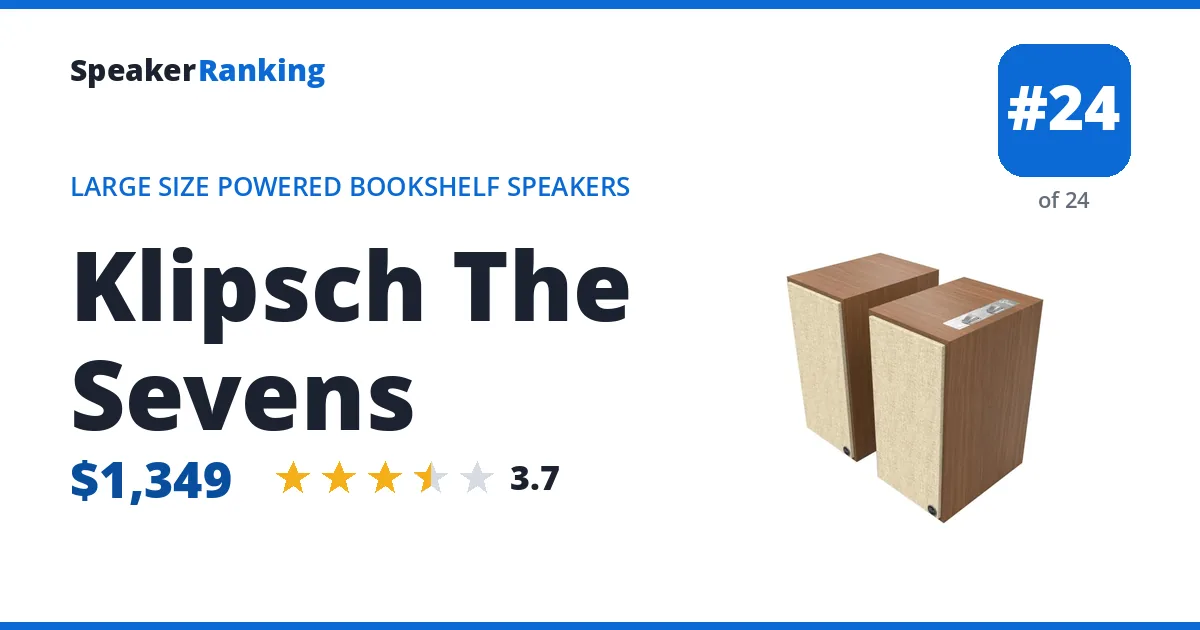
 Klipsch The Sevens: $999.99 per pair Amazon eBay
Newer model: the Klipsch The Sevens II. It’s likely to perform similarly, though we can’t confirm that yet.
Pros: Erin reported 49Hz -3dB extension, with useful bass for ordinary music listening. HDMI, phono, USB, optical and Bluetooth connections make the system convenient for TV and music, while app controls and a subwoofer output provide adjustment options. Bass reaches about 36Hz at -10dB, delivering a controlled thump near 40Hz in-room without strain. Measured bass extension of 49Hz (-3dB).
Cons: The review found a recessed 2-4kHz region and upper-treble emphasis, producing a scooped balance that a simple treble reduction did not fully fix. Relatively narrow horizontal coverage limits consistency across seats.
Full Klipsch The Sevens review and specifications →
| AES Input | No |
|---|---|
| Amplifier Power | 200W total (400W peak) |
| App | Yes (treble/mid/bass EQ, subwoofer output, dynamic bass mode) |
| Aux Input | Yes |
| Bass Extension (-10dB) | 36Hz (measured, Erin’s Audio Corner) |
| Bass Extension (-3dB) | 49Hz (measured, Erin’s Audio Corner) |
| Bluetooth | Yes, 5.0 |
| Bluetooth Codecs | SBC, AAC, aptX, aptX HD |
| Coaxial Input | No |
| Dimensions | 16.375”H x 8.125”W x 13.1875”D |
| Drivers | 6.5” high-excursion woofer, 1” titanium tweeter on Tractrix horn |
| Frequency Response | 39Hz - 25kHz (+/-3dB) (Manufacturer specified) |
| HDMI Input | Yes |
| Inputs | HDMI, Phono, 3.5mm, USB, Optical, Bluetooth |
| Optical Input | Yes |
| Outputs | Subwoofer |
| RCA Input | No |
| Subwoofer Output | Yes |
| TRS Input | No |
| USB Input | Yes |
| Weight | 22.3 lbs (10.1 kg) (primary), 19.8 lbs (9 kg) (secondary) |
| Woofer Cabinet | ported, rear flared port |
| XLR Input | No |
- Links
- Reviews, Comparisons and Sound Samples
- Head-to-Head Comparisons
- Klipsch The Sevens vs EVE Audio SC305
- Klipsch The Sevens vs Focal Twin6 Be
- Klipsch The Sevens vs Edifier R2850DB
- Klipsch The Sevens vs Edifier S3000Pro
- Klipsch The Sevens vs Presonus Eris Studio 8
- Klipsch The Sevens vs Kali Audio LP-8
- Klipsch The Sevens vs Adam Audio T7V
- Klipsch The Sevens vs Adam Audio T8V
- See all 36 comparisons
 Emotiva Airmotiv 6s: $800 per pair Discontinued eBay
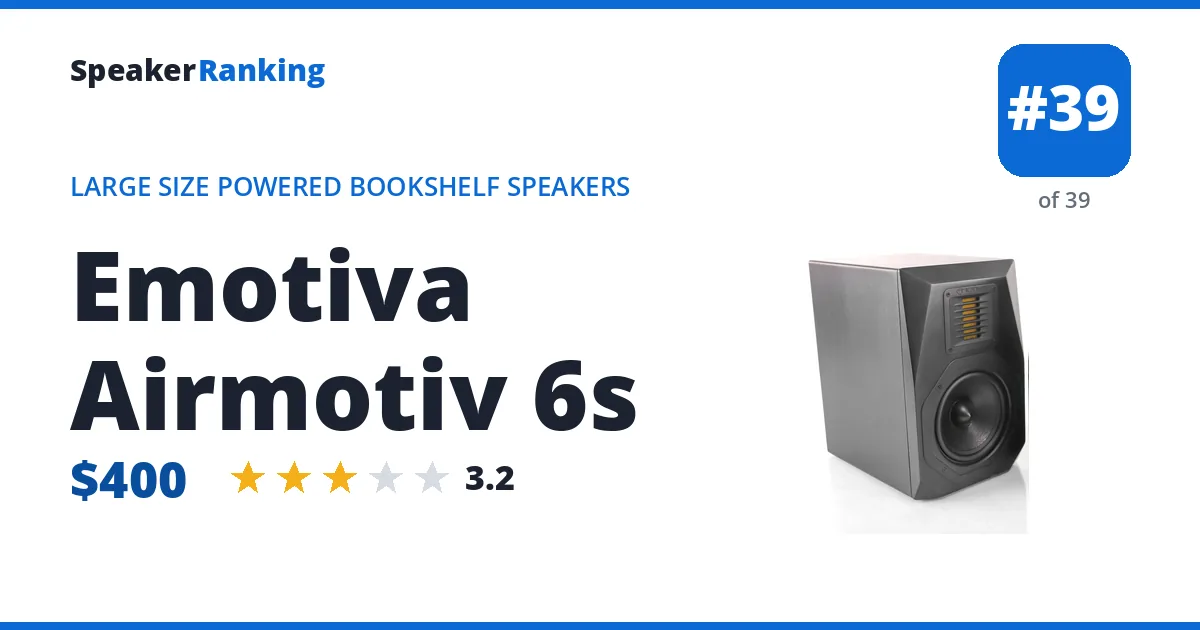
Pros: ASR measured 49.1Hz -3dB bass extension and a 5.75 ideal-subwoofer score. The review found useful output capability, making it a credible option for ordinary nearfield playback with additional bass support when needed. Measured bass extension of 49.1Hz (-3dB).
Cons: The 3.0dB response span from 300Hz to 5kHz includes lower-midrange unevenness that can change vocal weight. Treble peaks also prevent a fully neutral balance. Equalization may help, but the substantially higher EQ-optimized score is not its native performance. A suckout between 300 and 600Hz in the listening window is followed by a peak from 600Hz up. Discontinued.
Full Emotiva Airmotiv 6s review and specifications →
| AES Input | No |
|---|---|
| Amplifier Power | 210W total (100W tweeter, 110W woofer) |
| App | No |
| Aux Input | No |
| Bass Extension (-10dB) | 37.6Hz (derived, log-interpolated between spinorama.org -9dB/-12dB points) |
| Bass Extension (-3dB) | 49.1Hz (measured, Audio Science Review) |
| Bluetooth | No |
| Coaxial Input | No |
| DSP | No |
| Dimensions | 13.5” x 8.5” x 12.8” (343 x 216 x 324 mm) (H x W x D) |
| Drivers | 6.5” AirMotiv low-frequency transducer, 60x32mm AirMotiv tweeter |
| EQ | Yes (built-in presets) |
| Frequency Response | 42Hz - 25kHz (+0/-3dB) (Manufacturer specified) |
| HDMI Input | No |
| Inputs | XLR, RCA |
| Optical Input | No |
| RCA Input | Yes |
| TRS Input | No |
| USB Input | No |
| Weight | 24.9 lbs (11.3 kg) each |
| XLR Input | Yes |
- Reviews, Comparisons and Sound Samples
- Head-to-Head Comparisons
- Emotiva Airmotiv 6s vs M-Audio BX8 D3
- Emotiva Airmotiv 6s vs Focal Alpha 65 EVO
- Emotiva Airmotiv 6s vs JBL 4329P
- Emotiva Airmotiv 6s vs Adam Audio T8V
- Emotiva Airmotiv 6s vs Adam Audio T7V
- Emotiva Airmotiv 6s vs Kali Audio LP-8
- Emotiva Airmotiv 6s vs JBL 306P MKII
- Emotiva Airmotiv 6s vs Klipsch The Nines
- See all 20 comparisons