Short answer: the Genelec 8351B for flatness, the Neumann KH 150 for genuine low-end extension. The 8351B’s CEA2034 spinorama is exceptionally flat on and off axis, but deep bass distortion rises at 96dB SPL/1m and the reviewer notes deep bass suffers below about 100Hz. The KH 150’s 6.5” woofer reaches a genuine 39.6Hz with a listening window smoothness of 0.69, though its 3.89 sound power directivity standard deviation is the batch’s widest.
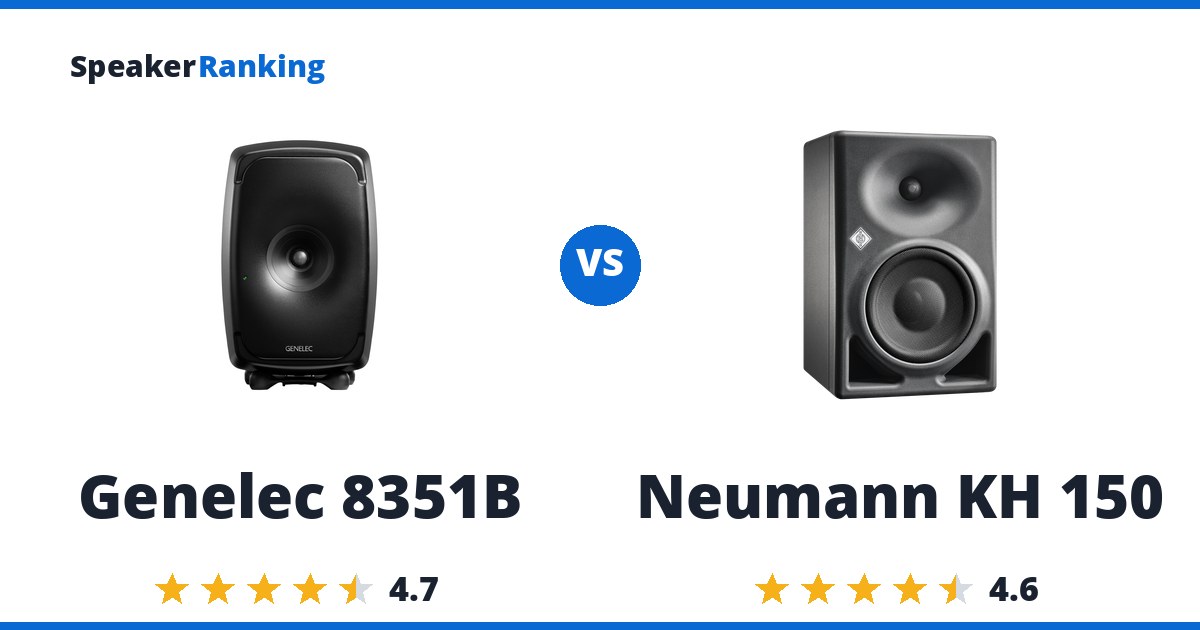
What the Neumann KH 150 offers: Neumann’s Mathematically Modelled Dispersion waveguide produces a listening window smoothness score of 0.69 with a steadily narrowing directivity index through the treble, and the 6.5 inch woofer reaches a genuine 39.6Hz extension point. Set against that: The sound power directivity index has the widest standard deviation of any speaker in this batch, 3.89, meaning off axis energy tracks the on axis response a little less consistently than the tightest speakers here as frequency rises.
Buy the Neumann KH 150. Both are rated the same for sound quality, and it costs $5,752 less than the Genelec 8351B.
Looking for alternatives? See the complete Powered Home rankings.
Specifications Side By Side
| Genelec 8351B | Neumann KH 150 | |
|---|---|---|
| Price | $9150 per pair | $3,398 per pair |
| Ranked | #4 of 79 in Large Size Powered Bookshelf Speakers | #8 of 79 in Large Size Powered Bookshelf Speakers |
| Bass Extension (-10dB) | 28Hz (measured, Audio Science Review) | 34.2Hz (measured, Audio Science Review) |
| Bass Extension (-3dB) | 33Hz (measured, Audio Science Review) | 39.6Hz (measured, Audio Science Review) |
| Dimensions | 17”H x 11.3”W x 10.9”D (431.8 x 287 x 276.9 mm) | 13.6”H x 8.9”W x 10.7”D (345 x 225 x 273 mm) |
| Inputs | XLR | XLR (balanced analog), RCA S/PDIF (digital) |
| Weight | 31.1 lbs (14.1 kg) each | 17.6 lbs (8.0 kg) each |
| Drivers | 8.6” woofer, 5” coaxial with tweeter midrange, 0.75” (19mm) coaxial tweeter | 1” tweeter, 6.5” woofer |
| App | Yes (GLM) | - |
| Bluetooth | No | No |
| DSP | Yes | - |
| EQ | Yes (via GLM software) | - |
| Frequency Response | 32Hz - 40kHz (±1.5dB) (Manufacturer specified) | 39Hz-20.4kHz +/-3dB |
| Amplifier Power | 550w Per Speaker | 245W total (145W woofer, 100W tweeter, 10% THD+N) |
| Maximum SPL | 113dB @ 1m (manufacturer specified) | 118.7dB @ 1m half space (manufacturer specified) |
| XLR Input | Yes | Yes |
| RCA Input | No | Yes |
| TRS Input | No | No |
| Optical Input | No | No |
| Coaxial Input | No | Yes |
| USB Input | No | No |
| HDMI Input | No | No |
| AES Input | No | No |
| Aux Input | No | No |
| Enclosure | - | ported |
| Crossover Frequency | - | 1.7kHz |
| Warranty | - | 2 years |
| Country | - | Germany |
| Spinorama Preference Score | - | 6.65 |
| Spinorama Preference Score with Perfect Sub | - | 8.38 |
Related Speaker Comparisons
How Genelec 8351B compares with other leading options:
- Genelec 8351B vs Neumann KH420
- Genelec 8351B vs Genelec 8361A
- Genelec 8351B vs Aalto Speakers Aalto 3 Active Pro
- Genelec 8351B vs Neumann KH 310 A
- Genelec 1032C vs Genelec 8351B
Prices on this page were last checked October 3, 2026 at 10:26 PM UTC. Product prices and availability are accurate as of that date/time and are subject to change; the price and availability shown on Amazon at the time of purchase will apply to the purchase of this product.
As an eBay Partner, we may be compensated if you make a purchase.
The Two Speakers In Full
 Genelec 8351B: $9150 per pair B&H Photo Video eBay
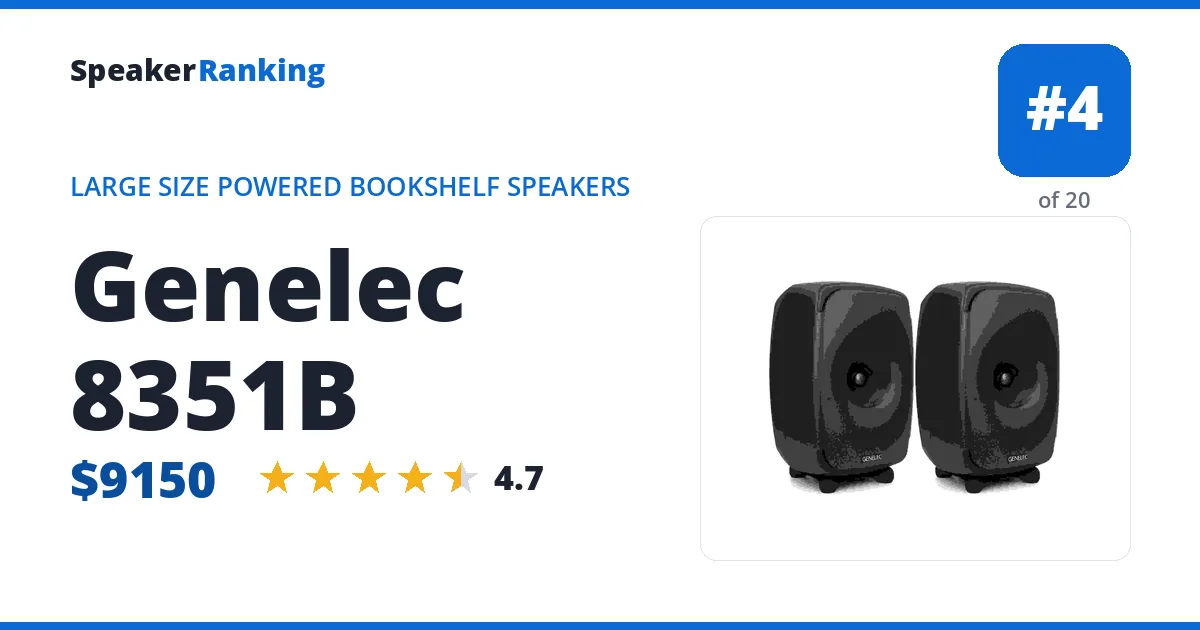
Pros: The vertical ASR measurement scores 7.75 with an ideal subwoofer and reaches 35.2Hz at -3dB. Coaxial midrange and treble help maintain consistent sound as the listening angle changes. Low measured distortion at ordinary listening levels and GLM calibration make it a strong precision-monitoring choice. Measured bass extension of 33Hz (-3dB).
Cons: Bass distortion increases at higher playback levels, so a subwoofer remains useful for demanding material. Upper-treble distortion in the test also cautions against assuming unlimited output. Calibration hardware adds to an already expensive system, and the quoted result is for the measured vertical orientation.
Full Genelec 8351B review and specifications →
| AES Input | No |
|---|---|
| Amplifier Power | 550w Per Speaker |
| App | Yes (GLM) |
| Aux Input | No |
| Bass Extension (-10dB) | 28Hz (measured, Audio Science Review) |
| Bass Extension (-3dB) | 33Hz (measured, Audio Science Review) |
| Bluetooth | No |
| Coaxial Input | No |
| DSP | Yes |
| Dimensions | 17”H x 11.3”W x 10.9”D (431.8 x 287 x 276.9 mm) |
| Drivers | 8.6” woofer, 5” coaxial with tweeter midrange, 0.75” (19mm) coaxial tweeter |
| EQ | Yes (via GLM software) |
| Frequency Response | 32Hz - 40kHz (±1.5dB) (Manufacturer specified) |
| HDMI Input | No |
| Inputs | XLR |
| Maximum SPL | 113dB @ 1m (manufacturer specified) |
| Optical Input | No |
| RCA Input | No |
| TRS Input | No |
| USB Input | No |
| Weight | 31.1 lbs (14.1 kg) each |
| XLR Input | Yes |
- Links
- Reviews, Comparisons and Sound Samples
- Head-to-Head Comparisons
- Genelec 8351B vs Neumann KH420
- Genelec 8351B vs Genelec 8361A
- Genelec 8351B vs Aalto Speakers Aalto 3 Active Pro
- Genelec 8351B vs Neumann KH 310 A
- Genelec 8351B vs Genelec 1032C
- Genelec 8351B vs Genelec 8350A
- Genelec 8351B vs HEDD Type 20 MK2
- Genelec 8351B vs SHIVAUDYO Point Zero
- See all 27 comparisons
 Neumann KH 150: $3,398 per pair B&H Photo Video eBay
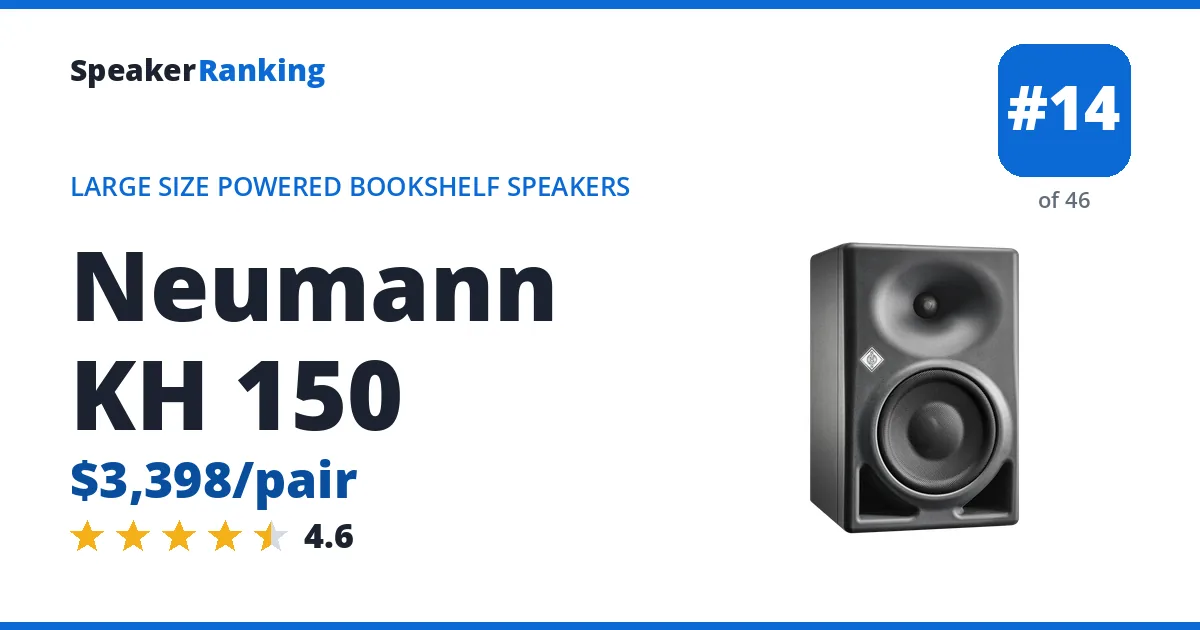
Smaller models: the Neumann KH120 MKII (rated 4.7/5) and the Neumann KH80 DSP (rated 4.6/5).
Pros: An exceptionally tight 1.0dB response span from 300Hz to 5kHz supports neutral vocals and instruments. The measured ideal-subwoofer score is 8.38, with -3dB bass extension to 39.6Hz. DSP and optional MA 1 alignment offer useful control over room-related response errors. Measured bass extension of 39.6Hz (-3dB).
Cons: A two-way nearfield monitor cannot match the largest three-way systems for deep-bass output at distance. Keep the tweeter near ear height to avoid crossover-related changes off the vertical axis. MA 1 calibration requires additional equipment, and studio connections are less convenient than a consumer streaming system.
Full Neumann KH 150 review and specifications →
| AES Input | No |
|---|---|
| Amplifier Power | 245W total (145W woofer, 100W tweeter, 10% THD+N) |
| Aux Input | No |
| Bass Extension (-10dB) | 34.2Hz (measured, Audio Science Review) |
| Bass Extension (-3dB) | 39.6Hz (measured, Audio Science Review) |
| Bluetooth | No |
| Coaxial Input | Yes |
| Country | Germany |
| Crossover Frequency | 1.7kHz |
| Dimensions | 13.6”H x 8.9”W x 10.7”D (345 x 225 x 273 mm) |
| Drivers | 1” tweeter, 6.5” woofer |
| Enclosure | ported |
| Frequency Response | 39Hz-20.4kHz +/-3dB |
| HDMI Input | No |
| Inputs | XLR (balanced analog), RCA S/PDIF (digital) |
| Maximum SPL | 118.7dB @ 1m half space (manufacturer specified) |
| Optical Input | No |
| RCA Input | Yes |
| Spinorama Preference Score | 6.65 |
| Spinorama Preference Score with Perfect Sub | 8.38 |
| TRS Input | No |
| USB Input | No |
| Warranty | 2 years |
| Weight | 17.6 lbs (8.0 kg) each |
| XLR Input | Yes |
- Links
- Reviews, Comparisons and Sound Samples
- Head-to-Head Comparisons